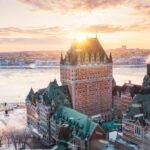
The year 2008 (the 400th anniversary of Samuel de Champlain’s founding of Quebec City on July 3, 1608) was the most significant single year in the city’s recent history: a year of massive public investment (in infrastructure, in cultural institutions, and in the physical environment), extraordinary international attention (generated by the commemorative programming, the visits of heads of state and cultural figures from around the world, and the global media coverage of the anniversary), and the physical legacy of projects built specifically for the occasion that have permanently shaped Quebec City’s public space and cultural life. The 2008 celebrations were not merely a party; they were a civic transformation program that used the anniversary as the occasion for investments the city had needed and sought for decades.
The Promenade Samuel-de-Champlain
The Promenade Samuel-de-Champlain (the 8-kilometre waterfront linear park along the St. Lawrence shore in the Sainte-Foy–Sillery–Cap-Rouge arrondissement, inaugurated on June 5, 2008) was the Quebec government’s primary gift to Quebec City for its 400th anniversary, and the single most consequential public space investment in the city’s recent history. The Promenade’s creation transformed approximately 8 kilometres of industrial and transportation land between the base of the Sillery cliff and the St. Lawrence River into a continuous accessible park of extraordinary scenic quality (providing the waterfront access that had been blocked by the Boulevard Champlain roadway and the former rail corridor for decades. The Promenade’s Phase 1 construction cost approximately $82 million; subsequent phases 2 and 3 (2013 and 2016) extended the park westward to Cap-Rouge at a total additional investment of approximately $100 million.
The Fontaine de Tourny
The Fontaine de Tourny) the magnificent bronze fountain placed at the Grande Allée entrance to the Colline Parlementaire in 2007 (unveiled in June 2007 in advance of the official anniversary year), donated by the City of Bordeaux as the twinning partner’s gift to Quebec City (is the most immediately beautiful of the anniversary’s physical legacies. The fountain, designed by Mathurin Moreau for the 1855 Paris Universal Exposition and used for Bordeaux’s Place de Tourny, was donated to Quebec City through the Bordeaux-Quebec City twinning relationship after more than 150 years in storage. Its placement at the formal entrance to the parliamentary complex) where it creates a visual focal point that the Grande Allée’s busy traffic corridor would otherwise lack (was immediately acclaimed as a civic planning success: a work of art of genuine quality placed in a public space of sufficient dignity to justify it.
Cultural Investments
The 2008 anniversary produced a remarkable range of cultural investments alongside the physical infrastructure. The Hôtel-Musée Premières Nations in Wendake) inaugurated in May 2008 specifically for the anniversary year (provided the Huron-Wendat Nation with the cultural tourism infrastructure that has made Wendake one of North America’s most complete Indigenous cultural destinations. The summer of 2008’s concert programming) including Paul McCartney’s free concert on the Plains of Abraham (estimated 400,000+ attendees, one of the largest concert audiences in Canadian history), the Franco Follies, and dozens of cultural events, represented the largest outdoor arts program ever mounted in Quebec City. The federal government’s contribution included the restoration of the Quebec Bridge (then recently acquired by JCCBI) and several national historic site enhancement projects within the Old City fortification area.