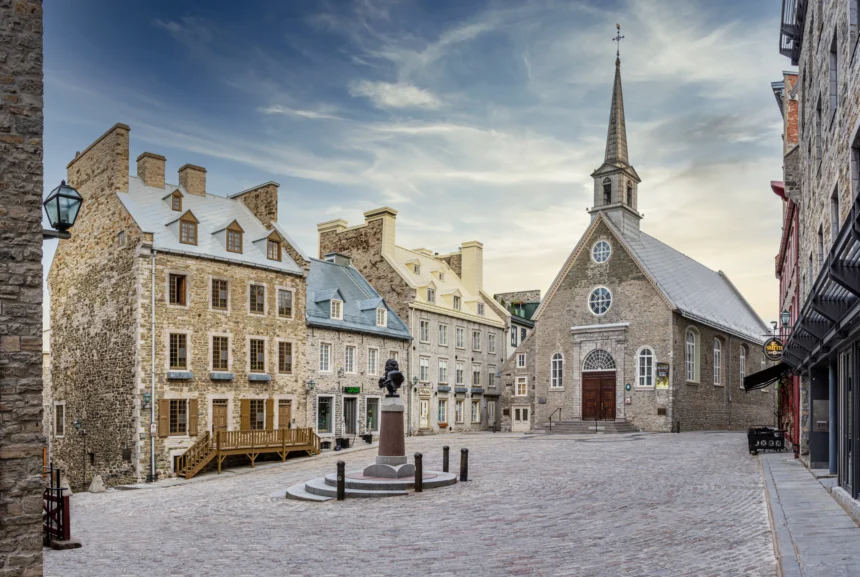
Place Royale (the public square and surrounding commercial district in Quebec City’s Lower Town, at the base of the Cap Diamant cliff between the Rue du Marché-Champlain and the St. Lawrence River) is the oldest continuously commercial site in Canada and the location where the human history of Quebec City is most densely concentrated: the pre-contact Indigenous occupation of the riverbank site (documented archaeologically), the Stadaconan settlement that Cartier encountered in 1534-35, Champlain’s construction of his Habitation (the first permanent European building in New France) in 1608, the subsequent development of the fur trade’s commercial infrastructure, the 300 years of colonial and post-colonial commerce that made this square the economic heart of the largest city in British North America, and the 20th-century decline and 30-year government restoration program that produced the heritage ensemble that visitors experience today.
Champlain’s Habitation (1608)
Samuel de Champlain’s construction of the first Habitation at the foot of the Cap Diamant cliff in the summer of 1608 (the physical act that defines Quebec City’s founding) was a practical decision rather than a symbolic one: the narrow terrace between the cliff base and the river provided the most defensible position for a permanent settlement, with the cliff protecting the landward side and the river providing the water access essential for the fur trade’s logistics. The Habitation (a three-building complex of wooden construction housing the colony’s 28 initial members) was built on the same site that now holds the Musée de la Civilisation’s glass-floored gallery where the stone foundations of the original structure are visible below the visitor’s feet. The physical continuity between Champlain’s 1608 construction and the contemporary museum (415 years of uninterrupted occupation of the same piece of ground) is the most profound heritage fact accessible in Quebec City.
The Fur Trade Era (1608-1760)
Place Royale’s commercial function during the New France period was organised around the fur trade’s seasonal rhythm: the canoe brigades arriving from the Great Lakes interior in late summer with the year’s fur harvest, the exchange of the furs for the imported European goods that the canoe men carried back to the interior, and the packing and shipping of the pressed beaver pelts in the holds of the ships that carried them across the Atlantic to the Paris hat factories that were the fur trade’s ultimate market. The commercial buildings that surrounded the square in this period (the warehouses, the merchants’ houses (the Maison Chevalier being the finest surviving example), and the church of Notre-Dame-des-Victoires (1688) that anchored the square’s institutional life) were built in the New France rubblestone tradition and several of them survive in the restored form that the government’s 30-year heritage program produced.
The Modern Heritage
The Place Royale heritage ensemble today (the cluster of restored 17th and 18th-century stone commercial buildings around the public square with Notre-Dame-des-Victoires at its centre) receives approximately 1.5 million visitors annually. The summer programming (costumed interpreters, the Fêtes de la Nouvelle-France event in August, outdoor performances) provides the most accessible engagement with the New France period available anywhere in Quebec City. In winter, the empty stone square under snow (reduced to its essential architectural and spatial character without the summer crowds and animation infrastructure) provides the most contemplative heritage experience available: the 17th-century building facades, the church, and the silence of the square create an atmosphere of genuine temporal displacement that the summer’s tourist density cannot replicate.