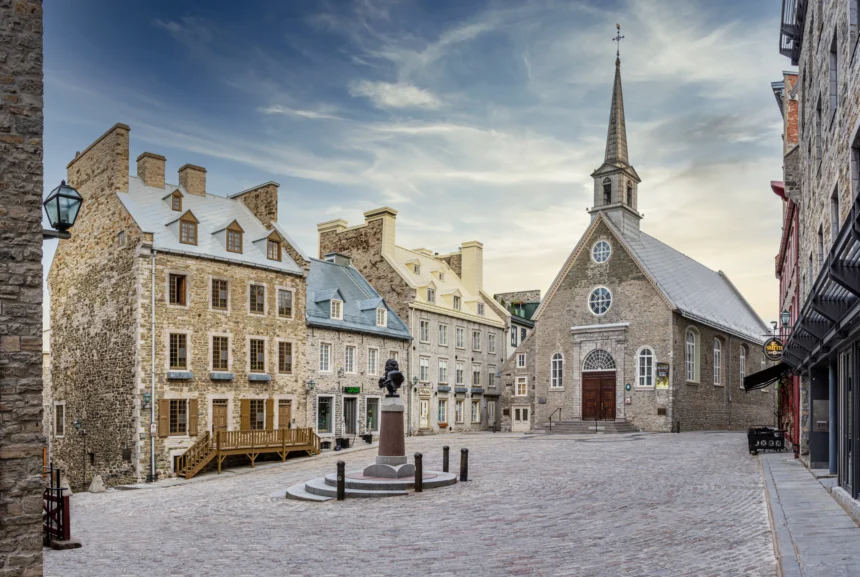
There’s a specific experience that happens to certain travellers at Place Royale in the Lower Town of Old Québec. They arrive expecting another tourist square, look around, see a fairly modest cobblestone space anchored by a small stone church, and initially think: that’s it?. Then they read a plaque. Or they step into the church. Or they stand still for a few minutes and start piecing together what happened on this exact ground.
Place Royale is where Samuel de Champlain built his first habitation in 1608. Everything that eventually became Québec — then New France, then colonial French Canada, then modern Québec — started here, on this specific patch of ground. That’s the kind of historical density that rewards close attention rather than quick scanning.
The Physical Space
Place Royale is a small square, maybe 30 metres across, paved in cobblestones, surrounded by restored 17th- and 18th-century stone buildings. The most prominent feature is Notre-Dame-des-Victoires, the stone church at the western end, with its modest but architecturally significant facade.
The square’s current configuration reflects a major restoration project that ran from the 1960s through the 1990s, rebuilding the buildings surrounding the square to approximate their colonial-era appearances. Some buildings are genuine 17th- and 18th-century structures; others are 20th-century reconstructions using traditional methods.
The bust of Louis XIV in the centre of the square (a replica of a 1686 original) is modest — nothing to photograph by itself, but central to the square’s historical identity.
The 400 Years of History
1608: Champlain’s Habitation
Samuel de Champlain arrived at this location on July 3, 1608, with 28 men. They immediately began constructing a fortified trading post — the Habitation — a three-building wooden structure with a small garden and defensive stockades. The Habitation stood roughly where the Musée de la Civilisation is now, 50 metres from the current Place Royale.
This was the first permanent French settlement in what became Canada, and it marked the beginning of 400 years of continuous French presence in North America.
1687: The Church
The current Notre-Dame-des-Victoires church was built in 1687, replacing an earlier wooden chapel. It’s the oldest stone church in North America. The name commemorates two French naval victories over the English (1690 and 1711).
The interior was damaged in the 1759 siege of Québec and later restored. Contemporary visitors can see the rebuilt interior, with a preserved historical altar and various religious art.
1759: The Siege
British cannon fire during the siege of Québec damaged much of the Lower Town. Place Royale and its surrounding buildings were significantly impacted. The church lost its original interior and most of the colonial-era buildings either burned or suffered significant damage.
The 19th Century: Commerce
Through the 1800s, Place Royale served as a commercial square — merchant activity, warehousing, trading. The Irish immigrant population came through these streets. The working economy of Québec’s port passed through here daily.
The Mid-20th Century Decline
By the 1960s, Place Royale was genuinely shabby — in need of restoration, largely abandoned residentially, surrounded by decaying buildings. The provincial government launched a major restoration project to return the square to its colonial-era character.
The Restoration (1967-1990s)
Under provincial leadership, the buildings surrounding Place Royale were reconstructed using traditional materials and techniques. The cobblestones were re-laid. The bust of Louis XIV was reinstalled. The church was restored. By the late 1990s, the square had been returned to a close approximation of its colonial appearance.
Today
Place Royale is now one of Québec City’s most-visited outdoor spaces. It remains modest in scale but rich in atmospheric value, particularly outside of peak summer hours.
What to Do There
Visit the Church
Notre-Dame-des-Victoires is generally open to visitors outside of service times. Interior includes:
- A boat-shaped chandelier — a historical reference to French naval battles
- Historical religious paintings from the colonial era
- An ornate wooden altar — restored from the original colonial design
- Historical pews and furnishings
Take 15-20 minutes inside. The acoustics are remarkable; even tourist-level quiet feels amplified.
Read the Interpretive Panels
Several outdoor plaques explain different aspects of the square’s history. Most visitors walk past without reading them; that’s a mistake. They provide specific context that’s hard to get elsewhere.
Sit on the Steps
The church steps are public seating. Sit for 10-15 minutes and watch the square as it changes — tourists passing through, locals crossing on their way elsewhere, the light shifting across the facades.
Walk the Surrounding Streets
The streets immediately around Place Royale are as historically significant as the square itself:
- Rue Notre-Dame — runs north/south through the Lower Town
- Rue Sous-le-Fort — parallel to Petit-Champlain
- Rue Saint-Pierre — toward the Old Port
These streets contain numerous other historic buildings, small restaurants, and quieter corners than Petit-Champlain.
Best Times to Visit
Early morning (before 9 AM) — Quiet, atmospheric, best for photos.
Late afternoon (after 4 PM) — Golden light on the building facades.
Evening (after 7 PM) — Fewer tourists, church possibly illuminated.
During a snowfall — Place Royale under fresh snow is arguably its most photogenic state.
December (Christmas season) — Seasonal decorations, Christmas tree, Midnight Mass on Christmas Eve.
Combining with Nearby Attractions
Place Royale is strategically located. You can combine it with:
- Musée de la Civilisation (2-minute walk) — contains the archaeological remains of Champlain’s Habitation
- Petit-Champlain (3-minute walk) — the famous cobblestone street
- Rue Saint-Paul — quieter Lower Town street with antique shops
- Old Port (5-minute walk)
- Dufferin Terrace via funicular (7-minute trip)
A well-paced Lower Town morning: Place Royale (30 minutes) → Musée de la Civilisation (90 minutes) → Petit-Champlain (45 minutes) → lunch.
Photography
Place Royale photographs well in several specific ways:
- Wide-angle shots from the eastern end looking toward the church
- Detail shots of building facades, chimneys, and architectural details
- People shots — visitors crossing the square add scale
- Seasonal variations — snow, autumn leaves, summer flower arrangements
- Interior shots inside the church (where allowed and quiet)
FAQ
Is Place Royale always free?
Yes. The outdoor square is public. The church is free to enter (suggested donation).
How long should I spend there?
45-60 minutes minimum for a meaningful visit, longer if you’re visiting the church and reading all the plaques.
Is it accessible?
Yes. Flat cobblestone surfaces. Church has ramp access.
Are there facilities nearby?
Yes. Restrooms at the nearby visitor centre. Cafés and restaurants within a 2-minute walk.
Is the square crowded?
Varies. Peak summer days can be busy; most other times are manageable.
Final Word
Place Royale rewards quiet attention. A quick pass-through gives you the postcards; a genuine 45-60 minute visit with church interior time and plaque reading gives you the history. This is the founding site of French Canada — the place where 400 years of Québec history began. Give it the respect of actually looking, reading, and thinking about what you’re seeing.