



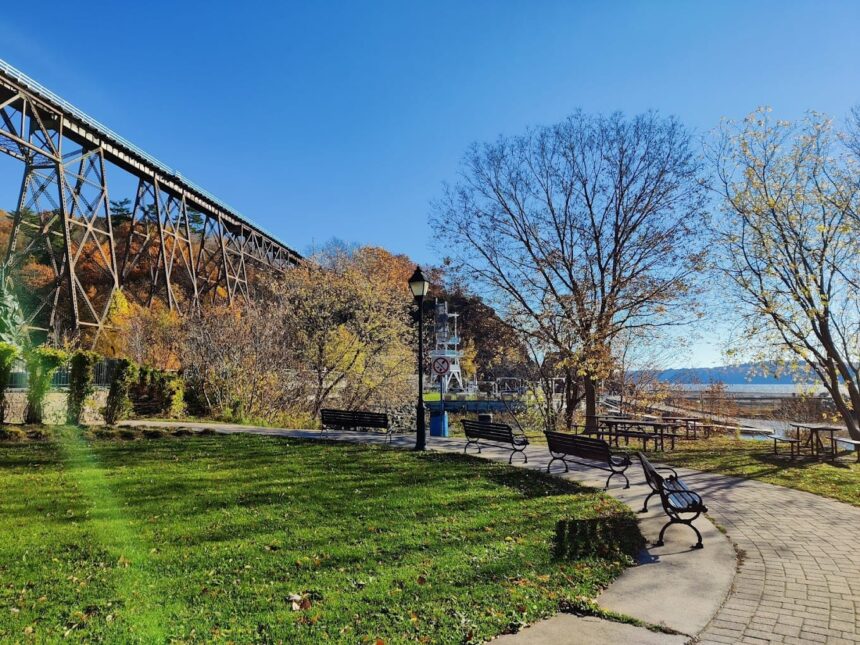
Cap-Rouge is the westernmost residential district of Québec City, perched on a bluff above the confluence of the Rivière du Cap Rouge and the Saint-Laurent. It is also the location of one of the earliest European settlements anywhere in North America: Jacques Cartier and the Sieur de Roberval established a short-lived colony here in 1541, predating Champlain’s Québec by 67 years. The settlement failed within two years. The site remained significant, and the village that grew around it across the subsequent centuries has retained a distinct character.
The archaeological site
The 1541 settlement, Charlesbourg-Royal, was rediscovered archaeologically in 2005. The site, on the north bluff above the Cap Rouge river, has yielded ceramics, iron artifacts, and structural remains that correspond to Cartier’s third voyage. It is now preserved as a provincial historic site and includes an interpretation centre, the Site archéologique Cartier-Roberval, which opens seasonally from late May through early October. The exhibits place the settlement in the context of Cartier’s full voyages and of the subsequent French strategy for North America.
The interpretation is honest about what went wrong: disease, winter, conflict with the local Indigenous population, and a collapse of the settlement’s leadership led Roberval to evacuate in 1543. The French did not return in earnest for six decades. For visitors interested in the longer arc of European presence in the Saint-Laurent valley, the site is essential context.
The village core
Cap-Rouge’s traditional village runs along rue Provancher and the adjacent streets on the bluff above the river. Several heritage buildings survive, including the parish church and a cluster of nineteenth-century stone houses. The village has retained a surprising degree of low-scale residential character despite being surrounded by postwar suburban development.
The harbour at the foot of the bluff, the Port de Cap-Rouge, remains a small-craft marina used by local sailors and paddlers. The cycling path that runs along the Saint-Laurent from the western suburbs into central Québec City passes along the marina’s edge.
The residential suburbs
Beyond the village, Cap-Rouge is a suburban district built mostly between 1965 and 1990. Housing is predominantly single-family detached, with a mix of bungalows, split-levels, and larger two-storey homes on generous lots. The demographic profile is family-dominated and francophone, with a strong professional and academic presence connected to Université Laval, which is a short drive away.
Housing prices in Cap-Rouge have climbed faster than in most peripheral districts over the past decade, driven by the combination of good schools, generous lots, and proximity to both the campus and the autoroute network.
Parks and recreation
The Base de Plein Air de Cap-Rouge is the main recreational asset, a municipal outdoor-activity centre with cross-country ski trails in winter, a beach and swimming lake in summer, and rental equipment for paddling on the Saint-Laurent. It is open year-round and is one of the better-equipped such centres in the region. The Parc nautique de Cap-Rouge offers additional paddling access, with calmer conditions than the open river.
The Corridor du Littoral cycling path begins its western extension near Cap-Rouge, linking the district into the broader riverside network that runs all the way east to Montmorency falls.
Getting there
Cap-Rouge is 15 kilometres west of Vieux-Québec, 15 to 25 minutes by car via boulevard Champlain or Autoroute 40. RTC bus routes provide service to the village core and to the suburban interior, though frequency is weekday-oriented. The district is bike-accessible via the Corridor du Littoral for riders coming from central Québec.
Who Cap-Rouge suits
Cap-Rouge suits families who want a larger lot, a short drive to Laval, and a village core with a residual Quebec-seigneurial character. For visitors, the combination of the archaeological site, the village, and the outdoor recreational centre makes it a worthwhile half-day trip from Vieux-Québec, particularly in warm weather. It does not have the tourist retail or dining density of the old city, and should not be planned as a full day’s destination unless you have a specific interest in the Cartier settlement.






