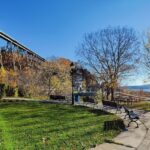
Place de Paris sits at the eastern end of the Vieux-Port on Rue du Marché-Finlay, a small rectangular plaza anchored by a white abstract sculpture titled Dialogue avec l’histoire by French artist Jean-Pierre Raynaud. The square was inaugurated in 1987 to mark the twinning of Québec City with Paris and remains the most explicit monument to the city’s continuing relationship with its founding metropolis. The plaza and its surroundings reward a slower look than most visitors give them.
Origins of the twinning
Québec City and Paris formalised a sister-city relationship in 1957 through the Association des maires francophones, one of the earliest international twinnings involving a North American city. The relationship deepened after Charles de Gaulle’s 1967 visit, which famously culminated at Montréal’s city hall but included a stop in Québec City that received less attention abroad.
The physical marker of the twinning took three decades to materialise. Through the 1970s and early 1980s, the former Finlay Market site at the eastern end of the Vieux-Port sat in redevelopment limbo. The 1985 agreement between the Ville de Québec and the City of Paris committed both capitals to a specific plaza with a commissioned sculpture and an exchange of installation expertise. The plaza opened in summer 1987 as part of the city’s broader Vieux-Port restoration.
The Raynaud sculpture
Dialogue avec l’histoire is a seven-metre white cube intersected by geometric openings and ribs, built from French stone and Québec granite in deliberate equal measures. Raynaud, who was a leading figure of the French nouveau réalisme movement, intended the work to represent the encounter between European tradition and the New World context. The abstract form divided local opinion at its unveiling; critics dismissed it as a foreign imposition, supporters praised its refusal to mimic the Old City’s stone vernacular.
Thirty-five years on, the work has aged into the landscape. It reads now as part of the Vieux-Port’s visual pattern rather than a contested foreign object. The regular geometric forms, the contrast of white against the dark stone of the surrounding warehouses, and the specific reference to the twinning mark the plaza clearly enough that visitors who know nothing of the backstory still register its civic purpose.
The surrounding buildings
Place de Paris opens on one side toward the Rue Saint-Paul warehouses, several of which now house restaurants and boutique hotels. The Hôtel Le Germain Québec occupies one of these former bank and warehouse buildings. The nineteenth-century Custom House, at the eastern edge of the plaza, remains a Canadian federal government property and is closed to public access except during occasional heritage-day events.
A second sculpture, a bronze called Voilier by Québec artist Marc-Antoine Côté, sits at the plaza’s southeast corner. It represents the maritime connection more literally than the Raynaud piece and attracts tourist photography at a higher rate, particularly among visitors who prefer figurative to abstract art.
The broader European relationships
Québec City maintains formal sister-city relationships with seven European cities in addition to Paris: Bordeaux, Calais, Rouen, Namur in Belgium, Liège, and two others. These relationships manifest primarily through cultural exchanges, student programmes, and occasional economic missions rather than through permanent markers like Place de Paris. The 2008 Quadricentennial celebrations brought mayors and delegations from most of the twinned cities to Québec for a week of events.
France remains the most substantial of these relationships. The Consulat général de France operates from Rue Saint-Louis in the upper town. The Alliance française runs French-language and cultural programming from a Sillery location. The Délégation générale du Québec in Paris handles the reciprocal representation and coordinates cultural and commercial exchange with provincial government funding.
Visiting the plaza
Place de Paris is open to the public at all times. It is typically least crowded in the early morning and at dusk, when the light off the Raynaud sculpture gives the strongest visual effect. The plaza is a reasonable meeting point for anyone coordinating a group in the Vieux-Port, partly because it sits off the main tourist circuit and so rarely becomes confused or over-full.
The Musée de la civilisation, a five-minute walk away, provides the clearest historical context for the relationships Place de Paris commemorates. Its permanent galleries include sections on the French regime and the continuing francophone identity of the province, making a combined visit of museum and plaza a coherent half-day.