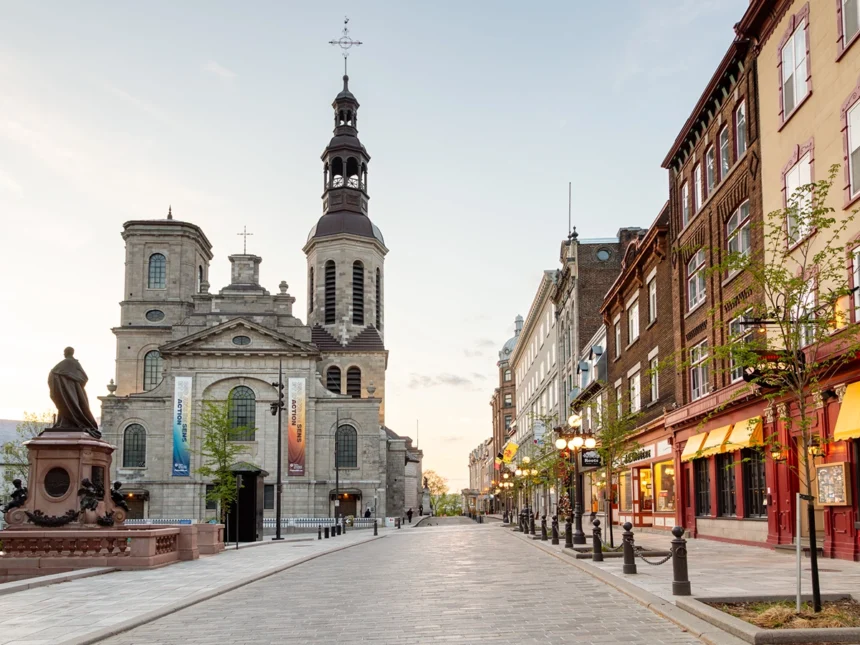
The Basilique-Cathédrale Notre-Dame-de-Québec, at the corner of Rue de Buade and Côte de la Fabrique, is the primatial church of Canada and the oldest parish north of Mexico. The current building, rebuilt several times since the first chapel opened in 1633, holds the tomb of François de Laval, the first bishop of New France, canonised by Pope Francis in 2014. The site combines the architectural history of the French regime with the ongoing role of a functioning cathedral parish.
Three centuries of construction
The first church on the site was a wooden chapel built in 1633 by the Jesuits and called Notre-Dame-de-la-Recouvrance. It burned in 1640. A larger stone church replaced it in 1647, only to be largely destroyed by British artillery during the siege of 1759. The reconstruction, under Jean Baillairgé and his descendants, defined the cathedral’s appearance through most of the nineteenth century.
A second catastrophic fire, in December 1922, destroyed almost everything except the exterior stone walls. The current interior, rebuilt between 1923 and 1925 under Raoul Chênevert, reproduces the eighteenth-century Baillairgé scheme with modern structural and fire-protection technology. The result is a building that reads as historic but incorporates twentieth-century reinforced concrete behind its neoclassical finishes.
The interior
The nave runs 72 metres under a barrel vault decorated with gilded plaster ribs. The high altar, carved by Raphaël Giroux in 1797 and reinstalled after the 1922 reconstruction, ranks among the finest pieces of Québec neoclassical woodwork, with carved scrollwork and painted panels that survived the fire intact. The cathedral holds over 800 seats and accommodates major diocesan events, weddings and funerals of public figures drawn from across the province.
Notable features include the royal canopy, a wooden structure modelled on the canopy at Saint-Peter’s in Rome that covers the bishop’s throne, the 1663 Lépine organ housed in the west gallery, and a series of stained-glass windows installed during the 1920s reconstruction that depict scenes from the history of the Québec diocese.
Bishop Laval
François de Laval, born in 1623, arrived in Québec in 1659 as vicar apostolic and became the first bishop of the diocese in 1674. He founded the Séminaire de Québec, administered the sacraments to a colonial population scattered across the Saint Lawrence valley, and established the administrative structures that shaped Canadian Catholicism for three centuries. He retired in 1688 and died in 1708.
Laval’s remains were moved several times before their current resting place in the cathedral’s Chapelle Notre-Dame-de-Pitié, a side chapel near the main altar. The tomb, designed in the 1990s during the preparation for his beatification, displays a bronze effigy above a stone sarcophagus. Pilgrims leave candles, flowers and written prayers at the rail; the cathedral staff clear these regularly and forward petitionary prayers to the Sanctuaire Saint-François-de-Laval next door.
The canonisation
Pope Benedict XVI beatified Laval in 1980. The canonisation process, which requires a confirmed miracle attributed to the candidate’s intercession, took more than three decades. Pope Francis canonised Laval on 3 April 2014 in an extraordinary equivalent canonisation, meaning the Vatican recognised the cultus of the candidate as sufficient without requiring a second miracle.
The cathedral hosted a major commemorative Mass on 3 May 2014, attended by Cardinal Marc Ouellet and several thousand faithful. Since then, the flow of pilgrims to Laval’s tomb has increased steadily, though the site remains less visited than the Oratoire Saint-Joseph in Montréal or Sainte-Anne-de-Beaupré.
Visiting
The cathedral is open to visitors from 08h to 16h most days, with access restricted during Masses and funerals. Entry is free. Guided tours in French and English run during the summer season; English tours are typically offered at 09h and 14h, French tours more frequently. A small interpretation centre near the main entrance provides historical context.
The Sanctuaire Saint-François-de-Laval, connected to the cathedral by an interior passage, offers a more focused experience of the Laval cultus. The sanctuary includes displays of relics, explanatory panels on the canonisation, and a quieter space for prayer or reflection. A visit combining the cathedral, the sanctuary and a walk through Place d’Armes typically takes 90 minutes.