The Cartier-Brébeuf National Historic Site sits on the Saint-Charles River, twenty minutes on foot north of the old city. It commemorates two distinct events: Jacques Cartier’s winter of 1535-1536, during which his crew survived with the help of the Iroquoian village of Stadacona, and the first mission of the Jesuit priest Jean de Brébeuf in 1625-1626. The interpretation is quieter than that of the Plains of Abraham, and the setting is parklike, but the site carries weight that most visitors overlook.
What happened here
Cartier’s second voyage ended with his ships frozen into the Saint-Charles River through the winter. Scurvy killed a quarter of his crew. The Iroquoian people of Stadacona, already in a fraught relationship with the French, provided a decoction of white cedar, called annedda in their language, that treated the disease. Cartier’s journal is the source; it is one of the earliest documented interactions between European and Indigenous peoples in what became Canada.
Ninety years later, Jean de Brébeuf and two other Jesuits landed nearby and built a temporary mission house. Brébeuf would go on to live among the Wendat people for decades and die among them in 1649 during the Haudenosaunee-Wendat wars. The site marks his first year in North America, before the Jesuit presence in Canada took its eventual shape.
The park today
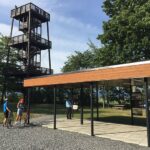
The grounds are open year-round as public green space, with a visitor centre that operates seasonally from late May through early October. The centre houses permanent exhibits on Cartier’s voyages, the Stadacona village, and Iroquoian material culture, developed in consultation with contemporary Wendat and Haudenosaunee communities. A full-scale reproduction of a longhouse sits at the northern end of the grounds; during summer it hosts demonstrations and talks, sometimes led by Indigenous interpreters.
A reproduction of Cartier’s ship, the Grande Hermine, stood on the property for decades but was dismantled in the early 2000s after it deteriorated beyond repair. The absence is a deliberate reminder that interpretive choices shift: Parks Canada has moved away from monumental reconstructions toward exhibits that foreground Indigenous perspectives.
Getting there
The main entrance is at 175 rue de l’Espinay, in the Limoilou borough. From Vieux-Québec, RTC bus 3 drops visitors within a five-minute walk. Cyclists can reach the site via the Corridor des Cheminots bike path, which runs along the river. By car, the site is 10 minutes north of the old city via Autoroute Laurentienne and offers free parking.
Practical information
Visitor centre admission is modest, typically around 4 CAD for adults in 2026, free for visitors 17 and under. Parks Canada Discovery Pass holders enter at no additional cost. The grounds themselves are free and open from dawn to dusk year-round; the riverside path remains usable in winter for anyone comfortable with snow-packed trails.
Allow 60 to 90 minutes for a full visit during summer. The longhouse and exhibits repay a careful look, and the setting on the riverbank is pleasant for a picnic. In winter the site reduces to the grounds alone, which is still a reasonable destination on a sunny afternoon.
Why it matters
Visiting Cartier-Brébeuf reframes the standard Québec City narrative. Most heritage tourism in the old city begins with Champlain in 1608 and treats the French-British conquest as the defining event. This site insists on the earlier encounter, on Indigenous presence before and during the colonial moment, and on the fact that European survival here depended on Indigenous knowledge. That reframing does not diminish what happens inside the ramparts. It complicates it, which is what good history should do.
Combining with other stops
The site pairs well with the Musée de la civilisation, whose permanent exhibit on Indigenous peoples of Québec provides the broader context. A half-day that includes the museum in the morning and Cartier-Brébeuf in the afternoon gives visitors a connected picture. For cyclists, the ride up the Corridor des Cheminots can be extended north to the Domaine de Maizerets, another underrated green space.