



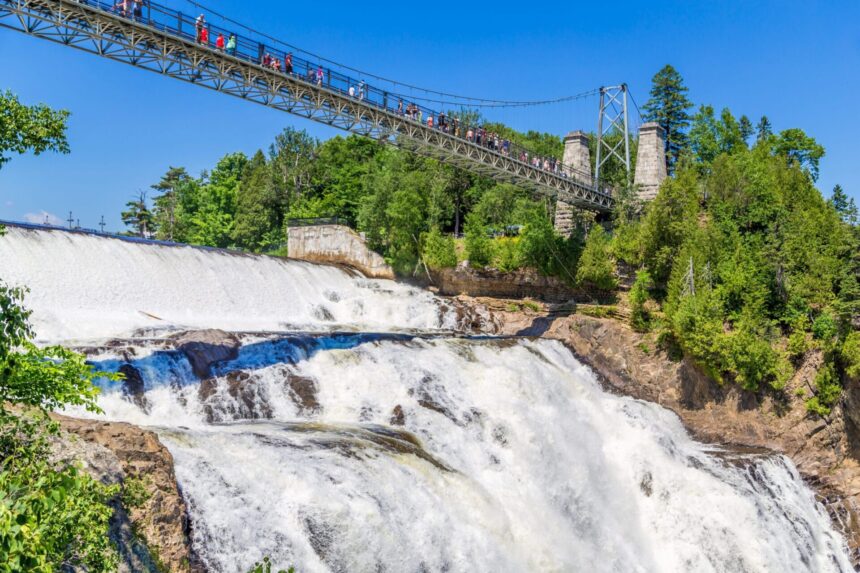
Tell a visitor to Québec City that there’s a waterfall 83 metres tall — taller than Niagara Falls, in fact — just 15 minutes from the Old City, and the response is usually a slightly skeptical pause. They’ve heard of Niagara. They haven’t heard of this. How is it possible that a waterfall that impressive is sitting quietly at the edge of a North American provincial capital, and nobody seems to talk about it internationally?
Fair question. The answer involves geography (Niagara is wider, not taller), history (Niagara was promoted aggressively in the 19th century while Montmorency was a local attraction), and scale (Québec’s tourism machinery has always had so many marquee sites — Château Frontenac, the Plains of Abraham, the walled city — that Montmorency is one of several near-iconic features competing for attention).
None of that changes the reality of the falls themselves. Chute Montmorency is one of the most impressive natural sites in Eastern Canada, and every visitor to Québec City should put it on the itinerary.
The Basics
Montmorency Falls is at the mouth of the Montmorency River, approximately 12 kilometres east of downtown Québec City. The falls are 83 metres tall (Niagara Horseshoe Falls is 57 metres) and roughly 30 metres wide at the crest. Water volume varies significantly by season — peak flow in late spring can triple the winter minimum.
The site is managed as Parc de la Chute-Montmorency by Sépaq, the Québec provincial park service. The park includes a manor house at the top of the falls, viewing platforms, a suspension bridge across the gorge, a cable car system, and a network of walking trails.
Four Ways to Experience the Falls
From the Base (Free)
A paved walkway leads from a small parking area at the base to a viewing platform directly at the foot of the cascade. This access is free and accessible to wheelchair users. You can walk right up to the falls, feel the mist, and photograph from the base.
This is the simplest, cheapest, and arguably most powerful way to experience Montmorency. On a tight schedule, this alone is worth the trip.
From the Top (Manor Area: Paid)
The top is accessed via the Manoir Montmorency, a historic house converted into a restaurant and visitor centre. Paid admission (around $10-15 in summer, less in winter) gives you:
- A panoramic viewing platform at the crest of the falls
- The 487-step stairway descending through the gorge
- The Pont Suspendu — a suspension footbridge across the top of the falls, with a straight-down view
- Manor-area gardens and walking paths
- The Manoir restaurant and café
Plan for 90 minutes to 2 hours.
The Cable Car
The Téléphérique Montmorency runs between the base and the top, operating most of the year (weather permitting) and included in the top-of-falls admission ticket. It’s about 2-3 minutes each direction and gives you a mid-air angle on the falls.
Useful for visitors avoiding the 487 stairs, and anyone who wants to combine the free base walk with the paid top area.
Ice Climbing (Winter Only)
Montmorency becomes a world-class ice climbing destination each winter as spray from the falls freezes into an ice wall known as the pain de sucre (sugar loaf). Certified guides offer lessons on the frozen falls, typically from late January through early March.
Expect $150-200 for a half-day lesson with equipment. No experience required — beginners do this regularly. Reasonable physical condition is expected.
The Seasons
Summer (June-August)
Peak tourist season. All facilities open, cable car on regular schedules, gardens in bloom, spectacular falls. Crowds manageable on weekday mornings, heavy on weekend afternoons. Ideal temperature for walking and stairs. Best photo time: early morning or late afternoon.
Fall (September-October)
Arguably the best season. Autumn colours in the surrounding forest, cooler temperatures, thinning crowds, excellent light. Peak foliage late September to mid-October.
Winter (November-March)
Genuinely magical. Spray creates elaborate ice formations, the sugar loaf builds up at the base, snow gives the site a different character. Cable car operates through winter (weather permitting). Base walk often accessible. Top stairs usually closed for safety.
Dress properly — the mist creates serious wind chill.
Spring (April-May)
Least impressive season. Melt patterns are muddy, some facilities closed for seasonal transitions, ice formations breaking up. Skip spring if you have a choice.
Getting There
By car: 15-20 minutes from downtown Québec via Boulevard Sainte-Anne (Route 138 E) or Autoroute 40. Parking at both base and top lots.
By bus: RTC bus 800 connects downtown Québec to Beauport, with a short walk or transfer to the falls. 45-60 minutes total.
By tour bus: Multiple operators offer half-day and full-day trips combining Montmorency with nearby attractions. $50-80 per person.
By bicycle: The Corridor du Littoral bike path connects central Québec to Montmorency (14 km each way). Popular summer day trip.
What to See Nearby
Montmorency pairs well with:
- Île d’Orléans — 10 minutes further east. Food, farms, historic villages.
- Sainte-Anne-de-Beaupré Basilica — 20 minutes further east. Major Catholic pilgrimage site.
- Canyon Sainte-Anne — 30 minutes further east. Smaller-scale but dramatic canyon.
Classic full-day itinerary: Montmorency in the morning → Île d’Orléans for lunch → Sainte-Anne-de-Beaupré in late afternoon.
Dining at the Manoir
The Manoir Montmorency houses a restaurant with probably the best view in the region — dining above an 83-metre waterfall. Traditional Québec cuisine, respectably executed. Prices elevated (you’re paying for the view) but better than most attraction-based restaurants. Reservations recommended in summer.
Photography Tips
- Golden hour for light angling into the gorge.
- The suspension bridge offers the most unique angle.
- The base walkway puts mist on your lens; use a hood.
- Long exposure photos require a tripod and ideally a neutral density filter.
- Winter ice formations at the base are extraordinary — sugar loaf in a good year reaches 25-30 metres.
Practical Tips
Arrive by 10 AM on summer weekends to avoid full parking lots at the top.
Wear proper shoes. 487 stairs is real; trails can be slippery.
Dress in layers. Temperature differences between top and base plus mist-induced wind chill.
Accessibility: Base walkway, cable car, and top-of-falls viewing platforms are accessible. Stairs and suspension bridge are not.
FAQ
Is Montmorency worth visiting in winter?
Yes. Ice formations and quieter crowds make it arguably the most photogenic season.
Can I swim at the base?
No. Cold, currents, and swimming isn’t permitted.
Are dogs allowed?
Yes, on leash, on the base trail and most exterior paths.
How long should I budget?
Minimum 1 hour for base only; 2-3 hours for top and cable car; 4+ hours with dining or ice climbing.
Rideshare accessible?
Yes. $25-35 from downtown Québec.
Final Word
Montmorency Falls is one of those attractions Québec City offers almost as an afterthought — an 83-metre waterfall that would be the main event in most other cities, casually 15 minutes from your hotel. Take it seriously. Go. Spend at least a half-day. You’ll come back with photos that will make everyone wonder why they’ve never heard of this place, which is exactly the point — you’ll have just discovered a piece of Québec that deserves far more international attention than it gets.






