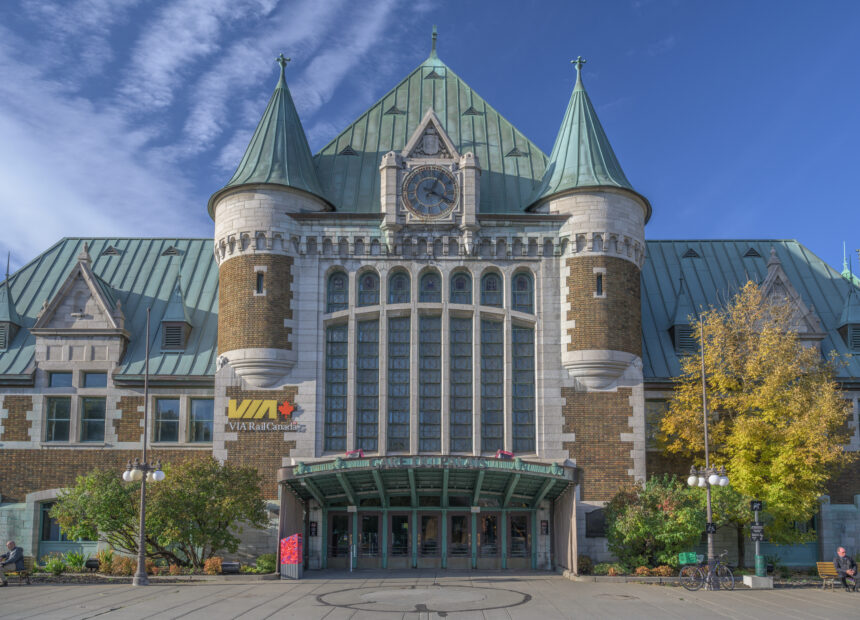
Gare du Palais, the passenger rail terminal in Québec City’s Lower Town, was designed by Bruce Price, the American architect responsible for the Château Frontenac, and opened in 1915. The building’s steeply-pitched green copper roof, round towers, and dormered windows make it among the most architecturally distinctive railway stations in Canada, explicitly designed to match the château-style vocabulary Price had established for Canadian Pacific Railway hotel properties a generation earlier. The station handles Via Rail passenger service on the Quebec City-Windsor corridor and serves as the regional intercity coach terminal.
Seasonal character
Via Rail runs three to four daily round-trip trains between Gare du Palais and Montreal’s Gare Centrale, with additional frequency to Ottawa and Toronto through Montreal connections. The journey time to Montreal is currently scheduled at 3 hours 15 minutes, though operational performance on this segment has deteriorated over the last decade due to aging track, rolling stock limitations, and freight-rail priority conflicts. The proposed Alto high-speed rail network, currently in public consultation through April 24, 2026, would eventually operate into Gare du Palais as its Québec City terminus, reducing the Montreal journey to approximately 90 minutes.
On foot from downtown
The station’s location in the Lower Town places it within walking distance of the Old Port, Place Royale, the Musée de la civilisation, and the Île d’Orléans ferry dock. The Escalier Casse-Cou and the Funiculaire provide two distinct ways to ascend to Upper Town and the Château Frontenac area; the Funiculaire is the gentler option for visitors with mobility constraints or heavy luggage. Taxi and ride-share staging at the station’s north side operates consistently, though coverage thins substantially on late-evening train arrivals.
A notable weakness in the station’s current configuration is its isolation from the TramCité alignment now moving to construction. The tram network, as currently designed, does not include a Gare du Palais stop. Passengers transferring between Via Rail (and eventually Alto) and the tram would need to either walk approximately 800 metres to the nearest tram station on Boulevard Charest, take a brief Réseau de transport de la Capitale bus connection, or use taxi services. This integration gap is one of the more visible planning shortcomings of the current tram network design, and the resolution is not yet publicly committed. It matters more for future decades than today, given Alto’s 2033+ likely operational horizon, but it is the kind of decision that becomes harder to reverse once TramCité physical infrastructure is complete.