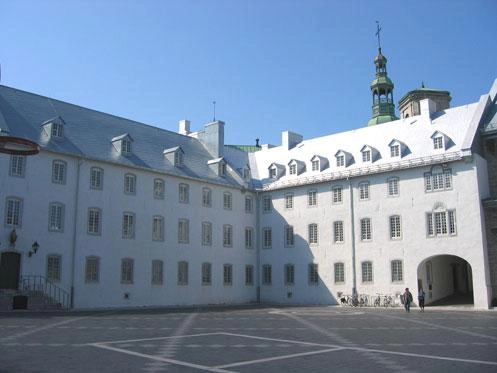
The Séminaire de Québec, founded by François-Xavier de Montmorency-Laval in 1663, is the oldest institution of higher education in North America north of Mexico. Established to train clergy for the colonial Catholic church, the Seminary broadened its curriculum through the 17th and 18th centuries and formally founded what is now Université Laval in 1852. The Seminary complex occupies approximately three city blocks in Upper Town between the Château Frontenac and the Hôtel-Dieu de Québec hospital, and substantial portions remain functioning religious and educational institutions.
The building
The architectural complex includes the Chapelle extérieure (the public-facing chapel dating to 1900), the Chapelle des Congrégations (1785), the Grand Séminaire main building (multiple construction phases from 1675 forward, its Aile de la Procure dated 1678-1681 by the provincial heritage register, which makes it one of the oldest surviving buildings in Quebec City), the Petit Séminaire (the secondary-school building dating to 1887), and the Musée de la civilisation‘s Séminaire wing with historical artifacts. The architectural interest rewards an unhurried visit; the Grand Séminaire courtyards are among the quietest and most contemplative spaces in Old Quebec, accessible during daytime hours with visitor respect for the continuing religious function of the complex.
History and origins
The Seminary Museum (Musée de l’Amérique francophone, operated under the Musée de la civilisation network), housed in the Séminaire’s historical collections building, holds approximately 450,000 objects spanning the Seminary’s four-century history. Highlights include early French-regime manuscripts and correspondence, silverwork and ecclesiastical objects from the 17th and 18th centuries, a substantial collection of 18th-century paintings, and the Seminary’s library of rare books. The museum’s programmatic focus on the French-speaking cultural presence across the Americas (not just Quebec, but Louisiana, Acadia, the Caribbean and Haiti, and the French-speaking communities in the United States) is more substantive than most visitors expect.
Practical visit information: the Musée de l’Amérique francophone is open Tuesday through Sunday during summer months, with reduced days off-peak; admission is $10 adult (discounts for seniors, students and groups). The historical Seminary courtyards (Cour du Séminaire, Cour de la Procure) can be entered through the museum’s ticketing area. The Cathédrale-Basilique Notre-Dame-de-Québec, immediately adjacent, shares architectural and historical context with the Seminary and makes sense as a combined visit. The Seminary’s overall significance in North American religious, educational and intellectual history is not well represented in most visitor itineraries; visitors with academic or religious-history interests will find the site among the most rewarding in the Old City.