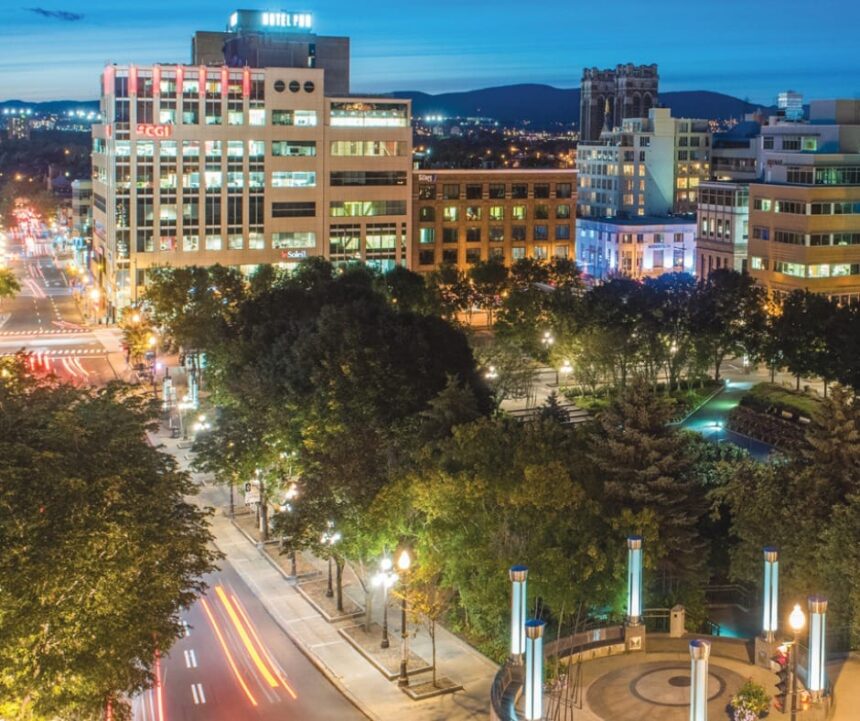
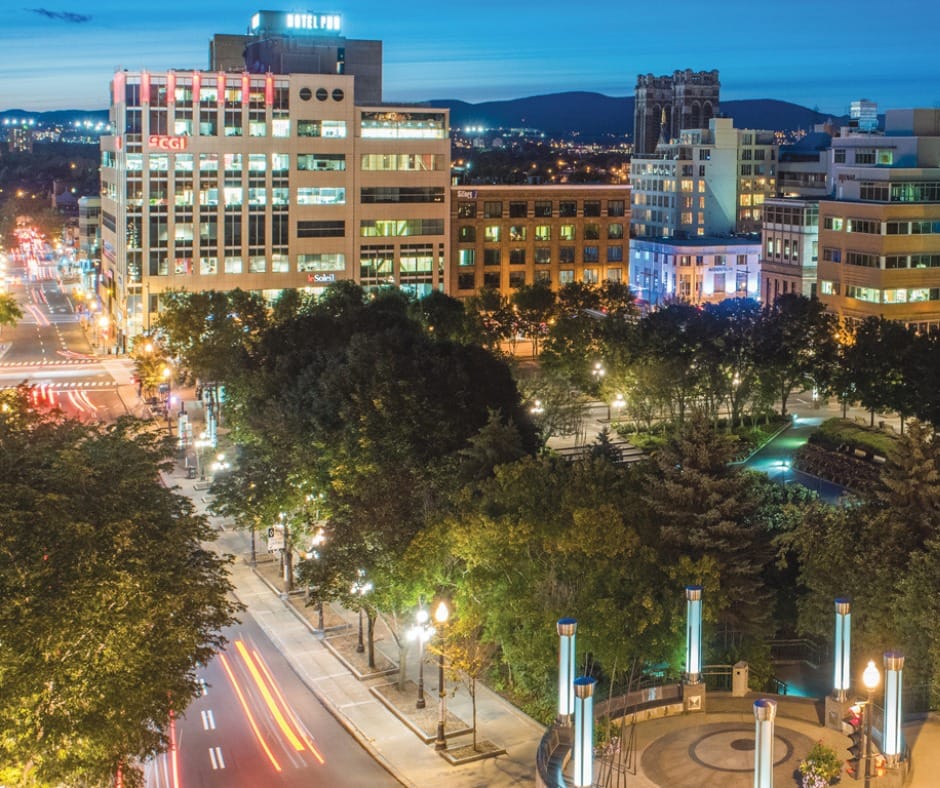
Saint-Jean-Baptiste sits on the Upper Town plateau immediately west of the walled city, bounded roughly by Avenue Honoré-Mercier on the east, Avenue Belvédère on the west, the cliff face above Saint-Roch to the north, and the Plains of Abraham to the south. Development of the quartier began in the 1850s as working-class housing for employees of religious institutions and Upper Town hospitals. The three-storey brick-and-wood rowhouses that define the area’s visual character were built during this period; the street grid has changed little in 170 years.
History and origins
Rue Saint-Jean is the spine. The segment inside the walls (from the Saint-Jean gate to Rue d’Auteuil) is a narrow pedestrian-oriented tourist street; the segment outside the walls (running west past Épicerie J.A. Moisan, the oldest grocery in North America operating continuously since 1871, to the Jesuit-built Chapelle historique Bon-Pasteur) is an extended arterial lined with independent bookstores, bars, queer clubs, thrift stores, restaurants and the largest concentration of record stores in Quebec City.
The quartier absorbed much of the punk and anarchist scene from the 1970s onward, a role it has not entirely relinquished despite rising rents. L’Autre Caserne, Le Knock Out, Le Sacrilège and Le Drague have been operating in various forms for decades as meeting points for a mix of political activists, LGBTQ residents, students and professionals in their 30s and 40s. The annual Fête arc-en-ciel, Quebec City’s pride festival, concentrates its outdoor programming on Rue Saint-Jean and the adjacent Place d’Youville.
Where things stand today
The Chapelle historique Bon-Pasteur at 1080 Rue de la Chevrotière merits a detour. Built in 1868 for the Sisters of the Good Shepherd, the chapel holds roughly 150 seats and a functioning 19th-century organ, and now operates as an intimate classical music venue under Quebec provincial heritage designation. Concerts run roughly 40 evenings per year, with tickets typically $25 to $40. The hall’s acoustics are substantially better than any contemporary venue in the city; violin, chamber and organ recitals benefit disproportionately from the space.
For travelers looking for a neighbourhood experience without the performative tourism of the walled city, Saint-Jean-Baptiste is the natural choice. The restaurant density is high, the pricing is 20 to 30 percent below equivalent spots inside the walls, and the demographics skew strongly local. Accommodation in the quartier is limited (few hotels, some short-term rentals), but lodging on Grande Allée or Avenue Cartier puts a visitor within a 5-to-10-minute walk of the neighbourhood’s dining spine. Rue Saint-Jean’s outside-the-walls segment takes 20 minutes to walk end-to-end at tourist pace.
For how this faubourg sits against the other quartiers, see our guide to Québec City’s neighbourhoods.