Quebec City’s geography is unusually dramatic a cliff divides the city into upper and lower towns, the St. Lawrence defines its eastern edge, and the Plains of Abraham anchor its western reach. Within this framework, distinct neighborhoods have developed personalities as individual as their architecture. Here’s how to navigate them.
Vieux-Québec Haute-Ville (Upper Town)
The fortified upper city is where most visitors spend most of their time — and rightly so. The concentration of historic architecture, the ramparts, the Plains of Abraham and the Château Frontenac is genuinely extraordinary. But it can feel like a stage set in peak season. The key is to go early, go late, and explore the residential streets away from the main tourist arteries.
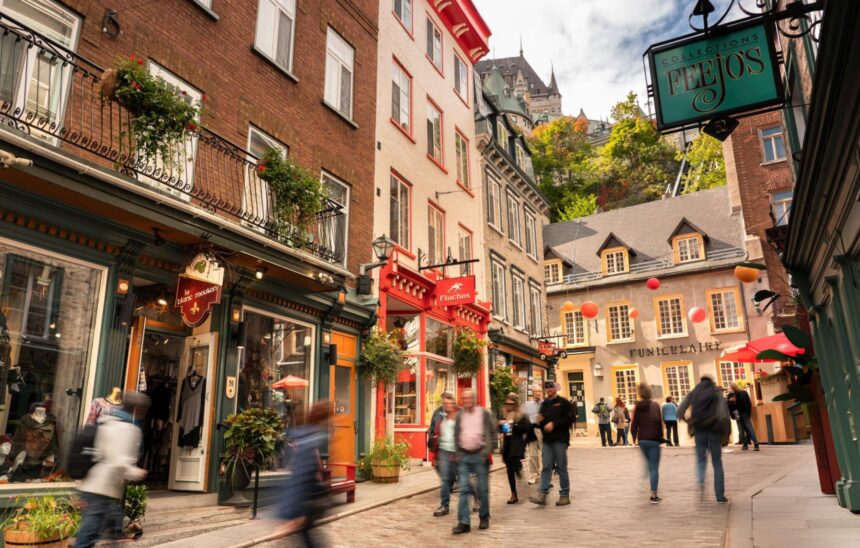
Vieux-Québec Basse-Ville (Lower Town)
The lower town ( including Petit-Champlain and the Old Port ) has a different character than the upper: more mercantile, more layered, with the working history of a port city visible in its architecture. Auberge Saint-Antoine is here. The best riverside restaurants are here. The Musée de la Civilisation is here. And the scale is more intimate than the upper town’s grand spaces.
Saint-Roch
The transformation of Saint-Roch from a struggling working-class district to the city’s creative and innovation hub is one of Quebec City’s great urban stories. The neighborhood’s streets ( particularly Saint-Joseph Est ) are lined with independent restaurants, coffee shops, boutiques, and galleries. The Méduse arts cooperative is here. Université Laval‘s technology park anchors the eastern edge. This is the neighborhood that shows where Quebec City is going.
Montcalm
The elegant residential neighborhood west of the Old City, running along the Grande Allée, is Quebec City at its most bourgeois in the best sense. Beautiful Edwardian and Victorian houses, excellent restaurants along Grande Allée, proximity to the Plains of Abraham, and a neighborhood feel that the tourist areas lack. Many consider this the city’s most desirable place to live.
Limoilou
The neighborhood most in transition Limoilou is where the next chapter of Quebec City is being written. Affordable relative to the rest of the city, increasingly populated by young professionals and creative types, with a main artery (3e Avenue) that has become one of the city’s most exciting dining and drinking destinations. If you want to feel the energy of a neighborhood becoming something, come here.
Every neighbourhood, in depth
This guide is the overview. Each neighbourhood has its own guide:
- Vieux-Québec — the walled city, Upper and Lower Town, and Quartier Petit-Champlain within it.
- Saint-Roch — the former industrial district that became the city’s restaurant and creative centre.
- Limoilou — flat, gridded, north of the Saint-Charles, and the best beer street in the city.
- Montcalm — Grande Allée, the museum quarter and the bourgeois avenues west of the walls.
- Saint-Jean-Baptiste — the faubourg immediately outside Porte Saint-Jean.
- Sainte-Foy and Sillery — the western boroughs, the university and the shopping centres.
If your question is where to sleep rather than where to walk, that is a different decision: see our neighbourhood accommodation comparison.
The neighbourhoods compared
| Quartier | Character | To Vieux-Québec | Relative cost | Suits |
|---|---|---|---|---|
| Vieux-Québec, Haute-Ville | The postcard: ramparts, Château, Dufferin | You are in it | Highest in the city | First visits of three nights or fewer |
| Vieux-Québec, Basse-Ville | Place Royale, the Old Port; quieter after dark | Ten minutes on foot or the funicular | High | Return visitors, dining-led trips |
| Saint-Roch | The restaurant and creative quarter | 15–20 minutes on foot | Roughly 15–25% below the walled city | Food-focused and longer stays |
| Saint-Jean-Baptiste | Residential faubourg, cafés and groceries | Immediately outside Porte Saint-Jean | Below the walled city | Week-long stays, self-catering |
| Limoilou | Flat grid, 3e Avenue, breweries | ~20 minutes on foot, across the river | The most accessible inner-city rents | Repeat visitors, cyclists |
| Montcalm | Grande Allée, museums, bourgeois avenues | Ten minutes on foot | Mid | Museum days, quieter evenings |
| Sainte-Foy | University, malls, chain hotels, parking | 15–20 minutes by car | Roughly 30–40% below downtown | Drivers, families, business |