The cabane à sucre season runs roughly from the first week of March to the second week of April in the Quebec City region. The exact dates shift with the weather: the sap rises in sugar maples when nights drop below freezing and days climb above it, a pattern that most years begins at the end of February and ends when the daily high passes 10 degrees Celsius for good. Most sugar shacks in the region open to the public from early March and close their dining operations by the third weekend of April, with the actual sap collection continuing for another week or two in the forest.
What to order
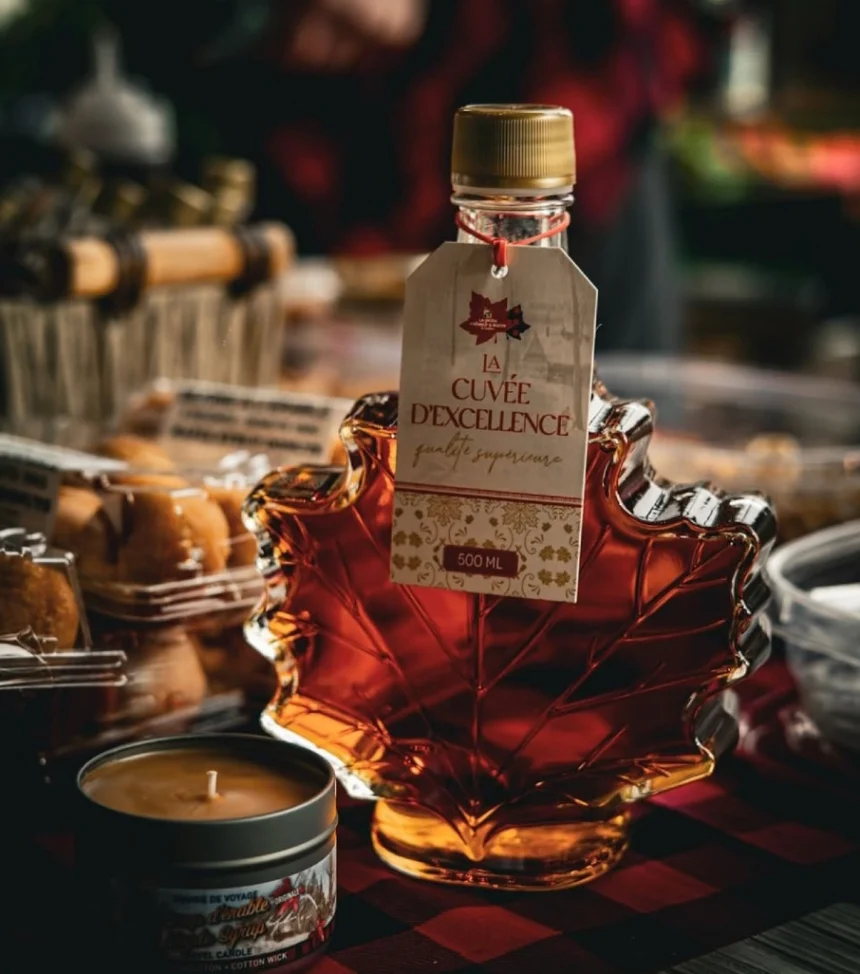
A visit to a commercial sugar shack follows a fairly standard format. Groups of twenty, forty, or a hundred people sit at long tables in a wooden dining hall. A fixed-price menu arrives in sequence: pea soup, ham baked with maple syrup, oreilles de crisse, baked beans with maple, potatoes, and sausages, followed by crêpes or pancakes with more syrup, and finally sugar pie or pouding chômeur for dessert. The meal is deliberately heavy, and two hours at a cabane à sucre table is the minimum most visitors need to eat their way through it. After the meal, guests often walk through the evaporator building to watch the syrup being reduced, and the final stop is usually the tire sur la neige, where hot syrup is poured onto packed snow and lifted on a wooden stick as a candy that hardens on contact.
The Quebec City region has several cabanes à sucre within a 30-minute drive. Érablière Le Chemin du Roy, in Cap-Santé on the north shore, handles large groups and is a regular choice for corporate outings. Cabane à sucre Pelletier-Lavoie in Saint-Gabriel-de-Valcartier, about 25 minutes from downtown, runs a more traditional programme with a smaller dining capacity. Cabane à sucre du Pied de Cochon, an hour and a half north-west in Mirabel, draws an enthusiastic food-media following for its chef Martin Picard’s reinterpretation of the standard menu; reservations there open months ahead and fill quickly. For the simpler neighbourhood version, any sugar shack with a wooden sign by the roadside and a parking lot full of minivans will generally deliver a respectable meal.
What it costs
Prices for a full cabane à sucre meal fall in a consistent range across the region. A standard all-you-can-eat adult meal, including soup, ham, beans, pancakes, dessert, and coffee, costs between 25 and 40 dollars at most operators; children under twelve pay roughly half. Higher-end operators like Pied de Cochon run substantially higher, with meals starting around 75 dollars per person. Reservations are generally required on weekends in March and April, and walk-ins are often impossible during the peak middle-of-season weekends. Most operators accept groups of eight or more by phone booking only.
The cultural context deserves some attention. The cabane à sucre tradition predates Quebec’s commercial adoption of the format by a long stretch. Indigenous peoples in the Saint Lawrence valley were tapping sugar maples and reducing the sap well before European contact; French colonists adapted the practice through the seventeenth and eighteenth centuries, and by the early nineteenth century sugar shacks were a standard fixture on farms across the colony’s maple-forested zones. The commercial cabane à sucre, as a destination restaurant rather than a family operation, emerged in the 1940s and grew rapidly through the 1960s. Today the sector supports roughly 7,000 tapped maple stands in the province, producing about 70 percent of the world’s maple syrup supply.
Seasonal character
For visitors planning a spring trip to Quebec City, a cabane à sucre lunch fits easily into a day trip. Most operators serve lunch and dinner sittings, usually with a single lunch sitting around noon and a single dinner sitting around six in the evening. The drive from downtown Quebec City to most regional sugar shacks takes 25 to 45 minutes, and the return route often passes through small villages that are worth a short stop. A weekend afternoon visit, combined with a morning at the Plains of Abraham or the Musée de la civilisation, makes for a complete day. Dressing for cold weather is sensible: the dining halls are heated, but the walk to the evaporator and the tire sur la neige station happens outside in what is often still winter weather.
One practical note. Many cabanes à sucre operate on a strict schedule determined by when guests arrive, and groups are expected to be seated for the meal at the announced time. Arriving late or trying to shift the seating usually produces friction. The operation runs on volume, and the kitchen’s margin for flexibility is small. Book ahead, arrive on time, and be prepared to eat more than you expected.