



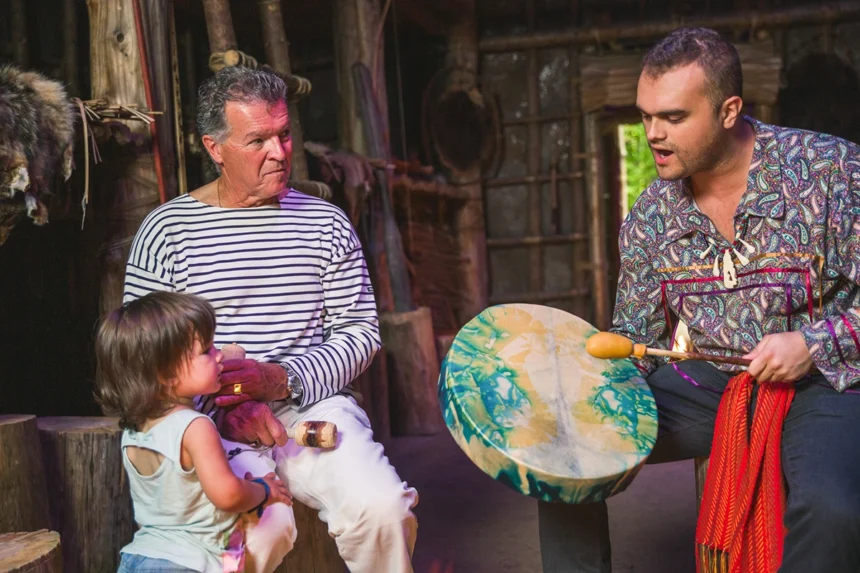
While the Wendake Huron-Wendat reserve (15 kilometres north of Quebec City’s Old City) is the most accessible and institutionally developed Indigenous cultural tourism destination in the greater region, it is not the only one. The Quebec City region sits at the junction of several First Nations territories whose tourism infrastructure, while more dispersed and less developed than Wendake’s, provides genuine engagement with distinct Indigenous cultures and histories. This guide covers the regional Indigenous tourism landscape for visitors who want to explore beyond the well-developed Wendake experience.
The Innu of the North Shore
The Innu communities of the Quebec North Shore (particularly Essipit (approximately 200 km northeast of Quebec City via the Route 138) and Uashat mak Mani-utenam (near Sept-Îles, 500 km northeast)) have developed cultural tourism offerings centred on the Innu relationship with the St. Lawrence, the boreal forest, and the caribou hunting tradition. Essipit’s cultural interpretation program (which combines coastal wildlife observation (beluga whale watching is a core offering in the St. Lawrence at this point), traditional Innu food preparation demonstrations, and guided access to Innu cultural sites) provides the most complete Innu cultural tourism experience accessible from Quebec City as a multi-day trip. The Innu traditional territory (Nitassinan) extends from the North Shore through the Laurentian interior to the Labrador border; guided wilderness experiences in this territory provide some of the most authentic boreal wilderness access available in eastern Canada.
The Abenaki at Odanak
The Abenaki community of Odanak (located near Sorel-Tracy, approximately 120 kilometres southwest of Quebec City via the Autoroute 20) maintains the Musée des Abénakis, one of Quebec’s finest Indigenous cultural institutions. The Abenaki (Wabanaki) people’s territory historically extended from the St. Lawrence valley southward through Vermont, New Hampshire, and Maine; the Odanak community represents the Quebec portion of this trans-border nation. The museum’s collections of Abenaki material culture (birchbark containers, splint baskets, beadwork, and the distinctive Abenaki wampum tradition) and its interpretation of the Abenaki experience of European contact, the missionary period, and contemporary cultural revitalisation make it among the most substantive Indigenous museum experiences accessible from Quebec City. The Abenaki also maintain cultural tourism programming in the summer season; contact the community at abenakis.ca for current offerings.
Indigenous Tourism in the Laurentians
The Atikamekw Nation (whose territory (Nitaskinan) covers the upper Saint-Maurice valley and the Laurentian interior northwest of Quebec City) maintains limited tourism infrastructure but provides guided wilderness experiences (hunting, fishing, and gathering on traditional territory) for visitors with specific interest in the boreal forest and the Atikamekw cultural relationship with the land. Contact Atikamekw Nation tourism organisations directly for current programming; the offerings are typically small-scale, personalised, and oriented toward visitors with serious interest in Indigenous ecology and culture rather than casual tourism. The combination of Quebec City’s established Wendake cultural tourism infrastructure with a day or multi-day trip to one of these less-visited communities provides the most complete engagement with the diverse Indigenous heritage of the Quebec City region available to the motivated visitor.








