The Wendat language (Wendake in the community’s own orthography) was classified as a sleeping language for most of the twentieth century. The last fluent first-language speaker is generally identified as Marie-Lucie Prudent, who died at Wendake in 1905. By the Second World War the language had effectively disappeared from daily use, and by the 1970s few community members could still produce more than a handful of words. The revitalisation now underway, roughly three decades old, is an unusually documented case study in returning a dormant language to active community use.
The archival record the revival draws on
The recovery has drawn on unusually good archival documentation. The Wendat, formerly part of the large Huron confederacy that inhabited what is now southern Ontario, had extensive contact with Jesuit missionaries from 1615 onward. Jesuit priests produced dictionaries, grammars, and prayer translations through the seventeenth and eighteenth centuries, the most complete of which is the Potier manuscript of 1751, a thousand-page Wendat-French dictionary preserved at the Archives du Séminaire de Québec. These written sources, combined with recordings made with the last elderly speakers by the anthropologist Marius Barbeau between 1911 and 1914, provided the linguistic corpus from which the language could be reconstructed.
The formal revitalisation programme began in 1998 under the Conseil de la Nation huronne-wendat and Linda Sioui, a community linguist who had worked on related Iroquoian languages at the Musée de l’Homme in Paris. The initial aim was modest: produce teaching materials for adults who wanted to learn the language. The first Wendat dictionary for modern learners appeared in 2002, and the first adult immersion courses ran in 2003 with twelve enrolled students.
The programme has since expanded considerably. The Ecole Wahta, a primary school in Wendake, now offers Wendat-language instruction as a second language to all students from kindergarten through grade six. A full Wendat-language immersion stream has been offered since 2018 for students whose families choose it, roughly fifteen to twenty children per cohort. Adult learners attend weekly evening classes at the Maison des Familles, with typical enrolment of 40 to 50 students across beginner, intermediate, and advanced streams.
How many speakers there are today
Estimates of current speaker counts vary. The Conseil de la Nation huronne-wendat reported in its 2023 annual summary that approximately 250 community members could hold a basic conversation in Wendat, up from an estimated 15 in 2000. Perhaps 30 to 40 people are described as proficient, meaning they can sustain extended conversation on a range of topics without switching to French. No one is a fluent first-language speaker, which remains the long-term goal of the programme and the one that will take another generation or more to achieve.
The reconstruction effort has had to make linguistic decisions that natural language transmission does not require. Some vocabulary has been revived from the seventeenth-century sources. Some has been borrowed from closely related Iroquoian languages (Mohawk, Seneca, Cayuga) where Wendat documentation is thin. Some has been created to handle contemporary concepts that had no seventeenth-century equivalent. The community has generally favoured creation from Wendat roots rather than borrowing from French or English where possible.
Public visibility of the language has grown substantially. Wendake signage is now bilingual French-Wendat throughout the community. The Conseil issues press releases in both languages. The Musée huron-wendat provides Wendat-language tours by appointment. The Hôtel-Musée Premières Nations, one of the larger Indigenous-owned hotels in Canada, uses Wendat-language room numbers and incorporates language elements into its guest-facing signage and menus.
Where to see the revival in person
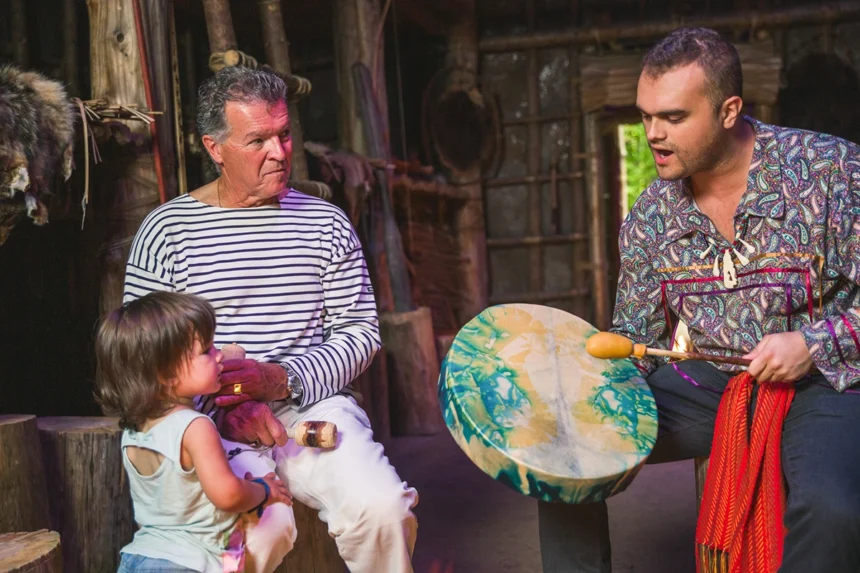
For a visitor interested in seeing the revitalisation in action, the useful stops are the Musée huron-wendat (open daily, $17 admission) and the Onhoüa Chetek8e traditional site, which runs demonstrations with integrated Wendat-language explanation. The Hôtel-Musée’s restaurant La Traite offers menu items in French and Wendat, with brief translations available on request. Wendake itself is about twenty minutes north of downtown Québec City by car, accessible by Highway 73 and exit 155.
The work is slow, deliberate, and not guaranteed to succeed. Fluent intergenerational transmission of a reconstructed language has been achieved in only a small handful of cases globally, Hebrew being the most cited, and the scale of the Wendat project is far smaller than Hebrew was in the 1880s. What the programme has established, over three decades, is a stable institutional infrastructure and a growing community of speakers who use the language in family and community contexts. Whether that produces a genuinely thriving language in another fifty years remains open.