



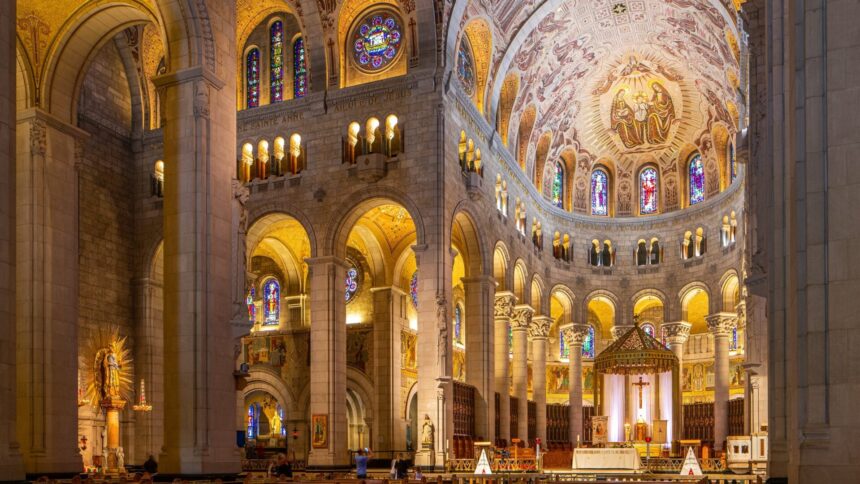
Sainte-Anne-de-Beaupré draws roughly 800,000 to one million visitors a year, making it the most-visited Catholic pilgrimage site in North America after the Basilica of Our Lady of Guadalupe in Mexico City. The basilica sits on a narrow strip of land between the Saint Lawrence and the Côte-de-Beaupré cliff, thirty kilometres east of Québec City. Pilgrims have come to this specific site continuously since 1658.
Origins
The first chapel at Sainte-Anne-de-Beaupré was a simple wooden structure built by the seigneurie of Beaupré in 1658. The dedication to Saint Anne, grandmother of Jesus and patroness of sailors in Breton tradition, reflected both the religious leanings of the Breton settlers who had arrived in the colony and the needs of riverside farmers exposed to the dangerous currents of the Saint Lawrence. The first recorded miracle, the healing of a paralysed labourer named Louis Guimond during the chapel’s construction, is documented in the parish register for March 1658.
A succession of larger churches followed. A stone church replaced the wooden chapel in 1676. A more ambitious basilica-form structure went up in 1872. The current basilica, begun in 1923 after the 1872 building burned, was completed in stages through the 1930s. Its designers, the Montréal firm of Maxime Roisin and Louis Napoléon Audet, chose a French Romanesque style with twin towers and an elaborate interior of mosaic, stone and stained glass.
The current basilica
The basilica dominates the Côte-de-Beaupré skyline. Its nave holds close to 10,000 worshippers, its twin towers rise 91 metres, and its interior features over 200 stained-glass windows produced by the Auguste Labouret atelier in Paris between 1947 and 1960. The crypt chapel below the main sanctuary holds a smaller shrine, popular during off-season months when the main basilica is closed for maintenance.
The Holy Stairs, a replica of the Scala Sancta in Rome, sit in a separate chapel across the parking lot. Pilgrims climb them on their knees, a devotional practice particular to this site and to the Vatican’s own Scala Sancta. The Way of the Cross, laid out on the hillside behind the basilica, has fourteen life-size bronze stations installed between 1913 and 1946.
The pilgrimage calendar
The main pilgrimage season runs from mid-May through October. The feast of Saint Anne, 26 July, draws the largest annual crowd; the nine-day novena leading up to it typically attracts 100,000 visitors. The feast of the Assumption on 15 August and Indigenous Peoples’ Day pilgrimages draw substantial numbers as well. First Nations pilgrims, particularly from the Wabanaki, Innu and Mohawk nations, have maintained their own annual pilgrimage since the late nineteenth century.
The basilica publishes a schedule of special Masses, blessings and processions on its website. For visitors who want to experience the site without the crowd, early mornings in July or any weekday in June or September offer a quieter setting.
The surrounding sacred landscape
Sainte-Anne-de-Beaupré anchors a broader sacred geography. The nearby Cyclorama of Jerusalem, a 360-degree painted panorama installed in 1895, represents a devotional form once common across North America and now rare. The Scala Santa chapel predates the current basilica. The Musée de Sainte-Anne, open in summer, displays votive offerings, historical vestments and the accumulated material culture of three centuries of pilgrimage.
Farther afield, the Notre-Dame-du-Cap basilica at Trois-Rivières, the Oratoire Saint-Joseph in Montréal, and the Sanctuaire du Lac-Bouchette in Lac-Saint-Jean complete Québec’s four major pilgrimage destinations. Some pilgrims visit all four in a single summer tour; the Route Sainte-Anne, a driving circuit promoted by the province’s tourism office, links them.
Getting there
Sainte-Anne-de-Beaupré is a 35-minute drive from downtown Québec City on Route 138. Parking is free on basilica grounds. Public transit requires a transfer: RTC bus 800 to Boischâtel, then a regional shuttle in summer only. Several tour operators run daily buses from Old Québec from June through October, typically combining the basilica with Montmorency Falls and Île d’Orléans. The full return trip from Québec City, with time for a basilica visit and lunch, takes roughly five hours by tour or six if driving independently with stops.








