The Côte-de-Beaupré ( the agricultural and heritage corridor following the north shore of the St. Lawrence from Beauport through Château-Richer to the Charlevoix boundary ) is one of the oldest continuously occupied agricultural areas in North America, and one of the most historically layered landscapes accessible from any major Canadian city. The Chemin Royal (Highway 138) follows a road that has connected Quebec City to its northeast hinterland since the French regime; the farm properties along it descend from the original land grants made by the Compagnie des Cent-Associés in the 1630s and 1640s many still operated by families with three to four centuries of connection to the same land.
Montmorency Falls (20 km)
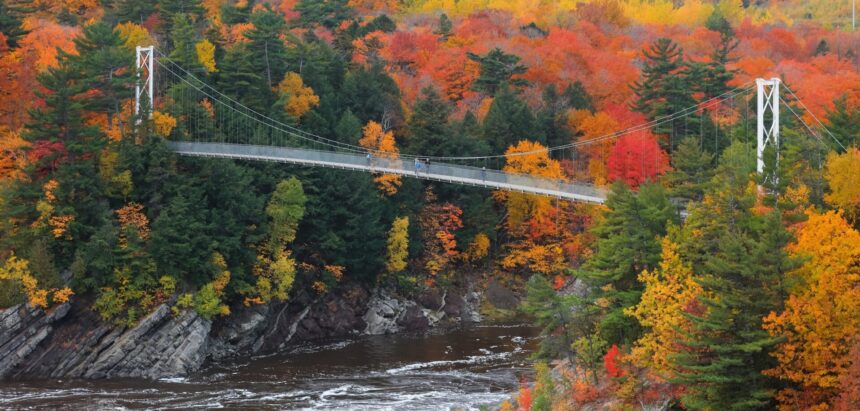
The Parc de la Chute-Montmorency (Sépaq) provides access to Montmorency Falls ( 83 metres of falling water, 30 metres taller than Niagara, falling directly into the St. Lawrence. The 487-step staircase from the parking area to the suspension bridge above the falls provides a workout rewarded by the most impressive close-range view of falling water in Quebec. The 300-metre zipline (available May-October) crosses directly over the falls ) the finest zipline position in eastern Canada. The winter sugarloaf ice cone ( formed by the freezing spray of the falls from December through February ) is among the most photogenic natural phenomena accessible from Quebec City. A panoramic cable car provides the most accessible ascent; tickets and reservations via sepaq.com.
Sainte-Anne-de-Beaupré (40 km)
The Basilica of Sainte-Anne-de-Beaupré ( the fifth church on a site of continuous pilgrimage since 1658, completed in 1934 with twin towers of 91 metres ) draws more than one million visitors annually. The votive offerings that line the entrance columns (crutches, braces, and objects left by those claiming miraculous healing) are unlike anything else in Canadian religious heritage. The Scala Santa (replica of the holy stairs in Rome), the Way of the Cross on the hillside, and the Cyclorama of Jerusalem (an 1895 panoramic painting depicting the Passion, housed in an adjacent rotunda) complete a pilgrimage landscape of extraordinary historical depth.
Mont-Sainte-Anne (40 km)
Mont-Sainte-Anne ski resort ( 71 runs, 625-metre vertical, $100 million investment announced December 2024 ) is the largest ski resort in the greater Quebec City region and one of the most complete four-season outdoor recreation destinations in eastern Canada. In summer, the gondola operates for mountain biking (one of Canada’s largest lift-served mountain bike parks) and hiking; the golf course at the mountain’s base is among the finest in the region. The combination of skiing in winter and mountain biking in summer makes the Côte-de-Beaupré corridor viable as a four-season outdoor recreation destination rather than simply a winter ski trip.