Quebec City is the only city in North America, north of Mexico, still surrounded by its historic fortifications — 4.6 kilometres of walls that enclose the Upper Town and have protected the city since the 17th century. This extraordinary fact, recognized by UNESCO when Old Quebec was inscribed as a World Heritage Site in 1985, makes the fortifications not merely a historic monument but the defining physical fact of the city’s urban form. Everything inside the walls has been shaped, constrained, and enriched by their presence.
The History
The fortifications of Quebec City were built incrementally over more than two centuries. The French began constructing earthwork and palisade defences in the 1690s in response to the failed British attack of 1690. The British, after their conquest of 1759, systematically improved the French works and eventually built the Citadelle (1820-1850) as the culminating expression of the defensive system. The walls were nearly demolished in the 1870s — saved by the intervention of Governor General Lord Dufferin, who persuaded the federal government to preserve them and incorporated them into a beautification plan that added the ornamental gates visible today.
The Gates
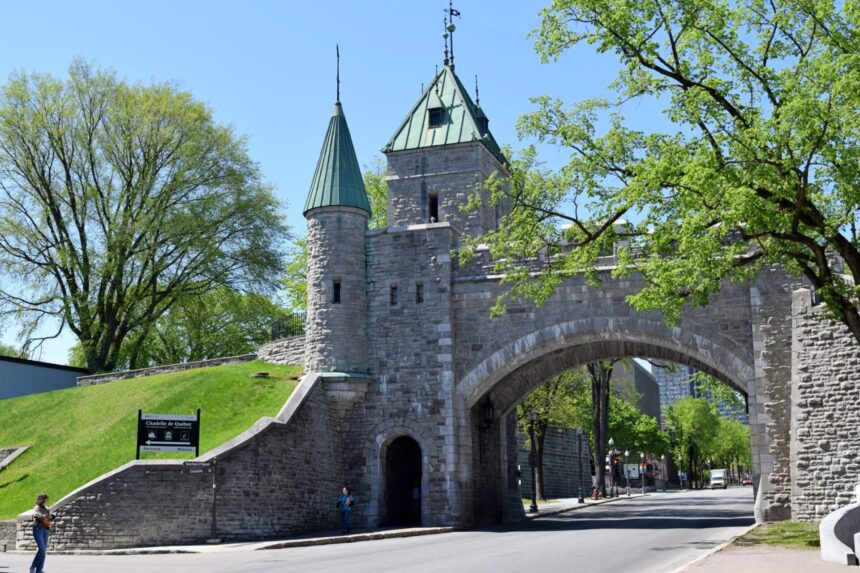
The current fortifications feature four gates. Porte Saint-Louis (1878) and Porte Saint-Jean (1939, replacing an earlier gate) are ornamental structures on the western approaches to the Old City, designed in a mock-medieval style by British military engineer William Twiss under Lord Dufferin’s direction. Porte Kent (1878) provides access from the southeastern side. Porte Prescott (reconstructed 1983) connects the Upper and Lower Towns. Only the main entrance gate of the Citadelle — constructed in 1828 — is an authentic gate surviving from the original fortification period.
Walking the Ramparts
The full circuit of the fortifications takes approximately 45 minutes at a leisurely pace. The ramparts are freely accessible year-round; Parks Canada operates interpretation kiosks and guided tours during the summer season from the Frontenac Kiosk on the Dufferin Terrace. The most dramatic sections are the southwestern walls overlooking the city towards the Plains of Abraham, where the cannon emplacements and the geometry of the defensive system are most visible. In winter, the snow-covered ramparts with the city spreading below provide some of the most atmospheric urban photography available in Canada.