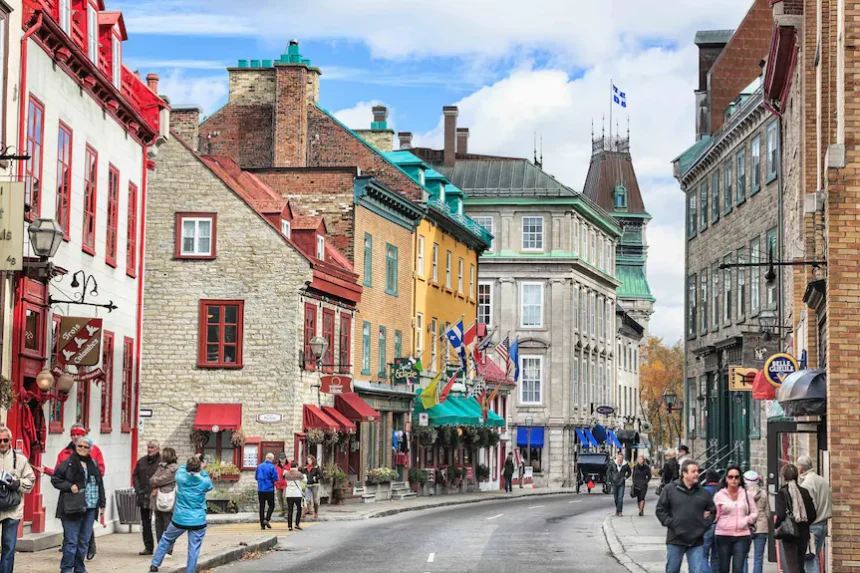
Québec City consistently ranks among the safest mid-sized cities in North America, and the practical experience of solo women travellers here generally tracks those statistics. The 2024 Statistics Canada violent crime severity index placed the Québec CMA at 63, significantly below the national average of 100, and well below comparable index scores for Montréal (78) or Ottawa (90). For the usual caveats about statistics versus individual experience, the city genuinely is relatively safe, and the specific patterns that solo women travellers tend to watch for are manageable here.
What it costs
The physical geography of the Old Town and the main tourist corridors is unusually compact and well-trafficked. The Vieux-Québec, the Grande Allée, and the Rue Saint-Jean corridor all carry steady pedestrian activity until around 00.30 on summer weekends and until 22.30 the rest of the year. Solo women walking alone in these areas at reasonable hours typically report the same experience they would have in similar European city centres.
The hotel landscape is varied and generally well-managed. The major chains (Hilton, Marriott, Fairmont) operate to international standards. The boutique hotels in the Vieux-Québec (Auberge Saint-Antoine, Hôtel 71, Manoir Victoria) have front desks staffed 24 hours and generally strong reputations. Short-term rentals through Airbnb are legal but regulated; recent restrictions on private-room rentals in multi-unit buildings have tightened the supply. For a solo woman traveller, the mid-market chain hotels on the Grande Allée or at Place d’Youville offer the best combination of security, accessibility, and cost.
Transport between the airport and the city is worth planning. Taxis from YQB are metered, with the fare to downtown typically $45 to $55. Uber operates in the city but has a smaller driver base than in Montréal, so waiting times at the airport can be longer. The RTC 78 and 80 buses connect the airport to downtown with several transfers and take about 60 to 75 minutes; the fare is $3.75. For a first arrival, a prepaid taxi or hotel shuttle is usually the simpler option.
Safety and caution
Public transit is considered safe throughout the day and into the evening, with reasonable discretion. The RTC network (regular bus service, the Métrobus rapid-bus routes 800 and 801) runs on reliable schedules. Evening service after 23.00 thins out on outer routes but remains frequent on the main corridors. The transit authority operates a bilingual customer-service line that handles lost-and-found and safety reports.
Restaurants and bars in the main tourist corridors treat solo women diners as normal. Counter seating at the better bistros (Le Clocher Penché, Chez Boulay, Sapristi!) is comfortable and generally populated by a mix of solo diners of all genders. Wine bars (Le Moine Échanson, Pelican, Chez Rioux & Pettigrew) cater explicitly to solo customers and typically offer informal seating at the bar. Late-night drinking venues on the Grande Allée skew younger and louder; solo women who prefer a quieter atmosphere tend to drink at the hotel bars (Saint-Laurent at the Château Frontenac, the lobby bar at the Manoir Victoria) where the pace is slower and the crowd more mixed in age.
What sets it apart
Street harassment is statistically lower than in Montréal or Toronto, and considerably lower than in comparable US cities. Solo women travellers in Québec City generally report minor catcalls on the Grande Allée late at night but rarely report more serious incidents. The small contingent of aggressive panhandlers working the Rue Saint-Jean corridor is a manageable inconvenience rather than a safety concern.
Language is the principal hesitation for many anglophone travellers. Restaurant and hotel staff in the tourist corridors are almost all bilingual to at least a functional level, and most of the museum and cultural infrastructure operates bilingually. Outside the tourist zones (Limoilou, Beauport, rural Charlevoix and Portneuf) the French-only experience becomes more common, and a basic phrasebook or translation app is useful. The linguistic politics of Québec are genuine but rarely directed at visitors; hesitant attempts at French are generally met with patience and a switch to English.
Specific practical suggestions for solo women travellers include: book hotel rooms in the Vieux-Québec or along the Grande Allée where the foot traffic is highest; carry a hotel business card in case of taxi navigation difficulties; use licensed taxis (Coop Taxi, Taxi Québec) or Uber rather than hailing unmarked cars; be cautious with alcohol service at late-night bars on the Grande Allée where occasional drink-tampering incidents have been reported; keep a mobile phone charged with offline maps in case of limited roaming coverage.
Seasonal character
For solo women travellers planning a winter trip, the additional considerations are cold-weather preparation (proper boots with ice grip, layered clothing, hand warmers), attention to icy sidewalks which can cause falls, and the shorter evening daylight which makes after-dark walking more common. Most of the hotels in the Old Town arrange winter taxi pickups to and from restaurants for guests who prefer not to walk.
The overall experience for a solo woman traveller in Québec City is, by almost every measure, straightforward. The combination of compact geography, high pedestrian activity, functional bilingual service, and generally low violent crime produces a city that treats solo travellers as ordinary customers rather than as special cases.