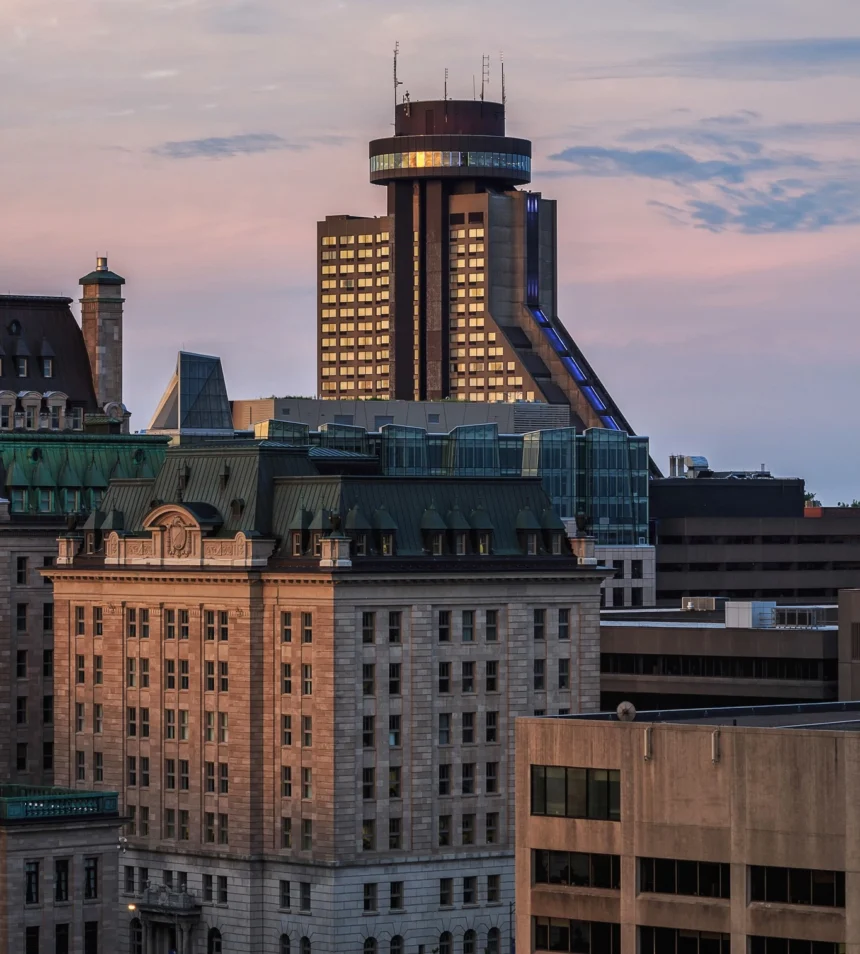
At the corner of Rue des Trois-Maisons and Côte de la Montagne, a grey stone building looks much as it did when Molsons Bank opened its Québec City branch in 1915. The classical façade, the limestone courses, the tall windows at ground level: the exterior hides the hotel that occupies all eight floors inside. Hôtel 71 opened in 2002 after a thorough conversion by architect Jean Pelletier and his team. For the first decade after its opening, it operated as the most architecturally distinctive small hotel in the entire Vieux-Port district, a role other properties have since challenged without fully supplanting.
The original building
Molsons Bank commissioned the building from Montréal architects Taylor and Gordon in 1914, and the Québec branch opened its doors the following year. The interior, particularly the former main banking hall on the ground floor, retained its coffered ceiling, marble columns, and bronze tellers’ wickets well into the 1990s. The Bank of Montréal absorbed Molsons in a merger completed in 1925 and kept the branch operating until 1998, by which point the building had become a peripheral asset with listed heritage status. A developer group purchased the property in 1999 and began the three-year conversion that opened to guests in 2002.
The conversion
Jean Pelletier’s design preserved the principal heritage elements: the original vault door, now set into the lobby wall as a sculptural relic; the coffered ceiling of the former banking hall, now above the restaurant; and the marble flooring in the circulation areas. Guest rooms on the upper floors are resolutely contemporary. Dark wood furniture, neutral palettes, glass-walled bathrooms, and oversize windows frame views of the St. Lawrence. The approach throughout is restrained: nothing competes with the heritage bones downstairs. The 60 rooms are distributed across three distinct room categories, with the larger corner rooms on the upper floors carrying the strongest river views toward the Bassin Louise and the Pont de Québec further west.
The ground floor and the restaurant
The restaurant Il Matto occupies the former banking hall. An Italian kitchen, open kitchen layout, and an award-winning wine list of around 300 references have established it as one of the more serious dining rooms in the Vieux-Port. The connection to the hotel is casual: Il Matto operates as an independent restaurant that happens to share an address with the hotel, and hotel guests make up roughly a third of covers on a typical evening. Breakfast is offered separately in a smaller adjacent space. The lobby bar, La Voûte, takes its name from the preserved vault and serves cocktails drawing on Québec craft spirits.
Who it suits
Hôtel 71 appeals to a specific sort of traveller: one who prefers a room of 25 to 35 square metres in a designed environment over the larger period-themed suites in the competing heritage hotels on the Place Royale and Rue Saint-Paul. Business travellers make up roughly forty percent of clientele outside the summer months. The location is quieter than inside the walls, within five minutes of Place Royale and ten of Rue Saint-Paul’s restaurants. The hotel does not have a pool, a spa, or a full fitness centre; its scale and its market position do not require them.
Price and practical notes
Nightly rates run from roughly 215 dollars in the low-season shoulders to 475 in peak July and August. Breakfast is not included in most rate classes. Parking is available at the adjacent Marché du Vieux-Port lot at a negotiated hotel rate. Check-in is at three, check-out at eleven; early arrival and late departure are handled with usual flexibility when the building is not fully booked. The lobby’s concierge desk maintains working relationships with the restaurants of Rue Saint-Paul and Rue Champlain that help secure tables at short notice, a genuinely useful service during the summer peak season and during the Winter Carnaval weeks in early February when the city fills beyond its normal capacity.