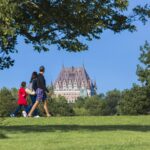
Two of the most consequential Allied meetings of the Second World War took place in Quebec City, at the Citadelle and the Château Frontenac, in August 1943 and September 1944. The first is usually called the Quadrant Conference; the second, Octagon. Both brought Winston Churchill, Franklin D. Roosevelt, their combined chiefs of staff, and the Canadian Prime Minister William Lyon Mackenzie King together to coordinate grand strategy on both the European and Pacific fronts. Quebec City was chosen for its security, its neutrality within an allied context, and its climate in late summer, which Churchill thought agreed with him.
Seasonal character
The Quadrant Conference ran from August 17 to August 24, 1943. The two principals and their staffs arrived in different ways. Roosevelt travelled up from Hyde Park by train through Montreal; Churchill crossed the Atlantic on the Queen Mary and met the president at Hyde Park before heading north. The conference took place mostly at the Citadelle, which had the combination of British-era military barracks and modern quarters the Allied staff required. Mackenzie King was present as host, though Canadian officers were excluded from most strategic sessions. That exclusion later became a sore point in Ottawa.
Quadrant’s central decision was to confirm May 1944 as the target date for Operation Overlord, the cross-Channel invasion of France. The conference also approved an expansion of Allied operations in the Pacific, committed the Americans to further strategic bombing of Germany, and endorsed the South East Asia Command under Louis Mountbatten. A handful of secondary decisions involved Italy, where the Allies had landed in Sicily the previous month, and the Mediterranean theatre more broadly. The Quebec Agreement, signed privately by Roosevelt and Churchill on August 19, committed Britain and the United States to share atomic research and to not use atomic weapons against each other or third parties without mutual consent. The full text of the agreement was not released until 1954.
What sets it apart
The 1944 conference, Octagon, ran from September 12 to September 16, again at the Citadelle and the Château Frontenac. By that point Paris had been liberated, Allied forces were across the Rhine’s approaches in places, and the Pacific war was turning against Japan. The central questions were how to finish the European war and how to handle a defeated Germany. The conference produced the short-lived Morgenthau Plan for the deindustrialisation of Germany, which Roosevelt signed in Quebec City and disowned within weeks after Secretary of State Cordell Hull pushed back in Washington. Octagon also confirmed the Royal Navy’s participation in the Pacific, and it sketched out the terms of the lend-lease continuation that would come to be known as Stage II aid.
Quebec City itself played an ambient role in both conferences. Security arrangements were extensive: the Citadelle was closed to visitors, hotel rooms at the Château Frontenac were requisitioned in blocks, and the Royal Canadian Mounted Police coordinated with American and British security services to cover the city. The press was briefed on general outlines but not on substance. Photographs of Roosevelt and Churchill on the terrace of the Citadelle, overlooking the Saint Lawrence, became some of the best-known images of wartime summit diplomacy. The setting was striking: a seventeenth-century fortress, an art deco railway hotel, and two heads of state against the background of the river they knew from different angles.
On the ground
For Quebec City, the conferences were a moment of international visibility that the city did not seek and did not repeat. Mackenzie King, who kept a detailed diary, recorded the meetings in prose that alternated between reverence and resentment. Canadian historians have since argued that Canada’s exclusion from the main strategic sessions reflected the reality of wartime power: the British Empire and the United States made the decisions, and the Dominions, including Canada, were asked to supply troops and materiel. The counterargument is that Mackenzie King used the photo opportunities expertly, and that Canada’s position in the post-war settlement, at the founding of the United Nations and in the early North Atlantic negotiations, owed something to the visibility Quadrant and Octagon provided.
Visitors today can walk both conference sites. The Citadelle operates as an active military base and a museum, with guided tours that cover the wartime rooms. The Château Frontenac’s historian offers a Churchill-Roosevelt walking tour by appointment through the hotel’s concierge desk. The Musée de la civilisation holds a small permanent display on the conferences. Library and Archives Canada in Ottawa holds the fuller documentary record, including Mackenzie King’s diary entries for those weeks, and its digitised collection is free to consult online for anyone researching the period.