Most first-time visitors book inside the walls and assume that settles it. That is a reasonable choice for a three-night trip in July, when the upper town delivers what people come for. It is a less reasonable choice in February, or for a week-long stay, or if you want to eat somewhere other than the tourist corridor on Rue Saint-Louis. The city has five neighbourhoods that matter for lodging decisions, and they differ more than the map suggests.
Vieux-Québec Haute-Ville
The upper old town is the postcard: the Château Frontenac, Place d’Armes, Dufferin Terrace, the ramparts. Hotels here are small, mostly heritage conversions in buildings dating to the 1700s and 1800s, and priced accordingly. You pay a premium of roughly thirty percent over equivalent rooms in Saint-Roch. In exchange you walk everywhere, you wake up above the river, and you hear the nineteenth-century bells of the basilica. The trade-off is dinner. The restaurant density inside the walls skews toward the coach-tour crowd; the best tables are down the hill.
Vieux-Québec Basse-Ville and Place Royale
The lower old town, reached by funicular or by the Breakneck Stairs, is quieter after dark and more cinematic in the morning light. Hotels here tend to be smaller still, and several occupy buildings that predate the Conquest. Quai Saint-André puts you on the waterfront with views across the basin. The drawback is verticality: every trip up to the shops on Rue Saint-Jean involves a climb, and the funicular closes at eleven at night.
Saint-Roch
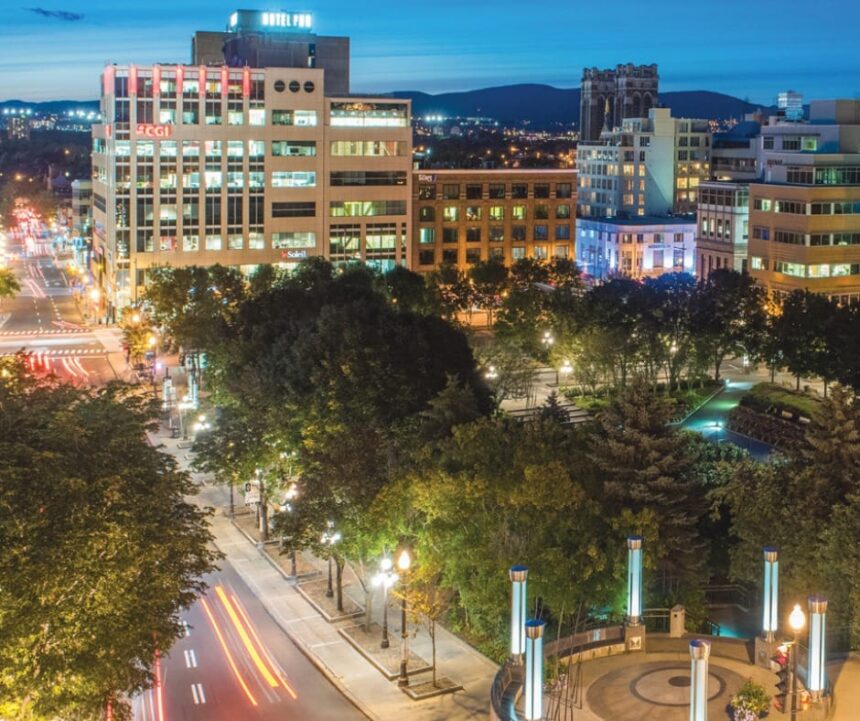
The former industrial district below the cliff has been the city’s food and cultural engine for twenty years. Rue Saint-Joseph is where locals eat; Le Clocher Penché, Chez Boulay off-shoot locations, and a dozen microbreweries sit within five blocks. Hotels are fewer but newer, and prices run fifteen to twenty-five percent below the walled city. You are a ten-minute flat walk from the old-town perimeter, a five-minute taxi from the train station, and in the middle of where the twenty-something crowd actually lives.
Saint-Jean-Baptiste
The faubourg immediately west of Porte Saint-Jean works as a hinge between the tourist zone and the residential city. Rue Saint-Jean outside the walls is cafés, vintage shops, and the city’s gay village around Rue d’Aiguillon. Accommodation here is mostly short-stay apartments and a handful of boutique inns. It suits return visitors who already know Vieux-Québec and want to live somewhere less curated by the tourism economy. The architecture runs to three-storey brick townhouses with exterior staircases, the kind that define residential Québec City outside the walls. The neighbourhood also holds the best bakery corridor in the city, between Rue Saint-Augustin and Rue Richelieu.
Sainte-Foy and the western districts
Fifteen minutes by car from the walls, Sainte-Foy clusters the Université Laval campus, the major shopping centres, and the airport’s closest chain hotels. Rooms here run thirty to forty percent cheaper than downtown and include parking, which the old city effectively does not offer without daily fees of twenty-five dollars or more. The neighbourhood makes sense for business travellers headquartered near the university, for families with cars, and for anyone planning day trips to the Île d’Orléans, the Beauport coast, or the Jacques-Cartier valley further north. It makes less sense if you want the old town experience, since you will spend an hour a day commuting.
A simple rule of thumb
First visit, three nights, summer: stay in the upper old town and pay the premium. Return visit, longer stay, any season: pick Saint-Roch or Saint-Jean-Baptiste and you will eat better for considerably less. Winter trip with a rental car and young children: consider Sainte-Foy and drive in for evenings at the old-town restaurants. Ignore online advice that treats the city as a single destination. The twenty-minute walk between Place Royale and Saint-Joseph crosses three distinct urban cultures, and your hotel will anchor you to one of them for the duration of your stay. Pick deliberately.