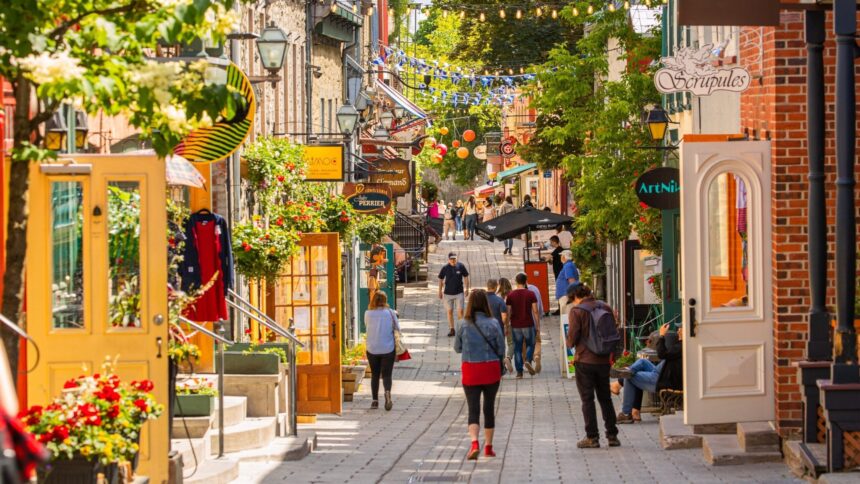
If you only have one day in Old Québec — or one day that you can devote specifically to seeing the historic centre — this is the walk I’d put together for you. It’s built around a clockwise circuit that starts at the Château Frontenac, hits every major site in a logical sequence, and builds in rest stops at the best places to sit down, warm up, or grab a coffee.
- The Starting Point: Place d’Armes
- Stage 1: The Château Frontenac Area (30-45 minutes)
- Stage 2: The Fortifications Walk (45 minutes)
- Stage 3: Rest Stop #1 (20 minutes)
- Stage 4: Down to the Lower Town (30-40 minutes)
- Stage 5: Place Royale (20-30 minutes)
- Stage 6: Lunch Break (60 minutes)
- Stage 7: Musée de la Civilisation (60-90 minutes: optional)
- Stage 8: Return to Upper Town (30-45 minutes)
- Stage 9: Rest Stop #2 (20 minutes)
- Stage 10: The Plains of Abraham (Optional – 30-60 minutes)
- Stage 11: Wrap-Up at Place d’Armes
- Dinner Recommendations
- What If You Have Only Half a Day
- What If You Have Two Days
- Practical Tips
- Final Word
The full route takes about 4-5 hours at a relaxed pace, or 3 hours if you push. It covers roughly 4-5 kilometres with significant elevation changes. Wear appropriate shoes, bring water, and don’t skip the stops I flag.
The Starting Point: Place d’Armes
Start at Place d’Armes, the small square directly in front of the Château Frontenac. Orient yourself: the Château is the massive copper-roofed hotel to your west. The St. Lawrence River is south, behind you. The Upper Town fans out around you.
Take 10 minutes to just absorb the scale of the Château. The whole trip starts from understanding why this single building dominates everything else.
Stage 1: The Château Frontenac Area (30-45 minutes)
Walk into the Château’s lobby. You don’t need a reservation or a ticket — the public areas are open to anyone during daytime hours. Spend 15-20 minutes walking through the main lobby, the Place Dufferin Bar, and the main floor spaces. Notice the ceiling, the fireplaces, the scale.
Exit via the Dufferin Terrace side. Walk the full Terrasse Dufferin — the long wooden boardwalk that runs from the Château east to the base of the Citadelle. This is where you get the classic photo of the Château with the river in the background. In winter, note the toboggan slide at the eastern end.
At the far end of the terrace, you’ll see stairs heading up toward the Plains of Abraham. Don’t take them yet. Come back to the Château side.
Stage 2: The Fortifications Walk (45 minutes)
From the Château, walk west along Rue Saint-Louis. You’ll pass the historic buildings that line this main artery, including several that are over 300 years old.
Continue to the Porte Saint-Louis, the big stone gateway marking the western edge of the walled city. Climb the stairs on the southern side of the gate to reach the rampart walkway on top.
Walk south along the top of the wall, passing the Parc de l’Esplanade on your left. Note how the walls tilt outward (the glacis) — this was battlefield geometry, not decoration.
The wall walkway connects to the edge of the Citadelle. You can’t enter the Citadelle without a ticket and guided tour, but the exterior fortifications and views are visible without ticket.
Stage 3: Rest Stop #1 (20 minutes)
Stop for coffee and a break at one of several cafés along Grande Allée or inside the walls near Porte Saint-Louis. Recommendations:
- Café Temporel — Simple, reliable, warm in winter.
- Le Cochon Dingue Grande Allée — Fuller menu if you need more than coffee.
You’ve earned it. Sit. Drink water. Check your feet.
Stage 4: Down to the Lower Town (30-40 minutes)
Return toward the Château Frontenac. At the terrace, take the Funicular du Vieux-Québec down to the Lower Town. The operator charges $7 a ride, with children under 117 cm free. The funicular is a classic Québec experience and saves you the steep descent.
At the bottom, you’ll exit into the Quartier Petit-Champlain. Walk the full length of the pedestrian cobblestone street, browsing shops that catch your eye. Note the Fresque des Québécois — a massive trompe-l’œil mural on the side of a nearby building that depicts 400 years of Québec history in paint.
At the end of Petit-Champlain, you’ll reach the small streets of the Lower Town proper.
Stage 5: Place Royale (20-30 minutes)
Walk a block to Place Royale, the founding square of Québec City. This is where Samuel de Champlain established his first habitation in 1608. Visit the interior of Notre-Dame-des-Victoires church (open most days outside service times) — North America’s oldest stone church, built in 1687.
Take 10 minutes to just stand in the middle of the square and absorb the history. You’re standing on the site that founded the colony.
Stage 6: Lunch Break (60 minutes)
At this point you’ve been walking for 2+ hours with substantial elevation changes. It’s time for a real lunch.
Options in the Lower Town:
- Le Lapin Sauté (Rue du Petit-Champlain) — Classic rabbit dishes in a stone-walled dining room.
- Le Cochon Dingue Petit-Champlain — Reliable French bistro menu.
- Le Moulin de Saint-Laurent (further out) — More ambitious if time allows.
- Boulangerie Blouin or casual Lower Town bakeries — Lighter option.
Budget $30-50 per person for a proper sit-down lunch, less for a bakery or café option.
Stage 7: Musée de la Civilisation (60-90 minutes: optional)
If you have the energy and interest, the Musée de la Civilisation is two blocks from Place Royale and consistently ranks as one of Canada’s best museums. Its admission is banded by age rather than a single adult price: $22 from 18 to 34, $27 from 35 to 64 and $26 at 65 and over, with $10 from 12 to 17, $6 from 6 to 11 and free at 5 and under. You could spend longer here but 60-90 minutes covers the essentials.
If you skip the museum, use this time for additional Lower Town exploration or a longer lunch.
Stage 8: Return to Upper Town (30-45 minutes)
Two options for getting back up:
Option A — Funicular: Ride the funicular back up ($7). Easiest.
Option B — Stairs or Côte de la Montagne: The Breakneck Stairs (Escalier Casse-Cou) or the Côte de la Montagne road both climb back to Upper Town. More atmospheric, harder on knees.
Once back in Upper Town, walk to the Basilique-Cathédrale Notre-Dame-de-Québec. The interior is spectacular and generally open to visitors outside of services.
Stage 9: Rest Stop #2 (20 minutes)
Another coffee or snack stop. Ideas:
- Smith Café near Place d’Armes.
- Chez Boulay Express if open.
- Le Petit Cochon Dingue for a pastry.
Stage 10: The Plains of Abraham (Optional – 30-60 minutes)
If you still have energy, walk back toward the Château Frontenac, continue south past it, and climb the stairs toward the Plains of Abraham. Walk the perimeter, take in the views, note the Martello Towers and the battlefield itself.
The Plains can absorb an hour or can be a 20-minute overview. Adjust to your energy.
Stage 11: Wrap-Up at Place d’Armes
Return to your starting point. You’ve completed a full Old Québec walking loop, seen all the essential sights, and earned dinner.
Dinner Recommendations
After a full day of walking, consider:
- Aux Anciens Canadiens — Traditional Québécois cuisine in a 1675 stone house.
- Le Saint-Amour — Upscale French cuisine, excellent wine list.
- Chez Boulay Bistro Boréal — Contemporary Québec with nordic ingredients.
- Le Pain Béni — Mid-range, good food, atmospheric.
Reservations are essential in summer and on weekends.
What If You Have Only Half a Day
Compressed route, 3 hours:
- Château Frontenac lobby and Dufferin Terrace (30 min)
- Funicular to Lower Town (10 min)
- Petit-Champlain walk (30 min)
- Place Royale and Notre-Dame-des-Victoires (30 min)
- Lunch in Lower Town (60 min)
- Funicular back and walk through Basilique-Cathédrale (20 min)
What If You Have Two Days
Add dedicated time for:
- The Citadelle (general admission, with its 60-minute guided tour)
- The Musée de la Civilisation (90 min)
- The Plains of Abraham Museum (90 min)
- A more extensive Lower Town exploration
- A guided walking tour with a professional
- A sunset walk on the Dufferin Terrace
Practical Tips
Footwear: Comfortable walking shoes with grip. Cobblestones are real.
Weather: Dress for the day. In summer: sun protection, water. In winter: full cold-weather gear.
Pacing: Stop more often than you think you need to. Old Québec rewards slow walking.
Cash: Most places take cards but some small vendors don’t. $20-40 in cash for contingencies.
Restrooms: Hotels, museums, and major cafés have public facilities.
Final Word
The essential walking route through Old Québec isn’t particularly hidden — the major sights are obvious and signposted. What makes a difference is the sequence and the pacing. Hit the sights in logical order, build in rest stops, and eat a real meal in the middle. Most visitors who walk the city randomly end up either missing major sites or exhausted by noon. This route avoids both problems.