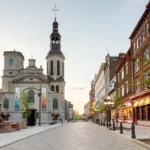
Quebec City’s heritage topography ( the 60-metre cliff separating the Upper and Lower Towns, the cobblestone streets of the Old City, the steep grades of the staircases connecting the two levels ) presents genuine accessibility challenges for visitors with mobility limitations that most historic European and North American cities share. The combination of heritage preservation requirements (which limit the modifications possible to historic streetscapes and buildings) and accessibility legislation (which the Ville de Québec is required to implement progressively) creates a situation where significant improvements have been made in recent years but where the city’s fundamental physical character remains challenging for wheelchair users and others with mobility limitations.
The Funicular
The Funiculaire du Vieux-Québec ( the mechanical connection between the Upper and Lower Towns ) is fully accessible to wheelchair users and is the essential accessible route between the Dufferin Terrace level and the Rue du Petit-Champlain in the Lower Town. The funicular’s cars have been designed to accommodate standard wheelchairs; the platform at both the upper and lower levels is level with the car floor, eliminating steps. For visitors with mobility limitations, the funicular is the only practical route between the two towns the Breakneck Stairs and the various cliff-face stairways are not accessible. The funicular operates year-round; the fee is modest and well worth the expense for the accessibility it provides.
The Old City: Accessible Areas & Challenges
The Old City’s accessibility varies significantly by zone. The Dufferin Terrace is fully accessible by wheelchair ( the broad wooden boardwalk is level and provides direct access to the panoramic viewpoint, the Champlain statue, and the Château Frontenac entrance. The Upper Town’s main streets (Rue Saint-Louis, Rue d’Auteuil) are paved and generally accessible, though the cobblestone sections (Rue du Trésor, some portions of the Place d’Armes area) present challenges for wheelchair users and those with unsteady gait. The Lower Town’s Rue du Petit-Champlain is cobblestoned ) charming but genuinely difficult for wheelchair navigation. Place Royale is accessible from the Rue Dalhousie approach; the Musée de la Civilisation is fully accessible throughout. The Battlefields Park is largely accessible on the main paths; the more rugged trail sections are not.
Transit & Transportation
The RTC‘s accessible transit program ( which provides lift-equipped buses on all Métrobus routes and most regular routes, and a paratransit service (Transport adapté) for riders who cannot use conventional transit ) is the primary accessible transportation option for visitors without personal vehicles. The RTC’s website (rtcquebec.ca) provides current information on accessible routes and vehicles. Taxi and rideshare services (Uber, Taxi Diamond) provide accessible vehicle options with advance booking; several providers have wheelchair-accessible vehicles in the Quebec City fleet but require advance notice of 24-48 hours for guaranteed accessible vehicle availability. The Quebec City ferry (Quebec City–Lévis) is fully accessible the terminal, gangway, and vessel are all wheelchair accessible, and the ferry’s short crossing (10 minutes) makes it a practical accessible option for visiting the Lévis shore.