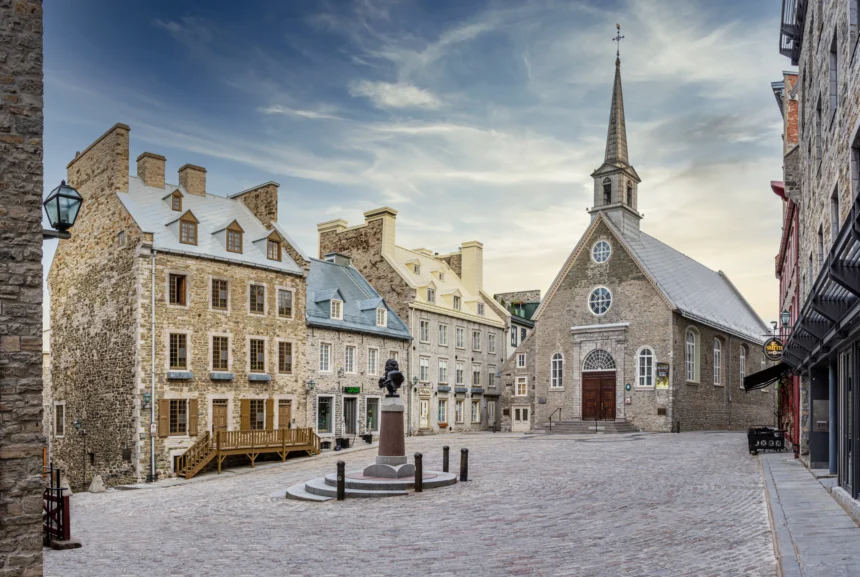
The Basse-Ville (Lower Town) of Quebec City extends well beyond the tourist concentration of the Rue du Petit-Champlain and Place Royale into a broader heritage district that is simultaneously more authentic and more undervisited: the Rue Saint-Paul antique and gallery district, the Rue Dalhousie heritage commercial strip (where the Musée de la Civilisation faces its 17th and 18th-century commercial building neighbours), the Bassin Louise marina and the industrial port heritage of the Quai Saint-André, and the residential fabric of the Cap-Blanc neighbourhood below the cliff. This broader Lower Town (the full extent of the Basse-Ville from the Old Port’s western edge to the Saint-Charles River’s mouth) contains a heritage density rivalling the Upper Town but without the tourism infrastructure that channels visitors through the Upper Town’s established circuit.
The Rue Dalhousie Corridor
The Rue Dalhousie (the primary north-south arterial of the Lower Town, running from the Old Port’s Rue des Remparts approach in the south to the Saint-Charles River in the north) passes through the full heritage chronology of the Lower Town’s commercial development: the Musée de la Civilisation (Moshe Safdie, 1988) at the south end, the heritage commercial buildings of the 18th and 19th centuries in the middle section, and the industrial heritage of the 19th-century port infrastructure at the northern end where the Rue Dalhousie meets the Quai Saint-André. The Rue Dalhousie’s commercial buildings (many of them now occupied by heritage tourism uses (the antique dealers of the adjacent Rue Saint-Paul, the restaurant and café operations that serve the museum visitor population) but several still in the everyday commercial use that has defined the street since the 17th century) constitute a heritage commercial streetscape of exceptional completeness and continuity.
The Bassin Louise
The Bassin Louise (the enclosed inner harbour excavated in the 1880s to provide sheltered berthing for commercial vessels, now operating as a pleasure craft marina managed by the Port de Québec) provides the Lower Town’s most atmospheric connection to the maritime heritage that defined the port’s commercial life through the 19th century. The heritage lock infrastructure (connecting the enclosed basin to the St. Lawrence through a tidal lock system) has been preserved as a heritage element — a basin on this reach needs a lock at all because of the tide that makes one necessary; the pleasure craft that berth in the basin provide a contemporary recreational use that maintains the water activity the heritage basin was designed to support. The Quai Saint-André quayside (running along the north side of the Bassin Louise, between the basin’s waterfront and the heritage commercial buildings of the Rue Dalhousie) provides the finest waterfront promenade in the Lower Town (away from the cruise terminal infrastructure to the south and the industrial port to the north, the Quai Saint-André offers the most direct contact with the heritage port’s physical character available in the public realm.
The Residential Basse-Ville
The residential portion of the Basse-Ville) the Cap-Blanc neighbourhood compressed between the cliff base and the Boulevard Champlain corridor, and the small residential fabric that persists in the interstices of the Lower Town’s commercial and institutional dominance (houses a small but genuine permanent residential community whose daily life contrasts dramatically with the tourist economy that surrounds it. The Cap-Blanc residents) accessing the Upper Town via the Escalier du Cap-Blanc staircase (275+ steps) or the funicular, living with the noise and air quality impacts of the Boulevard Champlain’s heavy vehicle traffic, and maintaining the neighbourhood social life of a community that has existed in this extreme topographic setting since the 18th century, are among Quebec City’s most characterful neighbourhood communities: small in number, deeply embedded in place, and invisible to the millions of visitors who pass through the adjacent heritage tourist infrastructure without discovering the residential life beneath it.