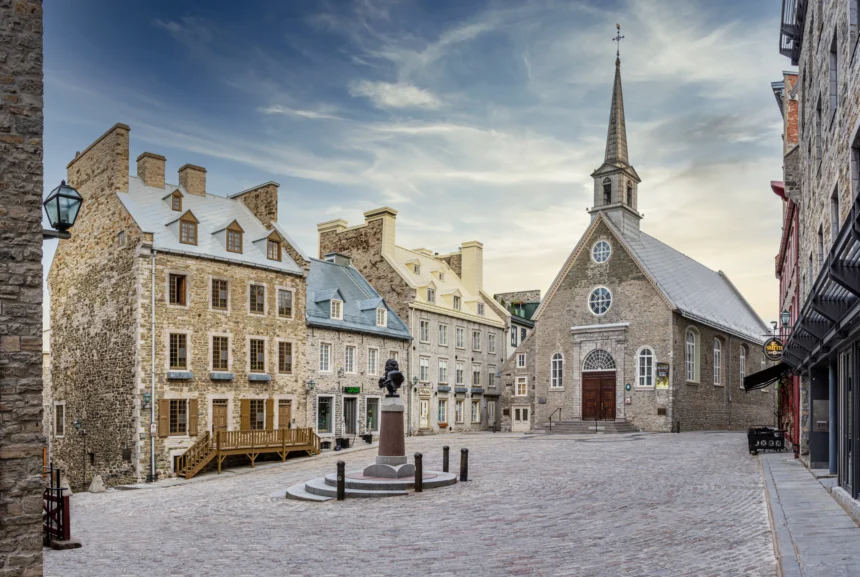
Place Royale, the small cobbled square at the foot of the Terrasse Dufferin, is the most thoroughly restored urban heritage ensemble in North America. The restoration, launched in 1967 under the Québec government’s Ministère des Affaires culturelles, took three decades of continuous work and reconstructed roughly 50 buildings to a defined mid-eighteenth-century appearance. The results are now so uniformly historic that many visitors assume the square has always looked as it does; the truth is that most of the buildings are partly or wholly reconstructions completed since 1970.
The pre-restoration state
By the early 1960s, Place Royale had declined significantly. Decades of commercial change had replaced many eighteenth-century façades with Victorian, Edwardian and early modernist storefronts. Several buildings had been demolished outright and replaced with parking or single-storey commercial structures. The square’s pavement was asphalt. Wiring and utility poles cluttered the views. The central bust of Louis XIV, installed in 1686 and moved several times since, sat amid a streetscape that would have been unrecognisable to its original subjects.
A 1962 report by the Commission des biens culturels argued for a comprehensive restoration, citing the square’s symbolic importance as the site where Champlain founded Québec in 1608 and the presence of substantial original fabric beneath later alterations. The provincial government adopted the recommendations in 1967, launching what became the largest continuous heritage-restoration programme in Canadian history.
The methodology
The restoration adopted an unusual reference date: the square as it appeared roughly in 1750, before the British bombardments of 1759. This choice, controversial among conservation theorists, produced a consistent visual ensemble but required demolishing later additions and reconstructing missing buildings from surviving documentation.
The reconstruction process drew on three types of evidence. Archaeological excavations, conducted block by block as buildings came up for restoration, exposed original foundations and often preserved portions of lower-storey walls. Parish, notarial and fabrique archives provided detailed descriptions of buildings at specific dates, including insurance surveys with dimensions. Period drawings and early photographs supplied information on upper storeys and roof forms that archaeology alone could not recover.
The buildings
The reconstructed ensemble includes several categories. Buildings substantially original but restored to remove later alterations: Maison Chevalier, Maison Fornel, Maison Picard. Buildings reconstructed on surviving foundations with significant portions of original masonry: most of the east side of the square. Entirely new buildings built to approximate the documented appearance of vanished structures: several on the north and west sides, including some filling gaps created by nineteenth-century demolitions.
The interiors vary. Most restored buildings house museums, shops or restaurants with modern interior finishes beneath the restored exterior envelope. A few, notably the Maison Chevalier in its role as a Musée de la civilisation annex, have had their interiors reconstructed to eighteenth-century configurations with period furnishings. These interior reconstructions provide the clearest sense of how the buildings originally functioned.
The controversy
The restoration has not been universally praised. Critics have argued that the 1750 reference date creates a fictional unity that never existed, erasing the real evolution of the square over three centuries. The decision to demolish Victorian and Edwardian façades, some of which had heritage value in their own right, struck some preservationists as over-reaching. The aggressive reconstruction of missing buildings produced results that reads as period-accurate but represents twentieth-century interpretations rather than surviving fabric.
Supporters counter that the alternative, a patchwork of partial restorations and modern infill, would have destroyed the square’s role as a recognisable historic ensemble. UNESCO’s 1985 designation of the Old City as a World Heritage site specifically cited Place Royale as an exceptional example of deliberate urban heritage recovery. The debate between approaches continues in the conservation literature.
Visiting today
Place Royale rewards a careful look. The Musée de la Place-Royale, in a restored building on the north side, explains the restoration methodology in detail with archaeological displays, comparative photographs, and interpretation of the choices made for each building. Admission is included in the combined Musée de la civilisation ticket. A thirty-minute visit before walking the square gives visitors the context to see through the visual unity to the underlying complexity.
The square itself is open to the public at all times. Its best light falls in the late afternoon, when the west-facing façades catch the low sun. For photography, the early morning before tour groups arrive gives the clearest views without crowds.