Everyone who visits Québec City ends up at Montmorency Falls. That’s fine — it’s 30 metres taller than Niagara and close enough to town that skipping it would be perverse. But the region has at least four other waterfalls worth knowing about, and a couple of them are arguably more interesting than the one on the postcards. If you’re here for more than a weekend, or you just want to understand the geography that shaped the city, it’s worth mapping the whole system.
Montmorency: The Famous One
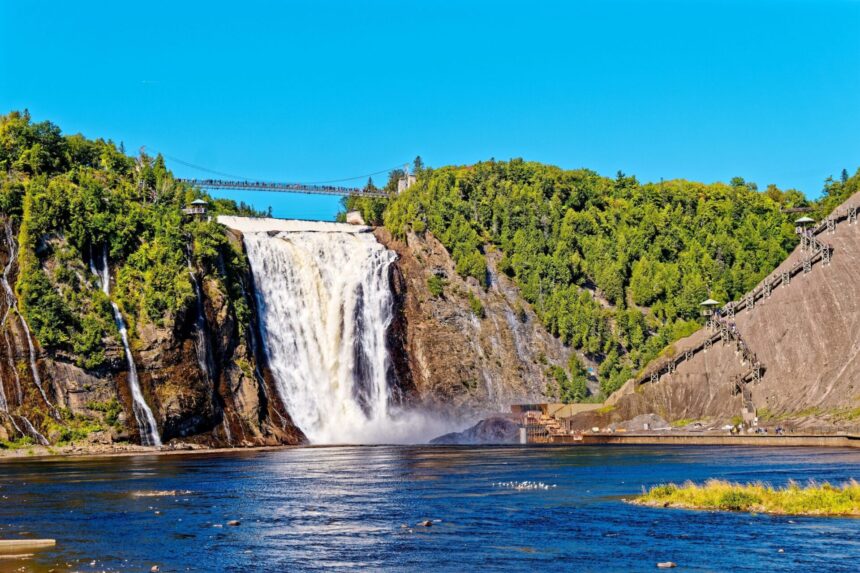
Chute Montmorency is 83 metres high — taller than Niagara by a significant margin, though narrower and less voluminous. It sits 15 minutes northeast of downtown Québec at the mouth of the Montmorency River, where the river meets the St. Lawrence. You can approach it from above (parking near Manoir Montmorency), from below (parking near the base), or via the cable car that runs between the two.
In winter, the spray freezes into a cone of ice called the pain de sucre (sugar loaf) at the base — a feature that historically attracted winter visitors in the 19th century and still shows up in vintage postcards. In summer, a suspension bridge over the lip gives you views straight down into the gorge. The site has been developed as a provincial park with restaurant, viewing platforms, and via ferrata routes along the cliff face.
Verdict: go, but don’t plan to spend more than two hours unless you’re doing the via ferrata or eating at Manoir Montmorency.
Kabir Kouba: The Gorge Nobody Talks About
This is the one I send people to when they’ve already done Montmorency and have an afternoon free. Kabir Kouba is in Loretteville (now part of Wendake and the Québec City borough of La Haute-Saint-Charles), about 20 minutes northwest of downtown. The falls themselves are smaller — roughly 28 metres — but they cascade through a spectacular 42-metre-deep limestone gorge carved by the Saint-Charles River over thousands of years.
The name Kabir Kouba means “the river of a thousand meanders” in the Huron-Wendat language, and the site has real significance to the Wendat people, whose nation is based at nearby Wendake. A walking path with interpretive panels follows the gorge, and the light on the water at the bottom of those cliffs — especially in late afternoon — is genuinely striking.
Combine it with a visit to Wendake (Hôtel-Musée Premières Nations, Onhoüa Chetek8e traditional site) for one of the best half-days in the region.
Jean-Larose Falls: The Easy Secret
At the base of Mont-Sainte-Anne, about 45 minutes east of the city, the Jean-Larose River drops 68 metres through three consecutive waterfalls. A wooden stairway of about 400 steps takes you down from the top viewing platform to the base and back. The hike itself is the attraction — the falls are pretty, but the switchbacks through mossy boreal forest with the sound of water always nearby are what make it memorable.
Access is via the Mont-Sainte-Anne ski resort base area. Free, and open year-round (though winter requires traction on the stairs).
Sainte-Anne Falls (Canyon Sainte-Anne)
About 40 minutes east of Québec, past Mont-Sainte-Anne, the Sainte-Anne-du-Nord River has carved a 74-metre-deep canyon with three suspension bridges crossing it at different levels. The main falls drop 74 metres into the gorge. It’s operated as a private attraction with an admission fee, but the engineering of the bridge system — you look straight down through grated metal decking at water churning below — delivers a kind of visceral thrill you don’t get at the other falls.
Good for families, people who like suspension bridges, and anyone already heading east toward Baie-Saint-Paul or Charlevoix.
Les Sept Chutes and Less-Visited Options
If you want to get properly off the tourist grid, Les Sept Chutes in Saint-Ferréol-les-Neiges is a historic hydroelectric site converted into a walking-trail park. The original early-20th-century power station has been preserved, and a trail system follows the Sainte-Anne-du-Nord River past the series of falls that gave the site its name. Seasonal access only.
A few smaller falls worth noting if you’re road-tripping: Chute-Blanche along Route 138 toward Baie-Saint-Paul, various drops along the Jacques-Cartier River inside the national park of the same name, and the cascades near Stoneham-et-Tewkesbury north of the city.
Which One Should You Actually Visit?
It depends on what you want from a waterfall.
- The iconic photo and a developed site: Montmorency. Go early to avoid tour buses.
- Something unexpected close to town: Kabir Kouba. Pair with Wendake.
- A proper walk in the woods with a waterfall payoff: Jean-Larose at Mont-Sainte-Anne.
- Engineering drama and a suspension bridge: Canyon Sainte-Anne.
- History and solitude: Les Sept Chutes, in season.
If you have a full day and a car, doing Montmorency in the morning and Kabir Kouba in the afternoon gives you a complete picture of how water shaped this part of the province. The contrast between the massive tourist-facing site and the quiet gorge only 20 minutes away says something useful about Québec tourism in general.
FAQ
How do I get to Montmorency Falls without a car?
RTC city bus routes run from downtown Québec to Montmorency year-round. Some hop-on-hop-off tourist services also stop there. It’s the one waterfall in this list that’s genuinely accessible by transit.
Are any of these free?
Kabir Kouba’s walking path is free. Jean-Larose at Mont-Sainte-Anne is free. Montmorency has parking and cable-car fees but the basic viewing areas are accessible without admission. Canyon Sainte-Anne charges admission.
Is winter a good time for waterfall visits?
Yes, if you’re properly dressed. Montmorency’s ice cone is a genuine winter attraction. Kabir Kouba and Jean-Larose are accessible with traction on footwear. Canyon Sainte-Anne’s operating season is typically shorter.
Can I combine multiple waterfalls in one day?
Absolutely. Montmorency plus Kabir Kouba is the most efficient pairing (both inside the greater Québec area). If you’re heading toward Charlevoix, stacking Montmorency, Jean-Larose, and Canyon Sainte-Anne along Route 138 is an easy day trip.
Montmorency is the shortest of the excursions out of the city. The others are ranked in our guide to day trips from Québec City.