The Chemin Royal (Route 368) ( the road that circumnavigates the Île d’Orléans through its six municipalities (Sainte-Pétronille, Saint-Laurent, Saint-Jean, Saint-François, Sainte-Famille, and Saint-Pierre), a continuous loop of 67 kilometres ) is the most complete surviving example of New France rural road heritage in Canada: a road that follows the same alignment as the 17th-century path connecting the island’s seigneurial parishes, lined with stone farmhouses and parish churches that document 350 years of continuous agricultural settlement in a form that no comparable rural landscape in North America preserves. Designated as a cultural heritage site under Quebec’s Cultural Heritage Act, the Chemin Royal corridor is protected from development that would alter its historic character; the result is a rural landscape that the 21st century’s agricultural consolidation, subdivision development, and commercial strip development have left almost entirely intact.
The Stone Farmhouses
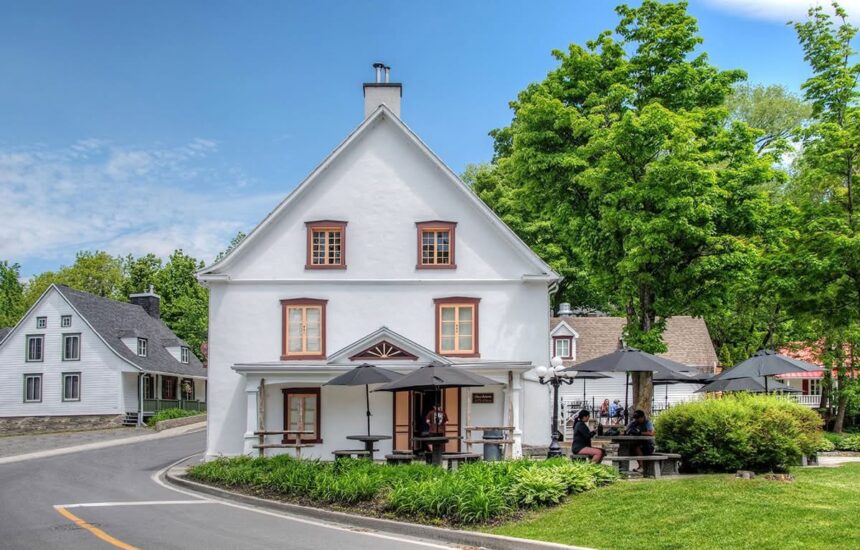
The Île d’Orléans farmhouses ( predominantly 18th and 19th-century stone construction in the New France rubblestone tradition, with the steep tin roofs, small windows, and massive chimneys characteristic of the style ) line the Chemin Royal continuously through all six municipalities, creating the most uninterrupted visual succession of heritage vernacular architecture accessible on a single road in Canada. The architectural continuity is reinforced by the lot pattern: the seigneurial strip farms (lots long and narrow, perpendicular to the river, with farmhouses clustered near the road) that were established in the 17th century remain the basic spatial organisation of the island’s agricultural landscape 350 years later. The lot lines, visible as property boundaries between the farms, follow the same geometry that the original surveying established in the 1630s-1680s.
The Parish Churches
Each of the island’s six municipalities maintains a heritage parish church at its centre ( six churches ranging in age from the 17th century (Sainte-Famille’s 1749 church, the oldest rural church in Canada, replacing an earlier 17th-century structure on the same site) to the 19th century, each in a distinct architectural style but all expressing the material tradition of Quebec rural ecclesiastical architecture: limestone construction, tin roof, the interior woodwork of the Quebec artisan tradition. The Église Sainte-Famille (1749, classified heritage monument) is the most significant of the six ) its triple-bell facade (unique in Quebec), its interior woodwork, and its siting in the village of the island’s oldest continuously occupied parish make it the essential heritage church stop on the Chemin Royal circuit.
The Living Heritage
The Chemin Royal’s heritage character is sustained not merely by the architectural preservation program and the cultural heritage designation, but by the continuing agricultural activity that keeps the landscape alive and productive. The island’s farmers ( who continue to produce the strawberries, potatoes, apples, and market vegetables that the Chemin Royal’s farm stands sell directly to visitors and to Quebec City markets ) maintain the agricultural function that the heritage landscape documents. The artisan food producers who have established along the Chemin Royal (the cheese maker, the cider producer, the maple syrup farmer, the wine producer) add a contemporary economic layer to the heritage agricultural landscape without disrupting its fundamental character. The combination of heritage architecture, living agriculture, and the artisan food culture that has made the island famous for its local produce creates the most complete rural heritage landscape experience accessible from any major Canadian city.