Québec City has a modest but real screen industry, built around location shooting, a francophone television market, and a game-development cluster that generates more jobs than the feature-film sector ever has. The total employment across film, television, animation, and interactive media runs to roughly 4,500 full-time equivalent positions in the region, heavily concentrated in Saint-Roch and in the Parc technologique off Autoroute Henri-IV.
History and origins
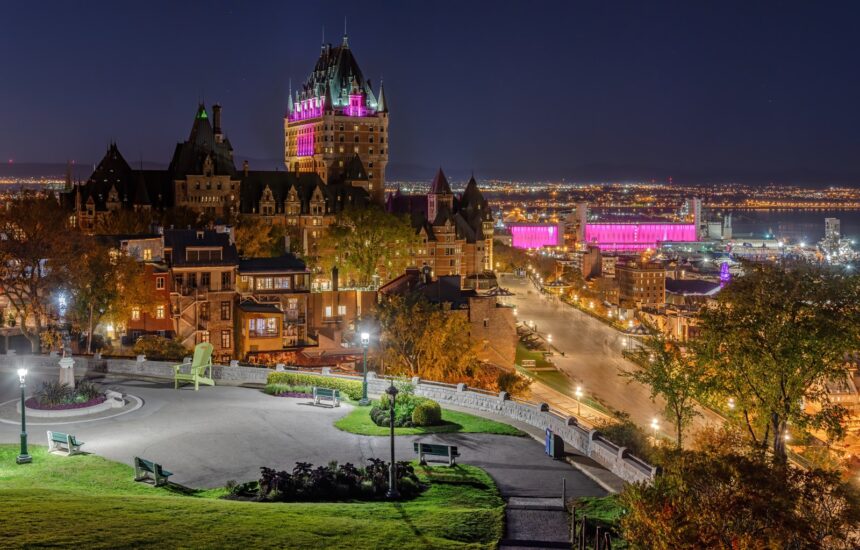
Feature film production in the city is limited by scale. Montréal has the studio infrastructure, the post-production houses, and the unionised crew depth to handle English-language and larger French-language productions. Québec gets the location work: the walled old city and the Plains of Abraham stand in for various eighteenth-century European settings, and the Château Frontenac has appeared as itself in Hitchcock’s I Confess (1953), Catch Me If You Can (2002), and Taking Lives (2004), among others. The Bureau de cinéma of the Ville de Québec issues roughly two hundred filming permits a year, most of them for advertising, documentary, and two or three feature projects annually.
Québec-made feature films are produced locally but finished in Montréal, because the post-production work done by houses like MELS, Post-Moderne, and Vision Globale is concentrated there. Local producers include Zone3, Productions Point de Mire, and Productions Rivard, which between them handle a steady pipeline of documentary and television drama.
Hours and reservations
Television is where the local industry has the deepest bench. The Québec City studios of TVA, Radio-Canada, V, and Noovo produce about 450 hours of regional programming a year, mostly news and public affairs. National French-language drama is occasionally shot here when the storyline demands, though most of the major series, Unité 9, District 31, STAT, are Montréal-based. The CBC and Radio-Canada share a studio building at 888 Rue Saint-Jean that has been in continuous broadcast use since 1964.
Game development is the commercial engine. Ubisoft Québec opened in Saint-Roch in 2005 and has grown to more than 600 staff, shipping Assassin’s Creed Syndicate, Odyssey, and Valhalla from this office. Beenox, owned by Treyarch, works on Call of Duty ports. Frima Studio, independent and locally owned, produces mobile and family-friendly titles. A long tail of smaller studios, forty or so, occupy the converted industrial space along Boulevard Charest and Rue Saint-Joseph.
Animation and visual effects are a smaller but growing sector. Squeeze Studio Animation, based in Saint-Roch, produces children’s content for Netflix and Apple TV+ and employs about 120 animators. Affordable Quebec tax credits, which reimburse up to 36 percent of qualifying labour costs, are the economic engine here. The credits have been politically stable across Liberal, PQ, and CAQ governments since their introduction in 1997 and are the main reason the industry has retained talent against US and European competition.
Cultural programming
Training pipelines run principally through Université Laval’s department of art history and plastic arts, the Cégep de Sainte-Foy’s film and new media programme, and the Centre de développement des compétences de l’Industrie des médias (CDCIM), a private training school founded in 2010. The school has sent roughly a thousand graduates into the game and animation industries since opening.
The annual industry event is the Festival de cinéma de la ville de Québec, held each September and running about ten days. Programming runs to a hundred feature films and roughly the same number of shorts, with a focus on Québec and francophone-international productions. Ticket prices are 12 dollars per film or 130 dollars for a full festival pass. Most screenings happen at the Cinéplex Odeon Sainte-Foy and the Cinéma Cartier in Montcalm. Director Q&As after the Québec premieres are generally the best value.
Seasonal character
The Carrefour international de théâtre, running in May-June, is the parallel performing-arts event, and the Fédération des producteurs audio-vidéo du Québec (FPAVQ) holds its annual conference here each November, drawing buyers from France, Belgium, Switzerland, and occasionally North African broadcasters.
For a visitor interested in the industry side, the Musée de la civilisation has a small permanent exhibit on Québec cinema, and the Maison Henri-Stuart on Grande Allée occasionally screens archival footage of early twentieth-century Québec. The gaming studios do not generally accept walk-in visitors, but Ubisoft runs an open house on the last Saturday of most Novembers as part of its recruiting calendar.