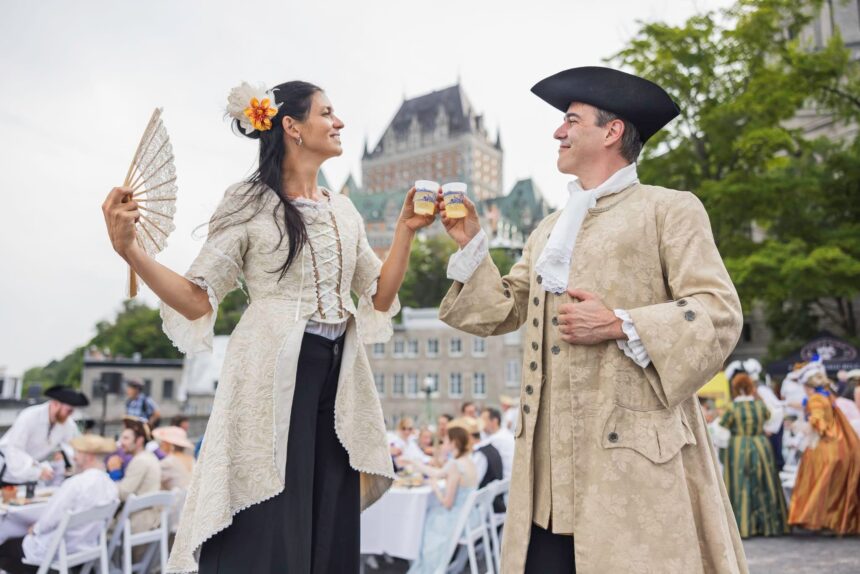
The Fêtes de la Nouvelle-France (held annually in Old Quebec City every August since 1997) is one of the most atmospherically engaging historical festivals in North America, and one that only Quebec City can authentically host: a celebration of the 17th and 18th centuries staged in the actual streets, buildings, and public spaces that date from that period. The 2025 edition ran August 7-10 in the Vieux-Québec, centred around Les Jardins and Place de l’Hôtel-de-Ville, with the Quebec government providing $441,500 in support (a recognition of the event’s cultural and economic significance for the Capitale-Nationale region.
What the Festival Is
The Fêtes de la Nouvelle-France recreate the daily life, material culture, music, and social rituals of New France) the French colonial territory that included present-day Quebec City from 1608 (Champlain’s founding) through the Conquest of 1759. Costumed interpreters animate the Old City’s streets in period dress; workshops in traditional crafts, cooking, and games run continuously; theatre performances, folk music, and historical recreation events fill the four-day program. Participants are invited (and many enthusiastically choose) to come in period costume themselves, making the festival a genuine participatory historical experience rather than passive observation. An entry medallion (médaillon) provides access to the festival’s main programming sites.
The Historical Setting
What makes the Fêtes de la Nouvelle-France unique in North America is the authenticity of its physical setting. The cobblestone streets of the Lower Town, the Place Royale with its Notre-Dame-des-Victoires church (built 1688), and the stone buildings of the Upper Town that date to the French regime create a theatrical environment that no purpose-built historical attraction can replicate. Walking through a recreated 17th-century market in a 17th-century space (rather than in a modern building decorated to suggest one) produces a qualitatively different historical experience. Jacques Cartier first made contact at Stadacona (this site) in 1534; Champlain founded the city in 1608; the festival celebrates the 150 years between those foundations and the Conquest of 1759.
Indigenous History at the Festival
Recent editions of the Fêtes have increasingly incorporated the Indigenous dimension of the New France period, the Wendat, Algonquin, and other First Nations whose presence, knowledge, and relationships with the French colonists were fundamental to the colony’s survival and development. This shift from a purely French-colonial narrative to a more complete historical picture reflects both the evolution of Quebec historical consciousness and the influence of the Truth and Reconciliation process on public history programming across Canada. The Huron-Wendat Nation from nearby Wendake participates in the festival programming, providing a First Nations perspective on the colonial encounter.