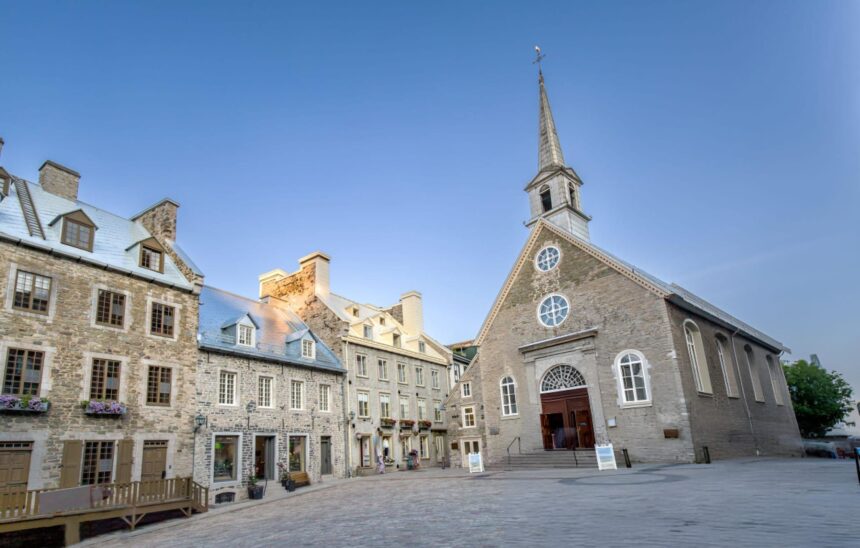
On July 3, 1608, Samuel de Champlain ( geographer, navigator, and one of the most consequential figures in the history of the Americas ) arrived at the site of the former Iroquoian village of Stadacona and began construction of the Habitation de Québec: a trading post and settlement that would become Quebec City, the administrative capital of New France, and the oldest continuously inhabited city in Canada. The founding of Quebec City was not an act of conquest in the conventional sense it was a deliberate choice to establish a permanent French presence at the strategic narrowing of the St. Lawrence River that could anchor the fur trade, maintain alliances with Indigenous nations, and serve as the base for further exploration of the interior of North America.
Champlain’s Habitation
The Habitation de Québec ( constructed in the summer and fall of 1608 at the foot of the cliff in the Lower Town, near the site of the present-day Place Royale ) was a practical, utilitarian structure: a wooden fort with storerooms, living quarters for the men, a courtyard, and defensive palisades. Champlain’s meticulous illustrations of the Habitation (published in his Voyages) are the primary documentation of its appearance; the structure itself no longer exists above ground, though archaeological excavations at Place Royale in the 1970s-1990s revealed the physical remains of the building’s foundations beneath the current street surface. The Musée de la Civilisation’s glass floor panels over the excavated remains allow visitors to look down at Champlain’s actual construction.
The Name “Québec”
The name “Québec” ( applied to the settlement and eventually the entire province ) derives from the Algonquin word “Kébec,” meaning “where the river narrows.” The narrowing of the St. Lawrence at the site of Quebec City ( where the river reduces from several kilometres wide to approximately 1 kilometre between the cliff and the Lévis shore ) is both the strategic feature that made the location valuable for defence and trade, and the linguistic origin of a name that defines a province, a city, and a national identity. The Algonquin people who used this word to describe the geographical feature could not have anticipated that it would eventually name one of the world’s most distinctive francophone cultures.
From Trading Post to Capital
Champlain’s Quebec City grew slowly the colony’s population reached only a few hundred souls by the time of Champlain’s death on Christmas Day 1635. The settlement survived English sieges and occupation (1629-1632, when the Kirke brothers captured Quebec for England), the devastating winter conditions that killed many of the first colonists, and the persistent uncertainty about whether France would sustain its commitment to North American colonisation. The arrival of the Augustinian Sisters in 1639 (who established the Hôtel-Dieu, the first hospital in North America north of Mexico), the Ursulines in 1639 (who established the first school for girls in North America), and the Jesuits (who pursued the Indigenous missions documented in the famous Relations) transformed Quebec City from a trading post to a genuine colonial community with the institutional infrastructure of a Catholic French town.