Somewhere in the planning phase of every Québec City trip, visitors run into the same confusing problem. Their guidebook mentions Quartier Petit-Champlain, their Instagram feed shows Place Royale, and their hotel concierge recommends a walk down Rue Saint-Louis. Three different places, three different photos, three enthusiastic recommendations — and in the pictures, they honestly look interchangeable. Cobblestones. Stone buildings. Flower boxes. French signage.
They are not interchangeable. These three famous streets and districts tell three completely different stories about Québec City, and the character of each one will probably matter more to your trip than you’d expect. Here’s the honest version of what each one is, what it gives you, and how to decide where to spend your precious vacation hours.
Quick Geographic Orientation
Before we compare them: all three are within a 10-minute walk of each other, inside the walls of Old Québec. Petit-Champlain sits in the Lower Town (Basse-Ville), accessed by the funicular from the Château Frontenac or by a steep staircase. Place Royale is also in the Lower Town, about a 90-second walk from the bottom of Petit-Champlain. Rue Saint-Louis runs through the Upper Town (Haute-Ville), connecting the Château Frontenac to the Saint-Louis Gate in the city walls.
Lower Town and Upper Town were historically — and still functionally — two different cities layered on top of each other. The cliff separating them is 53 metres tall. That physical divide matters to the character of what’s on each side.
Quartier Petit-Champlain: The Postcard
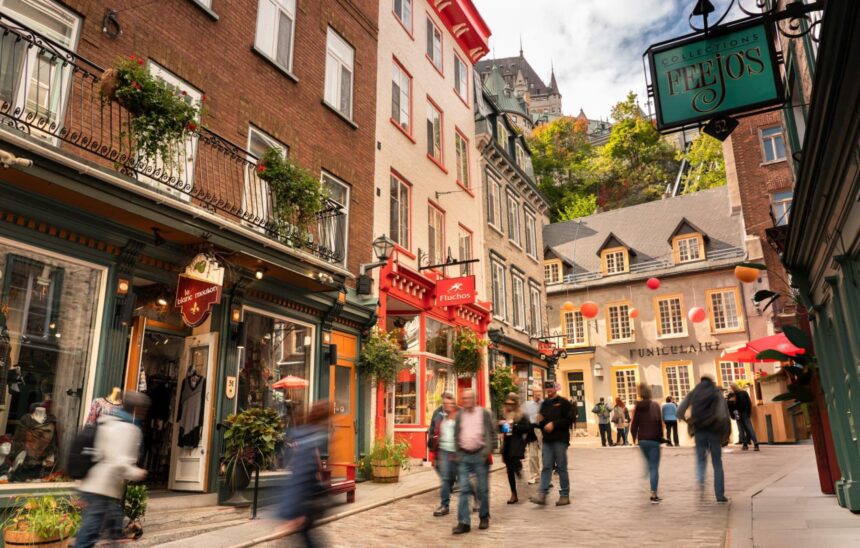
If you’ve seen an image of Québec City on a calendar, a chocolate box, or a Canadian tourism ad, you’ve probably seen Petit-Champlain. This single cobblestone street, about 400 metres long, is arguably the most photographed residential street in Canada. In winter, with Christmas lights strung across the façades and snow on the cobblestones, it’s straight out of a storybook. In summer, the same street becomes a riot of flower boxes and outdoor café seating.
What Petit-Champlain actually is, beneath the visual appeal, is a cooperative of small shops and restaurants. The merchants here banded together in the 1980s to restore and operate the district, and the continuity has kept big chains out. You’ll find handmade soap, Québec-designed clothing, artisan chocolatiers, small galleries, and a dense concentration of restaurants that range from touristy to genuinely excellent.
Go here if: You want the quintessential visual Québec experience, you’re doing shopping with a souvenir focus, or you want to eat at one of the better restaurants in the Lower Town. This is also the best single district for family travel — the street is pedestrian-only, the shops are kid-friendly, and there’s enough variety to keep a long afternoon interesting.
Skip or minimize if: You’re allergic to tourist crowds. July and August can be genuinely packed from 10 AM until dinner. Visit early morning (before 9:30) or in the shoulder seasons (late September, early November, March) to see it at its best.
Place Royale: The History Lesson
Place Royale is a small cobblestone square, maybe 30 metres across, with a church at one end (Notre-Dame-des-Victoires, built in 1687) and stone buildings around the perimeter. It doesn’t look like much at first glance. But you are standing on the founding spot of French Canada.
Samuel de Champlain built his first Habitation — a small fortified trading post — on this spot in 1608, and everything that eventually became Québec, then New France, then a large chunk of North American history, spread outward from this square. The church was added later, commemorating a French naval victory over the English in 1690. The buildings surrounding the square are a 20th-century restoration project, rebuilt stone by stone to approximate the 17th-century streetscape after centuries of fire, war, and neglect had worn it down.
What makes Place Royale different from Petit-Champlain is the weight. This is where things happened. Trading agreements, religious ceremonies, public punishments, declarations of war and peace, the grinding everyday commerce of a colonial outpost that lasted 400 years. When you’re standing in the middle of the square looking at the church, you’re in roughly the same position as a French fur trader in 1650.
Go here if: You care about history, you’re the kind of traveller who appreciates a quiet moment in a famous place, or you want a more contemplative Lower Town experience. Pair it with the Musée de la Civilisation, which is a two-minute walk away and holds the archaeological foundations of Champlain’s original Habitation.
Skip if: You need shopping, food, or active entertainment to make a place feel worthwhile. Place Royale is a square with a church. That’s the point.
Rue Saint-Louis: The Working Street of Old Québec
Rue Saint-Louis is the main east-west artery through the Upper Town, running from the Château Frontenac to the Porte Saint-Louis in the old city walls. It’s about 600 metres long, busier than Petit-Champlain with foot traffic and cars, and lined with a mix of restaurants, hotels, government buildings, and residences.
This is where real Québec life and tourism actually mix. The provincial Parliament is a few blocks over. Lawyers and civil servants lunch here during the week. In the evenings, Rue Saint-Louis fills with diners heading to the long-standing restaurants that anchor the street — Aux Anciens Canadiens in its 1675 stone house, Le Continental, Chez Soi la Crêpe, and a dozen others.
It’s also worth noting that Rue Saint-Louis is historically dense in a way that Petit-Champlain isn’t. The Wolfe-Montcalm Monument a block off the street marks the spot where the British general who won the 1759 battle for Québec died. The Jacquet House (built in 1677) and the Montcalm House (circa 1725) are among the oldest continuously occupied buildings in North America. The Porte Saint-Louis, the gate at the west end, is where Benedict Arnold’s Americans were repelled during the failed 1775 invasion of Québec.
Go here if: You want to understand how Old Québec actually functions as a lived-in neighbourhood, you’re looking for dinner in a historic setting, or you’re walking between the Château Frontenac and the Plains of Abraham. It’s the practical route that happens to be beautiful.
Skip if: You want pedestrian-only calm. There’s traffic, including horse-drawn calèches, which have their own tourist-industry complications.
The Honest Comparison Table
Here’s the short version, if you’re trying to pick:
- Best for photos: Petit-Champlain (visual), Place Royale (historic).
- Best for shopping: Petit-Champlain, by a mile.
- Best for history buffs: Place Royale, followed by Rue Saint-Louis.
- Best for dinner: Rue Saint-Louis for its concentration of long-established restaurants.
- Best for families with kids: Petit-Champlain — it’s pedestrian-only and kid-scale.
- Best for a contemplative afternoon: Place Royale, early or late in the day.
- Best single choice if you only have one hour: Petit-Champlain, but only because it concentrates the most different experiences in the smallest space.
The Actually Efficient Route: Do All Three
Here’s what I usually suggest to visitors who want to see all three without feeling rushed. It takes about four hours and builds in natural rest and food stops.
Start at the Château Frontenac around 10 AM. Walk the Terrasse Dufferin. Take the funicular (or the Breakneck Stairs if you want the exercise) down to the Lower Town.
First stop: Petit-Champlain. Give it 60-90 minutes. Browse shops, grab a coffee, take photos before the crowds thicken.
Second stop: Walk one block over and down to Place Royale. Give it 30-45 minutes. Visit the Notre-Dame-des-Victoires church (usually open to visitors except during services). Read the plaques. Sit on the steps for a minute.
Lunch: Back on Rue Sous-le-Fort or along the waterfront. Multiple options.
Third stop: Climb back up (funicular, or the longer walk via Côte de la Montagne) and walk Rue Saint-Louis. Give it 30 minutes for the walk itself, longer if you’re peeking into shops or stopping at the Wolfe-Montcalm Monument. End at the Porte Saint-Louis, where you can either continue onto the Plains of Abraham or turn around and head back to the Château.
Done. Three districts, three stories, one afternoon, and you’ve earned your dinner.
FAQ
Is Petit-Champlain safe at night?
Yes. Old Québec is one of the safest urban environments in North America, and Petit-Champlain is well-lit and well-travelled into the evening.
Are all three accessible for strollers or wheelchairs?
Partially. Petit-Champlain is flat but cobblestoned — manageable with effort. Place Royale is flat. Rue Saint-Louis has sidewalks but the cobblestones in some sections are difficult. The funicular connecting Upper and Lower Towns is accessible.
Can I drive on these streets?
No for Petit-Champlain (pedestrian). Technically yes for the others, but you shouldn’t. Park in one of the Old Québec garages and walk.
What’s the best season to see all three?
Late September through mid-October for the best combination of crowd levels, weather, and autumn light. Early December for the Christmas atmosphere. Avoid the peak July-August crush if you can.
One Last Thing
There’s a temptation, when you’re planning a trip, to treat these three streets as a competition — to figure out which one is “the best” and skip the others. Don’t. They’re three chapters of the same story, and Old Québec feels completely different depending on which one you’re standing in. Petit-Champlain sells you the dream. Place Royale grounds you in the founding. Rue Saint-Louis shows you how the city actually lives. All three are the real Québec.