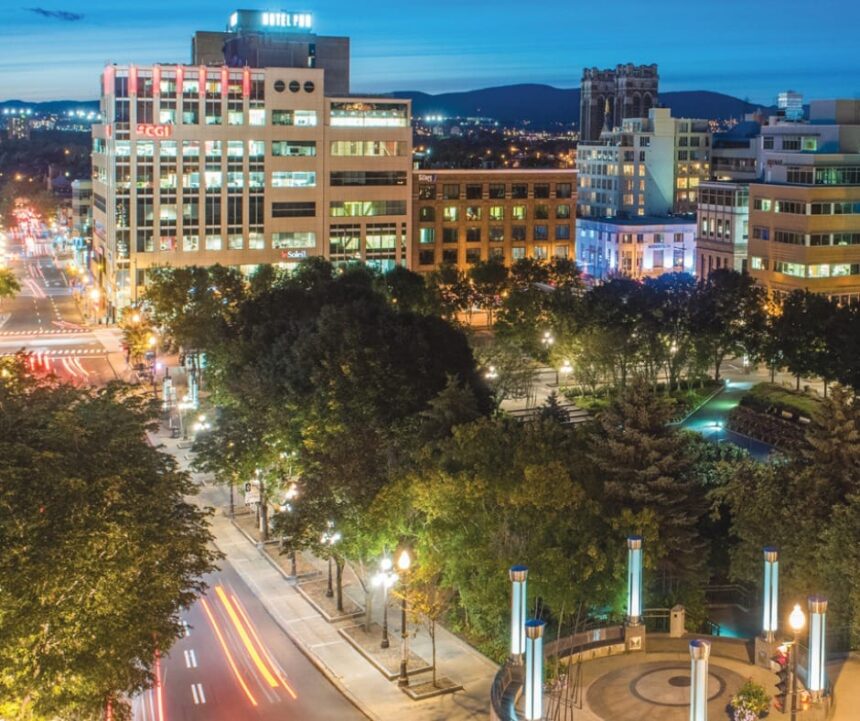
Saint-Roch‘s park network ( the constellation of small public spaces distributed through the neighbourhood’s dense urban fabric ) provides the daily outdoor life of Quebec City’s most urbanised inner-city community: the gathering spaces where the neighbourhood’s residents (the tech workers taking a lunch break, the children from the nearby daycare, the elderly residents walking their small dogs) conduct the informal social encounters that give urban neighbourhoods their community texture. The parks are small (the largest is perhaps half a hectare), often improvised in their origins (many were created from vacant lots or surplus road right-of-way rather than through planned park acquisition), and intensively used precisely because the neighbourhood’s density provides the population to sustain their daily social function.
Parc de l’Amérique-Française
The Parc de l’Amérique-Française ( the small triangular park on the Rue du Roi at the edge of the Colline Parlementaire, featuring the monument to the flags of the world’s Francophone nations (the display of 55 flags in a circular arrangement represents the diversity of the French-speaking world that Quebec’s linguistic heritage connects it to) ) is the most institutionally significant of the smaller public spaces adjacent to Saint-Roch. The park’s flag display makes it the most explicitly francophone public space in the city: the sight of 55 national and regional flags representing the French-speaking world from France to Senegal, from Louisiana to New Caledonia, provides a visual argument for the scale and significance of the French-language cultural world that Quebec City’s position as capital gives it particular responsibility to represent.
The Ruelles Bleues et Vertes
The Ruelles bleues et vertes (blue and green alleys) program ( the Ville de Québec’s initiative converting paved service alleys to vegetated, permeable community spaces ) has created the most evenly distributed small park infrastructure in Saint-Roch: dozens of transformed alleys running between the neighbourhood’s residential blocks, providing community gardening space, informal play areas, seating, and the permeable ground surface that reduces stormwater runoff into the Saint-Charles River watershed. The converted alleys’ visual character varies widely (the oldest conversions have developed the planted diversity of a small urban garden; the newest are still establishing their vegetation cover), but the cumulative effect is a neighbourhood green infrastructure distributed at the block level rather than concentrated in a few larger parks.
The Social Function
The small parks and ruelles of Saint-Roch serve a social function that larger parks cannot fully replicate: the proximity of a small park to every residential building in a dense neighbourhood (most Saint-Roch residents are within 100 metres of a park or ruelle) means that outdoor space is genuinely accessible on an impulse, without planning or travel time. The impromptu lunchtime park visit, the after-dinner dog walk to the neighbourhood’s green space, and the summer afternoon spent reading in the park are social practices that the distributed small park network enables and that a concentrated large park format would make less accessible for the majority of the neighbourhood’s residents. The parks’ role in the neighbourhood’s social infrastructure ( as spaces for the informal encounters that build community without requiring organised events ) is the most important dimension of their value, less measurable than biodiversity or stormwater management but as significant for the quality of neighbourhood life.