



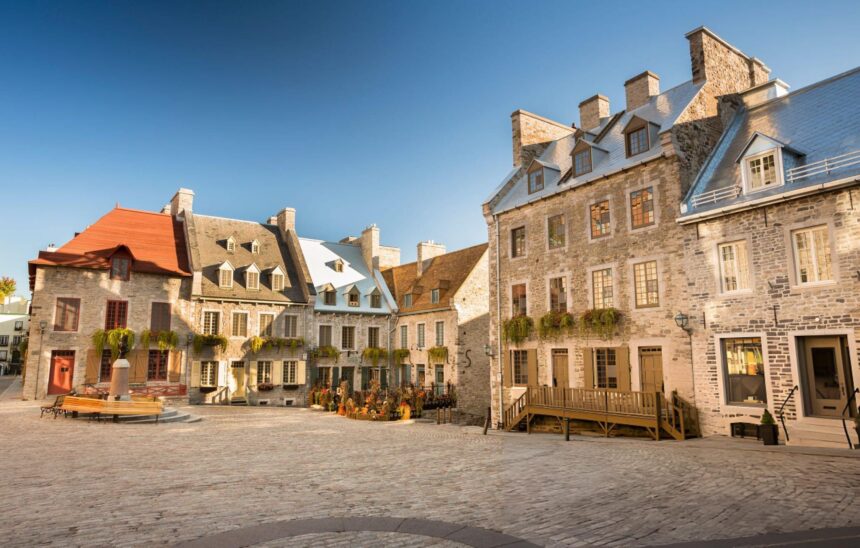
Place Royale is the public square and surrounding commercial district in Quebec City’s Lower Town, at the foot of the Cap Diamant cliff. It is the oldest continuously commercial district in Canada and the physical location of Samuel de Champlain’s Habitation, the founding settlement of New France in 1608. The Place Royale visitors see today is the result of a major archaeological and architectural restoration program undertaken by the Quebec government from 1960 through the 1990s, one of the most ambitious urban heritage projects in Canadian history, which rebuilt or restored the stone commercial buildings of the 17th through 19th centuries into a coherent heritage district.
The Commercial History
Place Royale was the commercial heart of New France from Champlain’s arrival through the British Conquest of 1759. The square was named Place Royale in 1686 when a bust of Louis XIV was placed at its centre; the original is now in the Musée de la Civilisation, and a copy stands in the square today. The merchants whose counting houses and warehouses surrounded the square, names including Philibert, Fornel, Chevalier, and Estèbe, controlled the fur trade that defined the colonial economy. The beaver pelt trade flowed through the adjacent port. After the Conquest, British merchants replaced the French ones, but the commercial character of the district continued for another century.
Notre-Dame-des-Victoires (1688)
The church built in 1688 on the site of Champlain’s Habitation faces the square and is the oldest stone church in North America still in continuous use. Glass floor panels in the nave allow visitors to look down at the stone foundations of the 1608 Habitation beneath the 17th-century church floor. The interior includes a ship model, a votive offering from sailors grateful for survival at sea, a collection of ex-votos, and a gilded altar. Together these represent one of the most authentic surviving expressions of New France material religious culture.
The Restoration and Maison Chevalier
The Quebec government’s restoration of Place Royale returned dozens of stone commercial buildings to their 18th-century appearance through archaeological research and careful reconstruction. The Maison Chevalier of 1752, the finest surviving example of New France merchant residential architecture, now houses a Musée de la Civilisation satellite focused on the material culture of colonial commercial life. The Centre d’interprétation de Place-Royale provides the most complete context for what the district represents in Canadian history.








