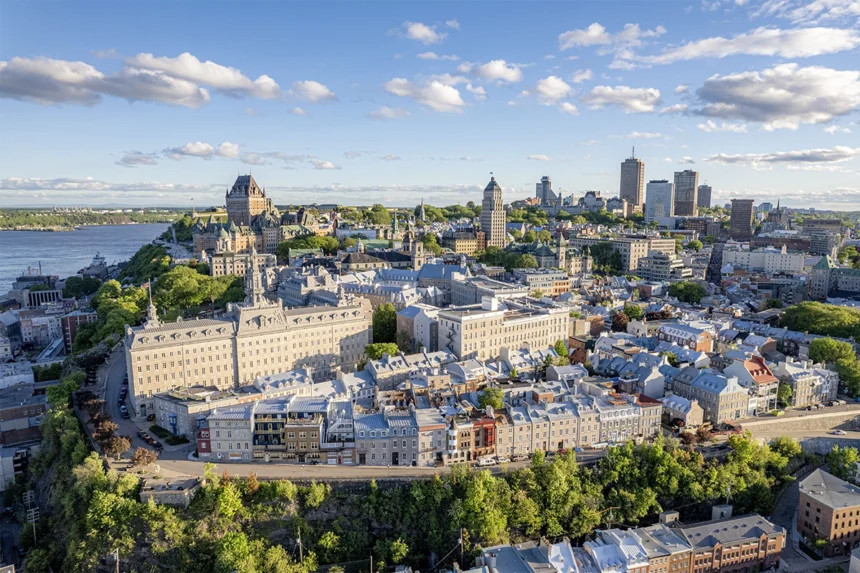
Quebec City is among the most visually French cities in the Americas. Visitors register the visual signals immediately: mansard roofs, grey limestone façades, narrow cobblestone streets, the château silhouette of the Frontenac hotel, the steeply-pitched copper roofs of the major civic buildings. The visual coherence produces an experience distinct from any other North American city and does so with such consistency that visitors often assume the architecture substantially dates from the French colonial period. Most of it does not.
The building
The British Conquest of 1759 destroyed much of the French colonial building stock in the city’s Upper Town. The bombardment that preceded Wolfe’s landing and the sustained British artillery fire during the siege flattened significant portions of the Place Royale, the Upper Town residential blocks, and several public buildings. The buildings most visitors now photograph as “French colonial architecture” are, in a substantial majority, either reconstructions from the 1960s and 1970s, British colonial period stone construction in the French idiom, or later 19th-century revivalist buildings that emulated the French aesthetic deliberately.
What it costs
The château-style vocabulary that defines the Quebec City skyline (Château Frontenac, Gare du Palais, the Ross Gaudreault cruise terminal, several hotel properties) is an invention of American architect Bruce Price in the 1890s. Price designed the Château Frontenac for Canadian Pacific Railway with a deliberate French historical pastiche, drawing on Loire Valley château vocabulary. The style proved commercially successful and was subsequently applied to other railway hotels across Canada (Banff Springs, Chateau Lake Louise, Empress Hotel), and then retrofitted onto civic buildings throughout Quebec City to produce the now-familiar skyline.
The 1960s-1970s reconstruction of Place Royale and the surrounding Lower Town, funded substantially by the provincial government under the Duplessis and later administrations, restored the square and the surrounding streetscapes to something approximating their French colonial appearance. The restoration was extensive and involved demolishing Victorian and Edwardian additions, rebuilding stone facades to period specifications, and removing commercial signage. The result is historically inflected but not historically authentic in a strict sense. Understanding that distinction does not diminish the visit; the current architecture remains visually distinctive and coherent. But it frames the experience accurately: what visitors see is Quebec’s 20th-century commitment to a particular historical aesthetic, not a surviving 17th-century city.