



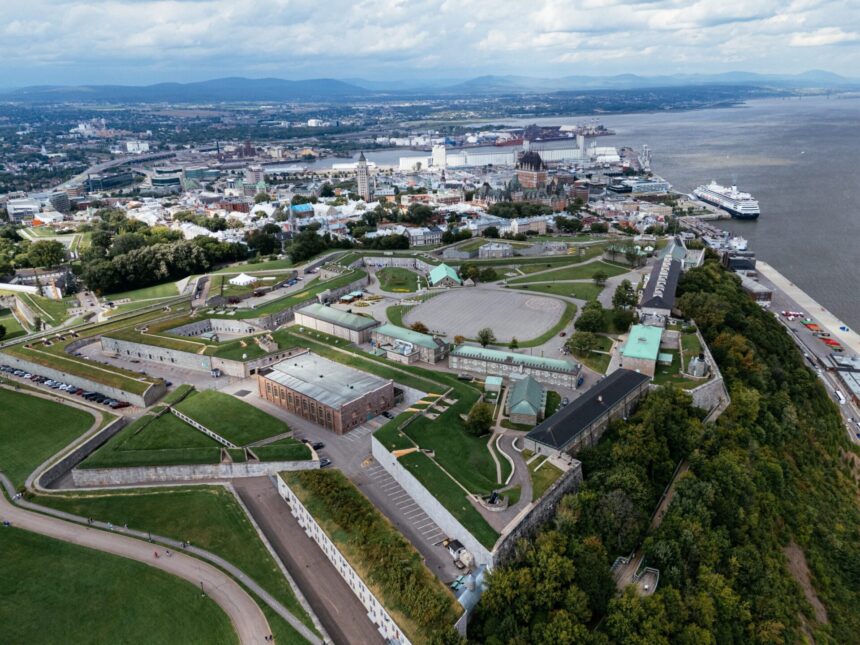
There’s a very specific pleasure to walking Old Québec. The streets are narrow, the buildings are dense with history, the topography shifts dramatically between Upper and Lower Town, and most of the interesting parts of the city are accessible only on foot. You can drive in a lot of cities. You can’t really drive the Old City of Québec — the scale is wrong, the streets are too tight, and you’d miss everything that makes the place special.
Walking tours, then, aren’t optional extras. They’re how you actually experience the city. The question becomes: self-guided or professional? Free or paid? General or thematic? Here’s the honest breakdown of your options.
The Case for Self-Guided
For most first-time visitors with reasonable curiosity and a decent guidebook, self-guided walking works very well. The Old City is compact (you can walk its perimeter in about 90 minutes), every major street is marked with historical panels, and the visual language of the architecture tells you most of what you need to know.
You pay nothing. You move at your own pace. You can stop when you want, skip what doesn’t interest you, and linger where you’re enjoying yourself.
The cost is depth — you’ll miss the specific anecdotes, the hidden details, and the kind of context a good guide provides. For an introductory experience, that’s an acceptable tradeoff.
Two Self-Guided Routes Worth Doing
The Essential Old Québec Loop (2-3 hours)
Start at Place d’Armes in front of the Château Frontenac. Walk south along the Château’s front, then turn onto the Terrasse Dufferin. Follow the terrace to its eastern end, where it merges with the Promenade des Gouverneurs.
Take the Promenade cliff walk south along the Citadelle‘s eastern wall. At the top of the climb, you’ll reach the Plains of Abraham. Walk west along the edge until you reach the area near the Plains museum, then turn north toward Grande Allée.
Return to the Old City via the Saint-Louis Gate. Walk Rue Saint-Louis east back toward the Château, stopping at the Wolfe-Montcalm Monument and noting the historic buildings along the way.
At the Château, take the funicular down to the Lower Town. Walk Rue du Petit-Champlain, visit the Fresque des Québécois mural, then work your way to Place Royale.
From Place Royale, walk to the Old Port, then climb back to the Upper Town via Côte de la Montagne (or the funicular again if you’re tired).
This loop covers roughly 4-5 kilometres with substantial elevation changes. It hits all the essential sites. Plan for 3 hours with modest stops, or up to half a day if you want to linger.
The Fortifications Walk (90 minutes)
Focus just on the city walls and military infrastructure. Start at Porte Saint-Louis, climb to the rampart walkway, follow the walls south and then east along the cliff, down past the Citadelle’s exterior (observing only; interior requires ticket), then along the cliff walk to the Château Frontenac.
This is a more focused historical walk, cheaper on energy than the full loop, and particularly good for military history enthusiasts.
Professional Tours: When They’re Worth It
Professional guided tours make sense in several specific situations:
- You want deeper historical content than self-guided materials provide.
- You’re a first-time visitor with limited time, and you want efficiency.
- You’re interested in specific themes (gastronomy, architecture, military history) that a generalist guidebook won’t fully cover.
- You have mobility or navigation concerns and want to follow a leader.
- You’re travelling with kids who respond better to a charismatic storyteller than to reading plaques.
The Main Professional Tour Operators
Cicerone Tours
Longstanding operator with multiple route options. Their general Old Québec tour runs 2 hours, typically $25-35 per person. Professional guides with serious historical training. Multilingual — English, French, Spanish, and sometimes other languages with advance notice.
Tours Voir Québec
Another strong operator with a broader range of specialty tours — food tours, Halloween walks, winter-specific routes. Prices and duration similar.
Free Walking Tours
Several operators offer “free” walking tours (pay-what-you-wish at the end). Quality varies widely. The best of them can be excellent value; others are marketing vehicles for tour add-ons. Tip meaningfully at the end if the tour was good — $15-25 is standard.
Les Tours du Vieux Québec
French-language focused with English availability. Local-owned, smaller operation, often more intimate experiences.
Specialty Thematic Tours
Food and Drink Tours
Several operators run food-focused walks that include tastings at multiple stops — 3-5 hours, typically $80-120 per person, including food and drink samples. Well worth it for food-focused travelers. Popular themes include Old Québec food tours, poutine crawls, and Saint-Roch neighbourhood food walks.
Ghost Tours
Québec City’s age and historical density make it a natural ghost-tour subject, and several operators offer evening themed walks focused on paranormal and dark-history content. Tone varies from academic to theatrical; check reviews for what you’re getting into.
Architecture Tours
Specialty operators (and some general ones) offer tours focused specifically on Québec’s architectural heritage — French colonial, English regime, Victorian, and modern. Good for design-oriented travelers.
Indigenous Perspectives Tours
A few guides offer tours focused on the Indigenous history of the Québec City region. Worth seeking out if that’s your interest.
Seasonal Winter Walks
Operators offer specifically winter-themed routes during cold-weather months, often including warming stops at historic cafés. Shorter (90 minutes is common) due to weather.
Audio Guides and Apps
A middle ground between pure self-guided and professional tours. Several audio-guide apps cover Old Québec with GPS-triggered narration. Quality varies; read recent reviews before downloading. Some are free; others run $5-15.
Izi.Travel has reasonable Québec City content.
VoiceMap has professional audio tours by local experts.
Les Remparts app (from Parks Canada) specifically covers the fortifications.
What to Bring
- Comfortable walking shoes with grip. Cobblestones and stairs are real considerations.
- Water bottle. Public fountains exist but aren’t abundant.
- Weather-appropriate clothing. Layers in shoulder seasons; full winter gear November-March; sun protection in summer.
- A camera (your phone is fine for most purposes).
- A small amount of cash for tipping guides or small purchases.
- Sunglasses and a hat depending on season.
Practical Tips
Timing: Morning tours (9:30-11:30 AM) work well in summer. Late afternoon (3-5 PM) avoids midday heat and catches golden hour. Winter tours are shorter and earlier due to daylight limits.
Group size: Smaller groups (4-8 people) are generally more substantive than larger tour-bus-scale groups. Check operators’ policies.
Language: Most tours run in both French and English, usually at separate times. Mixed-language tours exist but can be less effective.
Reservations: Book at least a day ahead in summer and on weekends. Winter tours often have space same-day.
Tipping: Generally 15-20% of the ticket price, in cash, for guided tours. For free tours, $15-25 per person if the tour was good.
A Suggested Walking-Focused Day
9:00 AM: Coffee near Place d’Armes, then begin a self-guided Upper Town walk.
11:00 AM: Funicular to Lower Town. Walking tour of Petit-Champlain and Place Royale (self-guided or professional).
12:30 PM: Lunch at a Lower Town restaurant.
2:00 PM: Optional professional afternoon tour — focused theme like food, architecture, or fortifications.
4:00 PM: Coffee break, rest feet, reflect on what you’ve seen.
5:00 PM: Sunset walk on the Plains of Abraham or along the fortifications if energy permits.
7:00 PM: Dinner. You’ve earned it.
FAQ
How much of Old Québec can I cover in a single walk?
The full Old City can be traversed in 90 minutes. Seeing it with depth requires multiple walks over several days.
Are professional tours worth paying for if I have a good guidebook?
For first-time visitors with specific interests (food, history, architecture), yes. For general sightseeing with good self-research, often not.
Can tours accommodate mobility issues?
Some do, specifically. Ask operators in advance.
Are tours different in winter?
Typically shorter, with more frequent indoor stops, and different themes (Christmas markets, winter festivals, Carnaval). Still offered by all major operators.
How does Québec City compare to other walkable historic cities?
Comparable to Charleston, Santa Fe, or old-town Prague — compact enough to cover on foot, dense enough with history to reward slow exploration.
Final Word
Walking is how you actually see Old Québec. The only question is whether you do it with a guide, a book, an app, or your own curiosity — and there are good reasons for each. Don’t skip this. You can drive past the Château Frontenac, but you can’t drive through the stories, the alleys, the small details, the contrasts between Upper and Lower Town, or the texture of four centuries compacted into a few square kilometres. Walk it. Multiple times. You’ll come home knowing you actually saw the place.





