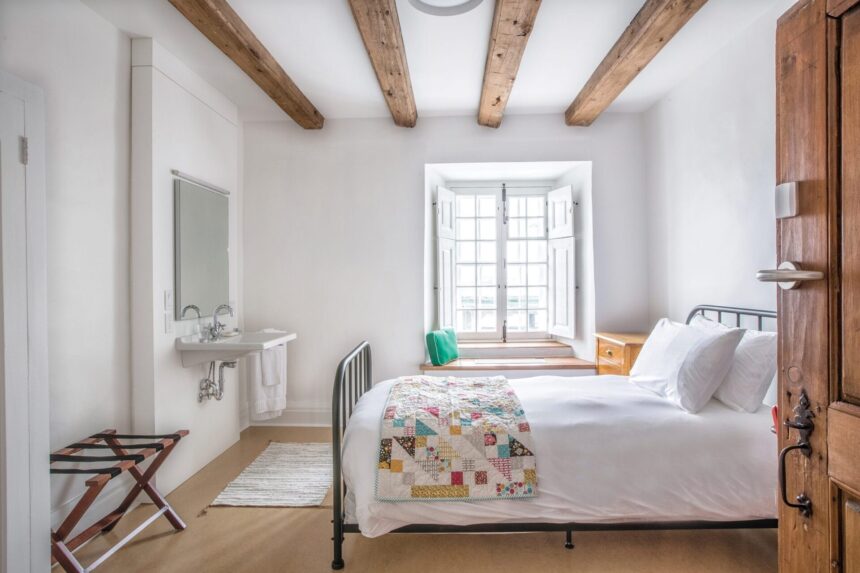
The big hotels in Vieux-Québec get most of the attention — Château Frontenac obviously, the Hilton above the walls, the Delta near the congress centre. But the real character of staying inside the fortifications comes from the smaller places: the 19th-century row houses converted into auberges, the stone townhouses on rue Sainte-Ursule that hold eight rooms, the B&Bs where the innkeeper actually lives upstairs and comes down to pour you coffee. If you’re going to pay Old Québec prices anyway, the case for choosing one of these over a chain hotel is strong.
Why Small Beats Big Inside the Walls
A few practical realities of staying in Vieux-Québec that favour small properties:
- The buildings themselves are the attraction. You came to Québec City partly for the 17th- and 18th-century architecture. Sleeping inside one of those buildings is different from looking at it from a modern hotel window.
- Scale matches the streets. Old Québec is a small, dense neighbourhood. A 400-room hotel feels out of proportion. A 12-room auberge feels right.
- Owners care. Small properties are usually owner-operated or managed by tiny teams. Problems get solved. Recommendations are honest.
- Breakfast is usually included — and in the better auberges, it’s an actual meal, not a plastic-wrapped muffin.
The trade-offs: no gym, no pool, fewer amenities, sometimes creaky floors and thin walls, occasionally no elevator. You’re paying for character. You’re not paying for standardization.
The B&B and Auberge Corridors
Three streets inside the walls concentrate most of the small-property inventory:
Rue Sainte-Ursule
The densest cluster of B&Bs and small auberges in Old Québec. Narrow, quiet, residential-feeling, two minutes from rue Saint-Jean and five minutes from Château Frontenac. Most of the properties here occupy 19th-century townhouses converted in the 1980s and 1990s. You’ll often get a room with a working fireplace, exposed stone, or an odd sloped ceiling from the original construction.
Rue Saint-Louis
More commercial and restaurant-oriented than Sainte-Ursule, but a handful of very good small auberges sit along it. Louder at night, convenient to everything.
Avenue Sainte-Geneviève and nearby
Just south of rue Saint-Louis, quiet and close to the Plains of Abraham. A few of the most elegant small properties are here, in buildings overlooking Parc du Cavalier-du-Moulin.
Boutique Hotels That Earn the Name
“Boutique” is an abused word. In Québec City, the places that genuinely deserve it are usually converted from something else — a bank, a warehouse, a convent, a townhouse — and their design leans into the original building rather than covering it up.
- Auberge Saint-Antoine — Built above an archaeological site in the Vieux-Port. The lobby displays artefacts pulled from the ground during construction. A serious property with a restaurant (Coteau) that stands on its own merits.
- Hôtel 71 — Occupies the 1871 building of the National Bank of Canada on rue Saint-Pierre. Twenty-foot ceilings in the historic rooms, modern aesthetic layered on the old bones.
- Monastère des Augustines — The most unusual option in the city. A restored 17th-century convent still operated in part by the Augustinian Sisters’ legacy, now functioning as a hotel with wellness programs, a small museum, and an ethic of silence and reflection. Not a conventional stay — but nothing about Québec City is conventional.
- Hôtel Manoir Victoria — Larger than a true boutique but with enough character and location (Côte du Palais, steps from Place d’Youville) to belong in the conversation.
- Hôtel Clarendon — The oldest continuously operating hotel in Canada (opened 1870). Art deco lobby, genuinely historic bar, good value relative to Château Frontenac.
What to Actually Book a Good Auberge
A few rules from years of watching people get this right or wrong:
- Look at recent photos, not the website’s hero shots. Properties change. The lobby from 2015 isn’t necessarily the lobby now.
- Read reviews for the specific category of room you’re booking. A property can have great suites and mediocre standard rooms, or vice versa.
- Check for an elevator if you have mobility concerns or heavy luggage. Many 19th-century townhouses have none. Climbing four flights with a suitcase is a real consideration.
- Ask about soundproofing if you’re a light sleeper. Old buildings were not built for silence. Street-facing rooms on rue Saint-Louis can be loud in summer.
- Book direct when possible. Small properties lose 15-20% to booking platforms. If you call, you’ll often get a better rate, a nicer room, or both.
Budget Realities
Inside the walls, expect to pay roughly what you’d pay in Montréal’s Vieux-Montréal for equivalent quality — which is to say, not cheap, but not at New York or Paris prices either. Shoulder seasons (late spring, early fall) deliver the best value. Winter Carnival and Festival d’été weeks spike prices significantly.
If you want boutique quality at lower prices, look at Saint-Roch and Saint-Jean-Baptiste — neighbourhoods just outside the walls that have developed their own small hotel and B&B scenes at a fraction of Old Québec rates. You’ll trade walkability to Château Frontenac for a more neighbourhood-like stay, which some travellers actively prefer.
FAQ
What’s the difference between a B&B and an auberge in Québec?
In practice the categories overlap. An auberge typically has more rooms (8-30), a staffed reception, and sometimes a restaurant. A B&B is usually smaller (3-8 rooms), often with the owner living on-site, and breakfast is the main shared amenity.
Do these places have elevators?
Many don’t. If you need step-free access, confirm before booking. Some of the boutique hotels (Auberge Saint-Antoine, Hôtel 71) do have elevators; most of the small B&Bs on rue Sainte-Ursule do not.
Is breakfast really included?
At most auberges and B&Bs, yes, and it’s often substantial — pastries, fresh fruit, eggs cooked to order, good coffee. It’s one of the real value propositions of the format.
How far in advance should I book?
For summer weekends and Carnaval, three to six months is prudent for the best properties. For shoulder seasons, a month is usually enough. Small properties book up faster than big hotels because they have fewer rooms to sell.