Spend 24 hours in Old Québec and you will inevitably see the Château Frontenac, walk Petit-Champlain, photograph Place Royale, and probably pass by the Citadelle. That’s the essential list. Every guidebook agrees.
- 1. The Séminaire de Québec
- 2. The Ursulines Convent and Museum
- 3. The Hôtel-Dieu de Québec Museum (Musée du Monastère des Augustines)
- 4. The Parc du Cavalier du Moulin
- 5. Rue du Trésor (Art Alley)
- 6. The Maison Chevalier
- 7. The Cathedral-Basilica Notre-Dame-de-Québec
- 8. Jardin Jeanne-d’Arc
- 9. Morrin Cultural Centre
- 10. Latin Quarter and Université Laval’s Old Campus
- Combining These Into a Day
- Why These Matter
- FAQ
- Final Word
But Old Québec is denser than most visitors realize. Inside the 4.6 kilometres of city walls, there are attractions that get 1/20th the foot traffic of the marquee sites and are, in some cases, more interesting. These are the places where you’ll find local Québécois on a weekend — families, couples, retirees — when the tour buses are parked on Dufferin Terrace.
Here are ten Old Québec attractions that deserve more attention than they get.
1. The Séminaire de Québec
Tucked into a quiet street behind the Notre-Dame Cathedral, the Séminaire de Québec is one of the oldest educational institutions in North America, founded in 1663 by Bishop François de Laval. It’s still an active educational facility (now housing parts of Université Laval), but portions are open to the public.
The main chapel is remarkable — 17th- and 18th-century religious art, preserved wood carvings, a quality of craftsmanship you rarely see. The Musée de l’Amérique Francophone, housed within the Séminaire complex, covers the broader history of French-speaking North America and is underappreciated compared to its more-famous neighbour the Musée de la Civilisation.
Budget 90 minutes. Admission around $8 for the museum.
2. The Ursulines Convent and Museum
The Monastère des Ursulines was founded in 1639, making it one of the oldest continuously operating convents in North America. The on-site museum covers the 400-year history of the Ursuline order in Québec, including their critical role in founding schools for Indigenous and French girls.
The chapel, recently restored, contains significant religious art. The museum itself is modest in scale but densely researched. Most importantly, the Ursulines were significant actors in New France‘s intellectual and religious life, and their story is underrepresented in most Québec tourist narratives.
Budget 60-90 minutes. Around $10 admission.
3. The Hôtel-Dieu de Québec Museum (Musée du Monastère des Augustines)
Founded in 1639, the Hôtel-Dieu was the first hospital established in French North America. The current museum, housed in a beautifully restored convent adjacent to the still-operating hospital, tells the story of four centuries of Augustinian nursing sisters who cared for Québec’s sick and wounded.
It’s also a working wellness retreat — you can book overnight stays in the monastic rooms, with traditional meals and wellness programming. The combination of medical history, religious history, and contemporary wellness makes this one of the more unusual museum experiences in Québec.
4. The Parc du Cavalier du Moulin
A small park at the western edge of the Old City, offering some of the best views of the Citadelle’s exterior fortifications and the St. Lawrence River beyond. Most visitors miss it entirely because it’s not on the main tourist circuits.
Excellent for photography. Especially beautiful in autumn with foliage turning.
5. Rue du Trésor (Art Alley)
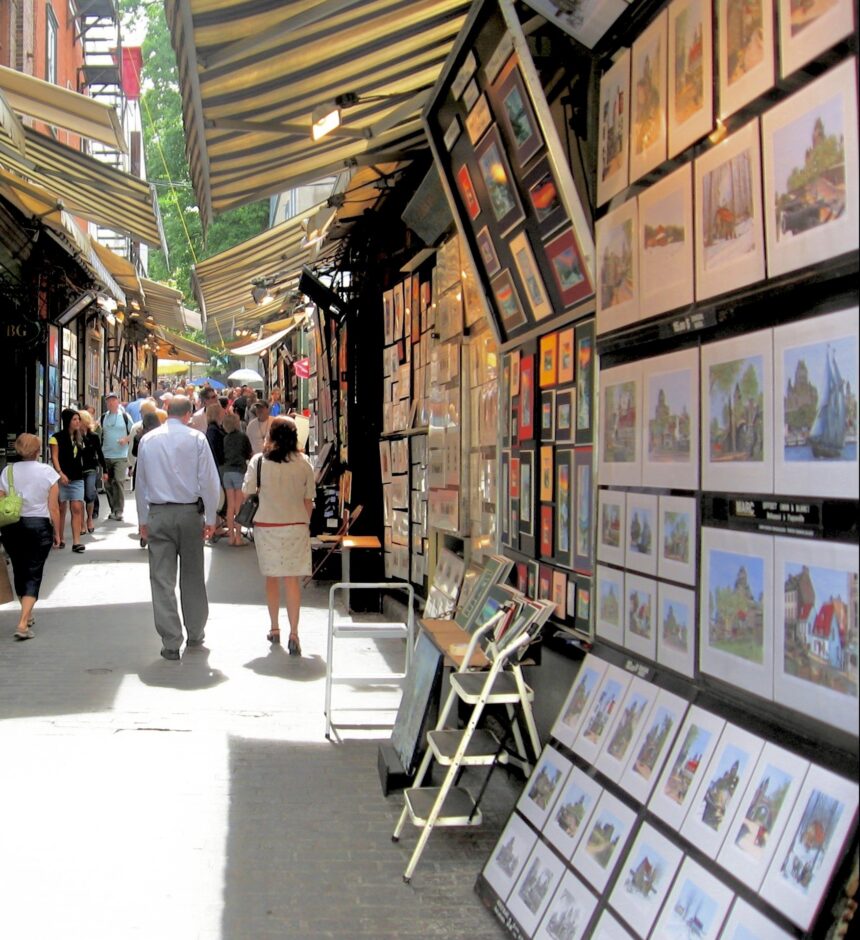
A narrow pedestrian alley connecting Rue Sainte-Anne to Rue du Fort, featuring local artists selling original paintings, photography, and prints. Most pieces depict Québec City scenes. Prices range from modest souvenir-sized works to serious gallery-grade pieces.
It’s a working art market, not a curated gallery — quality varies wildly — but it’s authentic, and you can buy directly from artists who work Québec’s streets for their material.
Budget 30-45 minutes for a browse.
6. The Maison Chevalier
A historic stone house at the western end of Petit-Champlain, dating to 1752. Operated as a small museum focusing on traditional Québec furnishings and domestic life. The interiors give you a surprisingly clear picture of how middle-class residents of Lower Town lived in the 18th and 19th centuries.
Free admission (or included in Parks Canada passes). Worth 30-45 minutes.
7. The Cathedral-Basilica Notre-Dame-de-Québec
Not exactly hidden — it’s one of the largest buildings in the Old City — but routinely underserved in visitor itineraries. The Cathedral of Notre-Dame-de-Québec is the oldest parish church in North America (original structure 1647, current building completed in 1925 after multiple reconstructions), and it serves as the mother church of Catholicism in Canada.
The interior is spectacular — gold-leaf decoration, impressive stained glass, a reliquary containing relics of the first bishop of Québec. The cathedral’s history museum in the basement covers 400 years of religious life in the city.
Open to the public outside of service times. Free entry, suggested donation.
8. Jardin Jeanne-d’Arc
A formal French garden on the Plains of Abraham centred on the equestrian statue of Joan of Arc. The garden is maintained in traditional French style, with seasonal plantings and a contemplative atmosphere.
Most visitors walk past on their way to somewhere else. Stopping to actually sit in the garden, even for 15 minutes, is one of the quieter pleasures available in this part of the city.
9. Morrin Cultural Centre
Housed in the old Québec Prison (operational 1813-1868), the Morrin Cultural Centre is now home to the Literary and Historical Society of Québec (founded 1824, the oldest English-language cultural institution in Canada), an extensive English-language library, and small exhibition spaces.
Guided tours cover the building’s history as a prison and as Canada’s third Presbyterian college. The library itself, with its wrought-iron balconies and 140,000-volume collection, is one of the most atmospheric book spaces in Canada.
Around $10 for guided tours. Library access free for members or with day pass.
10. Latin Quarter and Université Laval’s Old Campus
The area around Rue Saint-Louis, Rue de l’Université, and the Séminaire de Québec has been Québec’s Latin Quarter since the 17th century — named for the Latin language originally spoken by students at the Séminaire. Today it retains a distinctly scholarly feel.
Walking these streets early in the morning or late in the afternoon, when locals are present but tourists are mostly elsewhere, gives you a glimpse of Old Québec as a living neighbourhood rather than a historical attraction.
Combining These Into a Day
A suggested “beyond the obvious” walking itinerary for Old Québec:
10:00 AM: Morrin Cultural Centre guided tour.
11:30 AM: Walk through the Latin Quarter to the Séminaire de Québec. Visit the Musée de l’Amérique Francophone.
1:00 PM: Lunch at a Rue Saint-Louis restaurant.
2:30 PM: Visit the Ursulines Museum.
4:00 PM: Walk to the Jardin Jeanne-d’Arc. Rest in the garden.
4:45 PM: Stop at Rue du Trésor to browse local art.
5:30 PM: End at the Cathedral-Basilica for evening service ambience or quiet reflection.
Why These Matter
The famous sites of Old Québec are famous for good reasons — they deserve the attention they get. But they also define the tourist experience of the city in ways that can make Old Québec feel one-dimensional if that’s all you see.
These ten alternative attractions add depth. The Séminaire and the Ursulines show you that Québec was an intellectual centre as well as a political one. The Morrin Centre reminds you that English-speaking Québec is older than you might think. The art alley and the small gardens reveal the living neighbourhood beneath the historic infrastructure. Together, they give you a richer picture of the city than the top-10 list alone ever could.
FAQ
Can I visit all ten in a single day?
Theoretically yes, but you’d be rushing. Three to five in a day gives them proper attention.
Are most of these kid-friendly?
Varies. The Morrin Centre and Rue du Trésor work well with kids 6+. The religious sites require quiet behaviour.
Do most of these have English-language options?
Yes. All major museums have bilingual interpretation. Guided tours typically run in both languages.
Are they open year-round?
Most, yes. Some have reduced winter hours. Check specific websites.
Which one should I prioritize if I only have time for one?
The Séminaire de Québec complex (including the Musée de l’Amérique Francophone) offers the richest single experience.
Final Word
Old Québec rewards curiosity. The famous attractions handle the broad strokes of the city’s story; these lesser-known sites fill in the details, the contradictions, the human texture. If you’ve already done the tourist circuit, or you want to go deeper than the average first-time visitor, these ten places give you genuine additional material. Old Québec is bigger than the postcards suggest.