The site of Quebec City was occupied by human communities for thousands of years before Samuel de Champlain founded his trading post and habitation in 1608. Archaeological evidence from the Quebec City region documents continuous Indigenous occupation going back at least 8,000 years the product of successive cultures that exploited the strategic advantages of the St. Lawrence narrowing, the confluence of rivers (the Saint-Charles and the Montmorency entering the St. Lawrence near the site), and the productive hunting and fishing grounds of the surrounding territory.
Stadacona: The Iroquoian Village
When Jacques Cartier arrived at the site of present-day Quebec City in 1534-35, he found an Iroquoian-speaking village called Stadacona, governed by a chief named Donnacona. The Stadaconans ( a people that historians now classify as St. Lawrence Iroquoians, distinct from both the Huron-Wendat Nation and the Haudenosaunee (Iroquois) Confederacy ) maintained a settled agricultural community growing corn, beans, and squash alongside their hunting and fishing activities. The St. Lawrence Iroquoians’ language was distinct enough from other Iroquoian languages to be a separate tongue; Cartier and his men learned some of the vocabulary, which forms part of the earliest recorded documentation of any Indigenous language in Canada.
The Mystery of the Disappearance
When Champlain arrived at the site in 1603, Stadacona was gone ( the Algonquin-speaking Montagnais (Innu) had replaced the Iroquoian Stadaconans in the territory. The fate of the St. Lawrence Iroquoians ) why they disappeared between Cartier’s last visit (1542) and Champlain’s first (1603) remains one of the most debated questions in northeastern North American archaeology and history. Theories include: epidemic disease from Cartier’s early contact; warfare with neighbouring nations (Huron-Wendat or Algonquin); dispersal and absorption into other nations; or some combination of all three. The archaeological record provides fragmentary evidence but no definitive answer. The St. Lawrence Iroquoians left no surviving descendants who identify as such today.
Pre-Contact Archaeology in Quebec City
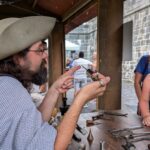
Archaeological excavations in Quebec City ( conducted systematically since the 1970s in conjunction with construction and restoration work in the historic core ) have uncovered pre-contact artifacts including stone tools (lithics), ceramics, and food remains demonstrating human occupation going back several thousand years. The Musée de la Civilisation’s excavations in the Place Royale area revealed the physical remains of the colonial Habitation beneath the historic streetscape and below that, pre-contact Indigenous occupation layers. The TramCité preparatory excavations in 2025-2026 have produced additional archaeological material from multiple periods. Quebec City’s archaeology is ongoing: every major construction project in the historic core is legally required to include archaeological monitoring.