Québec City has built one of the densest cycling networks of any mid-sized North American city, measured in protected kilometres per resident, and the Route verte that runs along the St. Lawrence through the metropolitan area is the backbone of that network. The numbers: about 400 kilometres of cycling infrastructure within the city boundary, of which roughly 160 are separated from traffic. That figure has grown steadily since the first serious municipal investment in 2006.
What sets it apart
The Route verte itself is a provincial network, not a municipal one, totalling about 5,300 kilometres across Québec when its last unconnected segment is completed. Within the Québec City region, the Route verte runs continuously from the Chutes Montmorency east of the city to the Parc des Chutes-de-la-Chaudière west of it, a distance of about 35 kilometres on the north shore. A second Route verte corridor crosses the Pont de Québec, runs along the south shore through Lévis and Saint-Romuald, and connects to the Lévis-Dorval ferry terminal for the crossing back to the old city.
The signature segment, and the one most visitors end up riding, is the Promenade Samuel-De Champlain, which runs for 7.5 kilometres along the river between the Parc de la Plage-Jacques-Cartier and the Quai des Cageux near the Pont Pierre-Laporte. It has a fully separated cycle track, a parallel pedestrian path, and a series of landscape installations by the landscape architects Daoust Lestage. The third phase, opened in 2023, extended the promenade east to the Anse au Foulon. Parking is available at both ends and at three intermediate points.
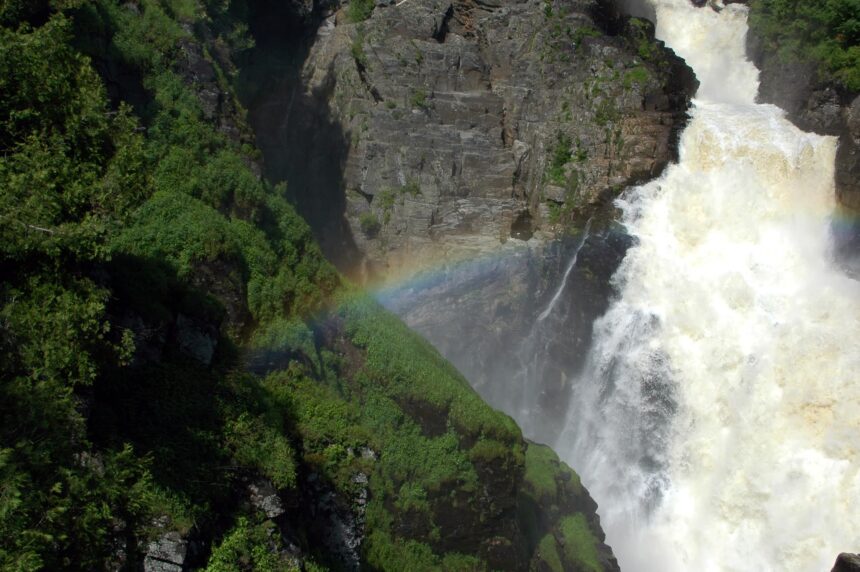
Beyond the Champlain promenade, three other networks deserve attention. The Corridor des Cheminots runs 22 kilometres on a former railway bed from Limoilou north to Shannon, a flat, protected route popular with commuters and weekend riders. The Corridor du Littoral, running from the Vieux-Port east along the river to the Chutes Montmorency, gives access to the falls without driving. The Corridor des Beauportois connects Beauport to downtown on a protected shoulder along Boulevard Henri-Bourassa.
Seasonal character
Bike share arrived late in Québec City compared to Montréal. The àVélo system, operated by the RTC transit agency, launched in 2022 with 440 electric-assist bikes at 60 docking stations and has expanded each year since. As of April 2026 the network has roughly 1,300 bikes at 150 stations, with service running from early May through mid-November. A single thirty-minute ride costs $3.50; a day pass is $12 and a seasonal pass $99. Riders under 14 are not permitted, and helmets are recommended but not required.
Private rental shops run a parallel business for tourists. Cyclo Services, based at the Vieux-Port, rents city bikes at about $35 a day and road bikes at $60. Ecolocyclo in Saint-Roch does similar. Most hotels in the Haute-Ville and Basse-Vile carry maps of the regional network and can arrange deliveries.
The Ville de Québec has committed, under its 2018 Plan de mobilité durable, to adding roughly fifty kilometres of new protected cycle infrastructure by 2030. Progress has been uneven: Boulevard Henri-Bourassa got protected bike lanes in 2021, the Rue Saint-Joseph project in Saint-Roch finished in 2023, and a disputed extension along Boulevard Charest east has been delayed to 2027. Snow clearing of cycle paths runs on about 140 kilometres of the network from mid-November through early April, giving Québec year-round cyclists a degree of continuous infrastructure that few Canadian cities match.
On the ground
Hilly topography remains the defining challenge. The Upper and Lower Town are separated by the escarpment, and the only flat routes between them run east through the Côte de la Montagne or via the funicular (bikes permitted outside rush hour, $4). Most cyclists learn to tolerate the two or three steep climbs that most useful downtown routes involve, or else stick to the river-level corridors.
For a visitor with one afternoon, the obvious ride is the Samuel-De Champlain promenade from end to end and back, about 15 kilometres round trip, mostly flat, with a stop at the Baie de Beauport beach or the Foulon restaurant along the way. The ride takes roughly ninety minutes at a casual pace and covers most of what is worth seeing from a riverside bicycle in the city.