Villeneuve and Château-d’Eau — the two northernmost quartiers of the Charlesbourg arrondissement, occupying the plateau terrain between the Boulevard Henri-Bourassa commercial corridor to the south and the La Haute-Saint-Charles arrondissement boundary to the north — are the most suburban, most car-dependent, and most environmentally proximate to the Lac Saint-Charles watershed of any inner-city Quebec City communities. The combination of large single-family lots (many properties have wooded portions that back onto the forest corridors of the watershed protection zone), the absence of commercial or institutional density that would support transit investment, and the distance from the inner-city employment centres creates residential communities that function as exurban in character despite being within Quebec City’s administrative boundaries.
The Lac Saint-Charles Proximity
The Villeneuve and Château-d’Eau quartiers’ most distinctive physical characteristic is their proximity to the Lac Saint-Charles reservoir’s protected watershed zone: the development restrictions that limit construction within 300 metres of the lake’s tributary streams and the watershed’s forested buffer zones create large undeveloped areas adjacent to and within the residential fabric of these quartiers. The result is a residential environment where coyote, deer, snowshoe hare, and various raptor species are regular backyard visitors — a level of wildlife integration unusual in any city’s residential neighbourhoods. The Chute Kabir Kouba in the adjacent Wendake territory (the 28-metre waterfall visible from the Route 573’s northbound lanes) is within cycling distance of the Villeneuve residential streets.
Community Character
The Villeneuve and Château-d’Eau communities — with their large-lot residential fabric, the absence of walkable commercial streets, and the dominant car culture of their daily mobility patterns — represent the most complete expression of the late 20th-century North American residential suburb within Quebec City’s administrative boundaries. The community organisations (the Comité de citoyens de Villeneuve, the school parent committees) sustain the social fabric of communities whose physical layout does not generate spontaneous neighbourhood interaction the way that the compact street grids of Limoilou or Saint-Jean-Baptiste do. The communities’ integration into Quebec City’s administrative structure (following the 2002 municipal mergers) has improved access to city services without fundamentally changing their suburban character.
Environmental Connections
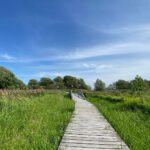
For residents interested in the natural environment, the Villeneuve and Château-d’Eau quartiers provide exceptional access to the environmental assets of the Lac Saint-Charles watershed: the various access points to the watershed’s protected forest corridors (hiking trails maintained by volunteer organisations within the development restriction zones), the Lac Delage private resort lake (a gated residential lake community adjacent to the watershed’s southern boundary), and the cycling connection to the Corridor des Cheminots trail system (accessible from the quartiers’ northern edges). The spring frog chorus from the wetlands adjacent to the residential development, the fall hawk migration visible from the plateau’s open areas, and the winter owl watching that the boreal forest edge provides are the environmental pleasures specific to these outer quartiers that the inner-city communities cannot replicate.