



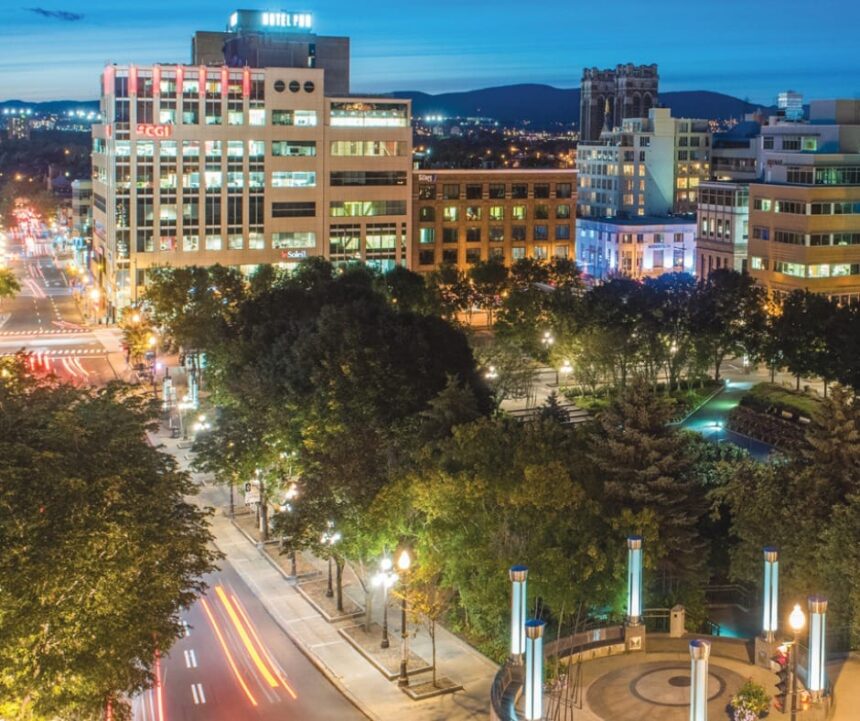
Saint-Roch (the Lower Town neighbourhood at the foot of the Cap Diamant cliff, bounded by the Boulevard Charest to the south, the Saint-Sauveur quartier to the west, the Saint-Charles River to the north, and the Vieux-Québec cliff face to the east) is Quebec City’s most remarkable urban transformation story of the past 30 years. In the 1970s and 1980s, Saint-Roch was one of the most economically distressed neighbourhoods in Quebec City (a post-industrial zone of vacant storefronts, declining population, and physical dereliction that had followed the collapse of the manufacturing and textile industries that had employed its working-class population. By 2000, a systematic combination of public investment, cultural institution anchoring, and private development had transformed Saint-Roch into Quebec City’s creative economy hub) a neighbourhood of technology companies, restaurants, galleries, bars, and independent retailers that generates more economic activity per square metre than any other non-tourist zone in the city.
The Méduse Cooperative: The Cultural Anchor
The Méduse cultural cooperative (established in 1995 in the Îlot Fleurie complex on Rue Saint-Joseph Est) was the institutional anchor of Saint-Roch’s cultural revival. Méduse brought together 11 artist-run organisations (production companies, publishing houses, artist studios, performance spaces, and cultural service organisations) under a single roof, creating the critical mass of cultural activity that attracted other cultural organisations, artists, and eventually commercial businesses to the neighbourhood. The Méduse model (cooperative cultural infrastructure enabling small organisations to share costs and generate synergies) has been studied internationally as a model for urban cultural revitalisation. Méduse continues to operate at the Îlot Fleurie, providing production facilities, exhibition spaces, and residencies that make it the most productive single cultural facility in Quebec City.
Ubisoft Quebec City: 3,000 Jobs in the Lower Town
Ubisoft’s Quebec City studio (opened in 1997, now employing approximately 3,000 people in its Îlot Fleurie complex adjacent to Méduse) is the most significant private-sector employer in the neighbourhood and the most tangible expression of Quebec City’s ambition to build a tech and creative economy beyond the government-service base. The studio has produced several major Assassin’s Creed titles (including Assassin’s Creed Odyssey and Assassin’s Creed Valhalla) and serves as one of Ubisoft’s primary development studios globally. The province’s generous multimedia production tax credit (up to 37.5% of qualifying labour costs) was the primary financial attraction; the quality of Université Laval’s game design and computer science graduates and the city’s relatively low cost of living (compared to Montreal or Toronto) have sustained the investment. Ubisoft’s presence has anchored a broader technology cluster in Saint-Roch that includes CGI, several smaller software companies, and digital marketing agencies.
Rue Saint-Joseph Est: The Restaurant Strip
Rue Saint-Joseph Est (the commercial main street running through Saint-Roch’s centre) is Quebec City’s most dynamic restaurant and bar strip outside the Old City’s tourist zone: a concentration of independent restaurants at multiple price points, wine bars, cocktail bars, craft beer taprooms, coffee shops, and specialty food retailers that reflects the neighbourhood’s mixed population of technology workers, artists, government professionals, and long-term working-class residents. The street’s character is notably more resident-oriented than the Grande Allée or the Rue du Petit-Champlain, the clientele is overwhelmingly local, the prices are generally more accessible than the tourist zones, and the atmosphere reflects a genuinely lived neighbourhood rather than a curated visitor experience. For visitors who want to eat where Quebec City residents actually eat, Rue Saint-Joseph Est and its immediate surroundings are the essential destination.






