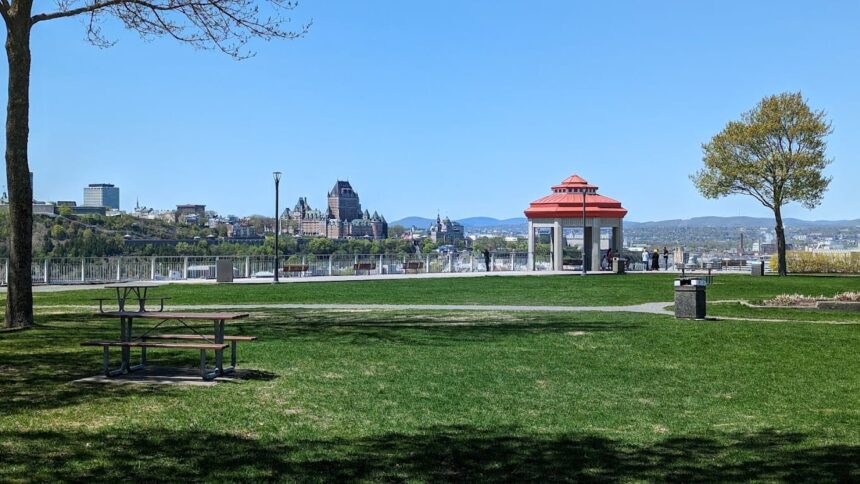
Québec City rewards older travellers who plan carefully around its hills. The Old City’s charm, which brings most visitors here, sits at two elevations connected by stairs, funicular and a steep street. The newer neighbourhoods in Saint-Roch, Saint-Jean-Baptiste and along the riverfront are much flatter. A well-planned itinerary mixes the two and uses Québec City’s excellent public transport and taxi network to manage the terrain.
Understanding the terrain
Québec City is divided into the Haute-Ville (upper town) and Basse-Ville (lower town). The Château Frontenac, the Plaines d’Abraham, Rue Saint-Jean and most of the historic institutions sit in the Haute-Ville at about 60 metres above the river. Place-Royale, the Musée de la civilisation and the Vieux-Port are in the Basse-Ville at river level. The connection between them is either the Escalier Casse-Cou (a 59-step staircase), a funicular, or a roughly 800-metre walk along Côte de la Montagne, which slopes steadily at about 10 per cent.
The funicular, running from the Terrasse Dufferin to the Place-Royale area, is the standard solution. It operates from 07h30 to 22h most of the year, costs C$5 one way, and is fully accessible for wheelchairs and walkers. The cars are small and can be busy during summer peaks, but the wait rarely exceeds ten minutes.
Accessibility of the main sites
Most major museums are fully accessible. The Musée de la civilisation has full elevator access to all exhibition floors, accessible washrooms, and rental wheelchairs available at the entrance. The Musée national des beaux-arts du Québec, on the Plaines d’Abraham, is similarly equipped. The Citadelle‘s main exhibition spaces have ramps and elevators, though the outdoor ramparts include some uneven surfaces.
Notre-Dame-de-Québec and the Séminaire’s public areas have step-free access from their main entrances. The Château Frontenac hotel lobby is accessible; guided history tours of the building include limited stair climbing that can sometimes be accommodated if requested in advance. The Plaines d’Abraham have paved paths throughout, with gentle slopes rather than stairs.
Transport options
The RTC bus network covers most tourist areas with fully accessible low-floor buses. Route 11 runs between the Old City and Sainte-Foy; route 800 connects the Old City with Beauport and Limoilou. Fares are C$3.75 per ride, with a day pass at C$8.75 that makes multiple trips worthwhile. Taxis are plentiful and reasonably priced; a typical Old City to Sainte-Foy fare runs C$20-$25.
For airport access, the city does not operate a standing shuttle. Taxis from Aéroport de Québec (YQB) to the Old City run C$42 flat rate, a price set by municipal regulation. Uber operates in the city but not with significantly cheaper fares for this specific route. Some hotels offer shuttle service by prior arrangement; asking at booking is worthwhile.
Pacing a visit
Older travellers consistently report that three nights give the best experience of the Old City without rushing. Day one in the Haute-Ville, day two in the Basse-Ville and riverfront, day three at a slower pace with an excursion to Montmorency Falls or Île d’Orléans tends to work well. Mornings generally offer better light and lighter crowds; afternoons from 14h onward can be busy in summer.
The Plaines d’Abraham merit a full morning rather than a rushed hour. Benches along the main paths allow frequent rests. The Terrasse Dufferin, the long boardwalk in front of the Château Frontenac, is the single best stretch for a leisurely walk with regular seating and reliable river views.
Practical considerations
Summer weather can surprise travellers accustomed to milder climates. July and August highs often reach 28-30°C with substantial humidity. Winter brings significant cold. Visits between mid-November and mid-April require serious cold-weather preparation, including traction aids for footwear, as sidewalks can be icy even when cleared. The tourist office at 12 Rue Sainte-Anne rents traction aids and offers detailed weather-specific advice.
Pharmacies are plentiful throughout the Old City. The largest Pharmaprix, on Rue Saint-Jean, has a full pharmacist on duty seven days a week. For travellers with chronic conditions, carrying a list of medications with generic names (French pharmaceutical practice sometimes uses different brand names) and travel insurance covering medical care is essential.