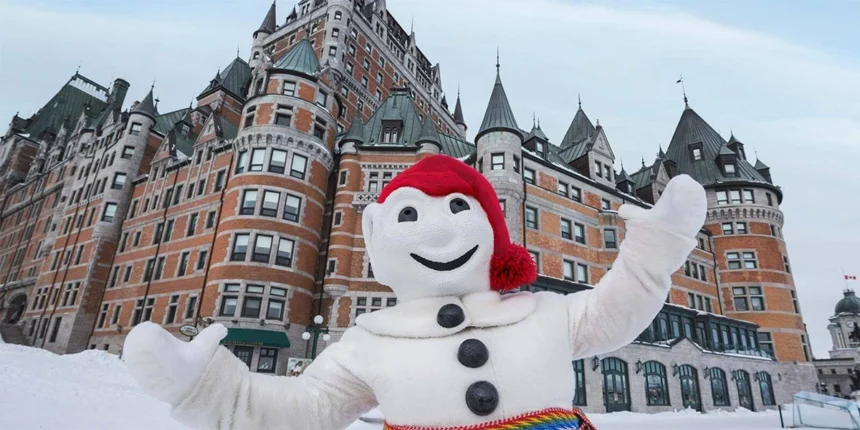
The Carnaval de Québec runs for seventeen days every winter, usually spanning the first three weekends of February. It began in 1894 as a merchants’ street festival, was revived in its current form in 1955, and now draws something close to a million visits per edition. Bonhomme, the snowman mascot in the red toque and arrow sash, turned seventy this decade. He has outlasted most things in Québec politics.
This guide assumes you have not been before and want to know what the event actually is, where it happens, and which parts are worth your time.
How the festival is organised
Carnaval is not one event but a calendar of dozens of events, staged across several sites in the city, anchored by a permanent zone on the Plains of Abraham. Entry to the Plains zone requires an effigy, a small plastic trinket that acts as your entrance pass and sells for about twenty dollars. The effigy changes design each year and is collected by regulars. A family pass with two adult effigies and two child passes comes in around fifty dollars.
Individual ticketed events (the ice canoe race, some of the concerts, the Saint-Hubert brunch) require separate tickets. Most street events, including the two night parades, are free.
The ice palace and Bonhomme’s residence
Each edition, builders construct an ice palace on the Plains of Abraham, usually out of a few hundred ice blocks harvested from Lac Saint-Joseph. The architecture changes year to year; the 2023 edition included a climbable observation tower, the 2024 edition returned to a more classical Bonhomme-chateau footprint. Bonhomme’s residence is technically a separate structure inside the zone and hosts meet-and-greets that draw long lines on weekends.
If you want to see the palace without the crowd, go on a weekday afternoon before sunset. The lighting after dark is the reason the palace exists, but midday light through the ice is its own thing and easier to photograph.
The night parades
Two night parades pass through the Saint-Jean-Baptiste and Saint-Roch neighbourhoods during the festival, one on the first Saturday and one on the second. They run about ninety minutes, feature floats and drum lines and Bonhomme in his official sleigh, and are genuinely cold. Temperatures on parade nights have historically hovered around minus fifteen Celsius. Hand warmers, thermal layers, and waterproof boots are not optional.
Pick a spot along Rue Saint-Jean or Rue Saint-Joseph an hour before the parade begins. The crowd goes deep by start time. Cafés along the route fill up quickly but are usually willing to let parade-watchers duck in between floats to warm up.
The ice canoe race
The Sunday-afternoon ice canoe race on the St. Lawrence is, quietly, the single most impressive event of the festival. Teams of five run boats across a shifting course of open water and ice floes between the Vieux-Port and Lévis, pushing, paddling, and leaping between ice plates depending on conditions. The sport has deep roots: before the first bridge opened in 1917, ice canoes were the winter link between the two shores.
Watch from the Terrasse Dufferin or from the Bassin Louise. Dress for two hours of exposed waterfront wind. The race is free to watch and worth the cold.
What else runs on the Plains
The Plains zone includes an ice slide that has been a Carnaval fixture since the 1950s, a human-foosball court, snow sculptures commissioned each year from an international rotation of artists, and food and drink stands. The official drink, caribou, is a red-wine-and-spirits mixture served warm; it is stronger than it tastes and should be respected.
A second family-oriented site, Place Jean-Béliveau, runs complementary activities for younger children. The ice-fishing demonstration and the dog-sledding zones rotate between years depending on conditions.
Timing your visit
The opening weekend is the busiest, the second weekend the sweet spot, and the final weekend the quietest. If you are flying in specifically for Carnaval, book the middle weekend. Weeknight attendance is a fraction of weekend attendance and temperatures are often milder.
Book accommodation in the Vieux-Québec, Saint-Jean-Baptiste, or Saint-Roch areas if you want to walk home from the Plains after events. Taxis and rideshares get scarce after parades end.
What to wear
A parka rated to minus thirty. Insulated, waterproof boots. A toque that covers the ears. Lined mitts, not gloves. Long johns. A neck warmer. Hand and toe warmers in both pockets.
Rental parka services operate in the Old Town for visitors travelling light. Companies will outfit you for a day at around fifty dollars. If you are planning more than one outdoor day in Québec winter, buying real gear is the better investment.
Practical things people do not tell you
Washrooms on the Plains zone are finite and distant. Use the café you just bought coffee at before you walk out onto the site. The Plains zone’s perimeter is more porous than it looks but the effigy is checked at manned entrances; random spot checks happen inside.
Food on site is functional, not memorable. Eat a proper meal in Saint-Roch or Saint-Jean-Baptiste before you go; think of the Plains zone as entertainment, not dinner.
The official app, updated each edition, publishes real-time schedules that shift more than the printed programme suggests. Check it the morning of.
Visiting outside carnival dates
If your trip does not overlap with the festival, there are festivals in Québec City in every month of the year, and you can still see Bonhomme’s statue at the Bassin Louise in summer and visit the permanent carnival archive exhibits that rotate through the Musée de la civilisation. The Hôtel de Glace, a separate winter attraction in Saint-Gabriel-de-Valcartier north of the city, runs from January through March and delivers a related but different ice-architecture experience.