Québec City runs a denser annual festival calendar than any other Canadian city its size. Some of this is deliberate cultural policy. The provincial and municipal governments subsidise public events at a level that would astonish American or English-Canadian visitors. Some of it is climatic: winter is long, and the city has decided to program its way through it rather than wait for spring.
This guide walks the calendar month by month, flags the events worth planning a trip around, and notes the quieter festivals that do not appear in the promotional materials.
January
The year begins quietly. Carnaval begins to stage its preliminary events toward the end of the month: an opening weekend teaser, the installation of the ice palace on the Plains of Abraham, Bonhomme‘s ceremonial return from his summer absence.
Nordicité, a smaller winter arts and light festival, runs in parallel some years in Saint-Roch. Check the programme before you come, as the event moves.
February: Carnaval de Québec
The Winter Carnival dominates February, seventeen days of Bonhomme, night parades, ice canoe races on the St. Lawrence, and street programming in Saint-Jean-Baptiste and Saint-Roch. A full guide to the event is on our site; the short version is that the middle weekend is the sweet spot, weeknight attendance is a fraction of weekend attendance, and the festival is genuinely cold.
The Red Bull Crashed Ice world championship returned to Québec City in some editions of the 2010s and has been rumoured to return periodically; the ice-cross downhill course on the Côte de la Montagne is a spectacular piece of engineering when it runs.
February also belongs to the Québec International Pee-Wee Hockey Tournament, played at the Centre Vidéotron. It has run every February since 1960, when it was founded to coincide with the Carnaval, and recent editions have brought on the order of a hundred and twenty teams from something like eighteen countries; a women’s division was added in 2023. If you are in the city with children in February, it is the other reason to be here.
March
Sugar-shack season begins in late March and runs through mid-April. This is not a festival in the formal sense, but the cabanes à sucre of the Beauce and Portneuf regions open their doors to day-trippers for maple-centred meals. Érablière du Cap and Cabane du Pic-Bois are the nearest traditional operations; Au Pied de Cochon’s cabane à sucre, which runs a more ambitious kitchen, books months in advance.
April
Quiet outdoors. The sugar-shacks finish, the city thaws. Les Rendez-vous Québec Cinéma, a French-language film festival, runs in early April some years and is worth checking if you read French.
Indoors it is the month of the Salon international du livre de Québec, the city’s book fair, held at the Centre des congrès. Recent editions have gathered over a thousand authors and tens of thousands of readers across five days, almost entirely in French. The dates move from year to year, so check them before planning a trip around it.
May
The Festival OFF Québec opens the festival year, a music showcase programmed in small rooms across Saint-Roch and Saint-Jean-Baptiste. Think of it as the Francophone equivalent of South by Southwest’s day-time programming, smaller and more specific.
The Manif d’art biennale of contemporary visual art runs in alternating years from late May through mid-July. It is the most serious contemporary art event the city produces.
June
Saint-Jean-Baptiste Day, the Québec national holiday, falls on June 24. Free concerts on the Plains of Abraham, neighbourhood street parties, and a large-scale fireworks event over the St. Lawrence. This is the festival locals care about most.
The week leading up to Saint-Jean hosts a series of smaller events: the Festival d’Opéra de Québec runs partial programming in mid-June, and Grande fête de la gastronomie occasionally overlaps.
July: the FEQ weeks
The Festival d’été de Québec, abbreviated FEQ, runs for eleven days in mid-July. Two hundred and fifty concerts across multiple stages in the Old City; the main stage on the Plains of Abraham has hosted the largest pop and rock acts in the world, Rolling Stones, Metallica, Arcade Fire, Taylor Swift in 2024, most of them at a passport-pass price (around 110 dollars for all eleven days) that Anglophone visitors find incomprehensible.
Passport passes sell out in advance. Day-specific entry for sold-out shows is rarely available. Plan accommodation at least four months ahead; the city books solid for FEQ.
August: Fêtes de la Nouvelle-France
The Fêtes de la Nouvelle-France, in early August, turn the Old City into a 17th-century re-enactment zone: period costume, market stalls, street theatre, music rooted in colonial French repertoire. Less intensive than FEQ, more family-friendly, and free to attend.
The Plein art craft fair, running most of August on the Grande Allée, is the annual meeting point for Québec’s studio potters, textile artists, and wood workers.
September: the Grand Prix cycliste
The Grand Prix cycliste de Québec, a one-day UCI WorldTour race in mid-September, turns the Old City into a road-cycling circuit for an afternoon. The course climbs the Côte de la Montagne and descends Rue Saint-Jean in a loop, sixteen laps, finishing on the Grande Allée. The race is free to watch from any point on the circuit.
Cinéma Cartier, a small neighbourhood festival of outdoor screenings on Rue Cartier, runs the same week.
Envol et Macadam, the city’s punk, hardcore and metal festival, takes three days in September at the Agora du Port de Québec and at partner venues around the city, with the opening night free. It has run since the 1990s and is the loudest thing in the festival year.
October
Fall colours peak in the first week. Québec en toutes lettres, the literary festival run by the Institut canadien de Québec, takes the second half of the month: around eleven days of readings, encounters and public events, overwhelmingly in French.
No major festivals, but the Île d’Orléans cider and apple harvest is at its peak, and a loop of the island between mid-October and mid-November doubles as an informal festival of orchards.
November
Quiet until the middle of the month, when the Christmas season opens. The Québec Cinéma Aller/Retour runs in some years; otherwise this is the pause between the harvest and the lights.
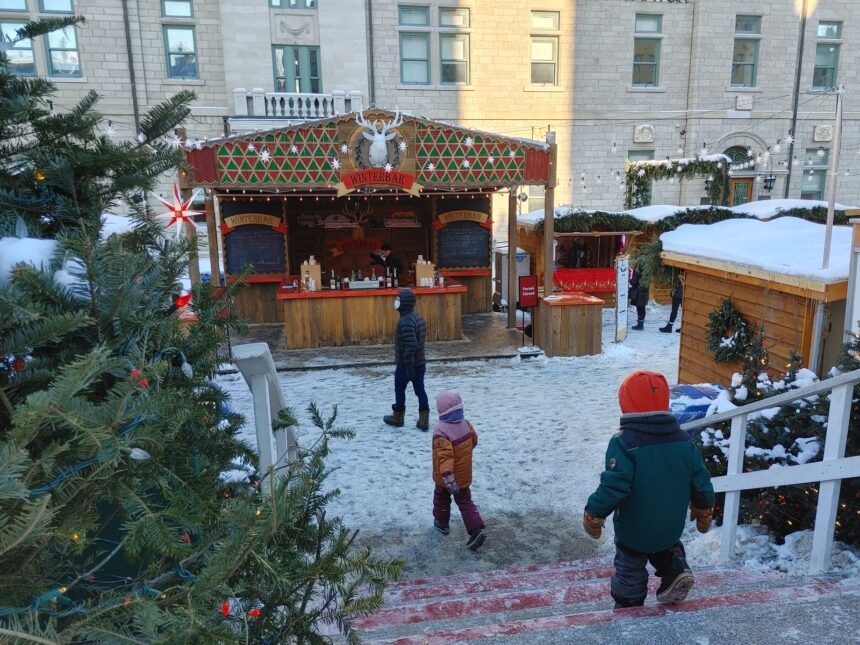
The Marché de Noël Allemand opens in the second half of November and runs until just before Christmas. It keeps a four-day week at first, closed early in the week until the middle of December, and it occupies six separate sites rather than one square. Our guide to the market carries the current edition’s exact dates and hours.
December: markets and lights
The German Christmas Market draws enormous crowds on Saturday afternoons; go early in the week and early in the afternoon. Its six sites are Place de l’Hôtel-de-Ville and the gardens beside it, Place d’Armes, rue Sainte-Anne, Place D’Youville and the garden behind Holy Trinity Cathedral — all in the upper town, a few minutes uphill from Petit-Champlain.
Onhwa’ Lumina, the multimedia night walk in Wendake, runs year-round and is particularly well-suited to December. The Marché de Noël allemand and the city’s street-lighting programmes together make the Old City a reasonable walking destination on cold December evenings. The year closes with New Year’s Eve programming in the Old City on 31 December.
Choosing which festivals to plan around
If you want one unmissable event, FEQ in July delivers the highest concentration of music for the money of any festival in North America. Carnaval in February is the most distinctive winter event on the continent. Fêtes de la Nouvelle-France, less famous, is the best value for families. Saint-Jean in June is the festival you attend to understand Québec rather than to be entertained.
If you are planning your first visit, aim for the middle weekend of FEQ or the middle weekend of Carnaval. Both are peaks; both require six months of accommodation planning; both are worth the planning.