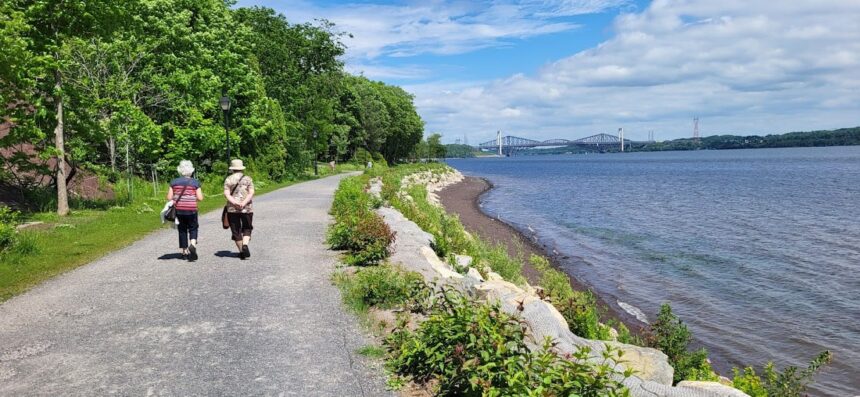
The Corridor du Littoral is Québec City’s riverside cycling and walking path, a nearly continuous 48-kilometre spine that follows the Saint-Laurent from Cap-Rouge in the west to Beauport and the Montmorency falls in the east. The eastern extension, which runs from the old port area through Limoilou and into Beauport, is the stretch that has seen the most investment in the past decade. For cyclists, it is the single most useful piece of infrastructure in the region.
The layout of the eastern extension
Heading east from the Bassin Louise, the path leaves the old port and runs along the north shore of the Saint-Laurent, passing the Naval Museum, the Estuaire interpretive centre, and a sequence of small parks that have been laid out specifically as rest stops for cyclists. The path is fully paved, separated from road traffic by landscaping or curbed protection for most of its length, and wide enough to handle two-way traffic plus pedestrian use.
At Beauport, the corridor crosses the Rivière Beauport on a dedicated cycling bridge opened in 2018. The bridge replaced a messy detour onto Route 138. Riders can now roll from the old port to the foot of Montmorency falls without a single stretch of shared roadway.
Surface, gradient, and conditions
The eastern corridor is flat. Cumulative elevation gain across the full 25-kilometre run from old port to Montmorency is under 50 metres. The surface is asphalt, maintained annually by the Ville de Québec, and remains in good condition through most of the riding season. Spring opening is typically by mid-April, weather dependent; the path closes for winter by early December. Snow clearance on select sections has been piloted since 2023 for year-round cycling, but coverage is not yet universal.
Headwinds from the east are a consistent feature. Riders heading out from downtown toward Montmorency often find the return trip significantly faster than the outbound. Planning accordingly is useful: arrive at the falls with enough daylight to make a relaxed return without rushing.
What to see along the way
Several stops repay a few minutes. The Baie de Beauport, roughly 10 kilometres from the old port, has a beach, picnic tables, and a rental pavilion that opens in summer. Further east, the Domaine de Maizerets sits slightly inland but is reachable by a short detour along rue d’Estimauville. The Moulin des Jésuites in Beauport, near the eastern end of the ride, is worth a stop for anyone interested in the seventeenth-century industrial history of the region.
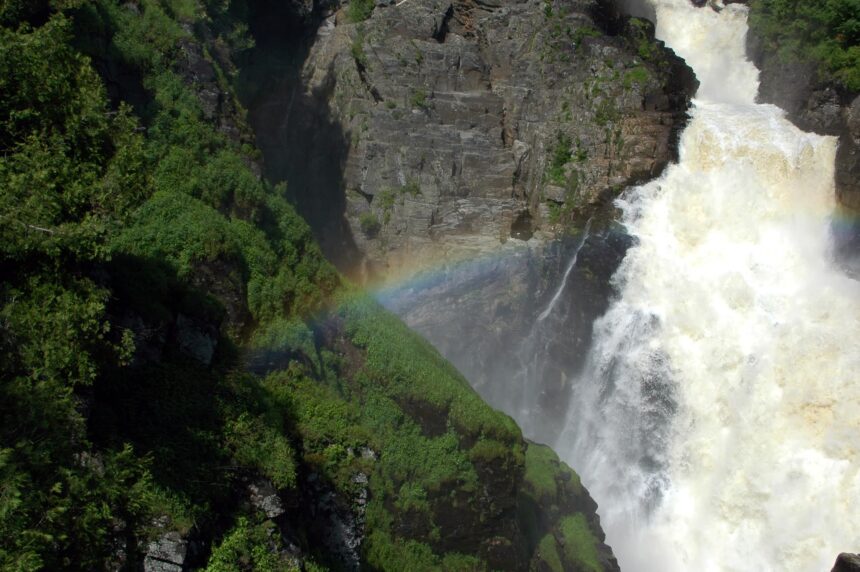
The approach to Montmorency falls from the west is one of the more dramatic pieces of urban cycling in eastern Canada. The falls appear in the distance over the last two kilometres, visible across the open shoreline and framed by Île d’Orléans beyond.
Rental and mechanical support
Several rental operators have opened along the corridor since 2015. Vélo Vert in the old port carries a full range of city, hybrid, and electric bikes and offers half-day and full-day rates. Électrocycle, near the Bassin Louise, specialises in electric assist, which changes the full-corridor ride from an ambitious day out into a comfortable afternoon. Repair shops are less densely distributed along the corridor itself, though Premier Cycle in Limoilou is a short detour from the main path and handles drop-in repairs.
Combining with a day trip
The most common full-day plan is a round trip from the old port to Montmorency falls with a lunch stop along the way. Total riding distance is 50 kilometres; ride time for a moderate rider is three to four hours. A three-hour break at the falls, including a walk across the suspension bridge, is comfortable; the return ride then lands in the old port in time for an early dinner.
For riders who want a longer day, continuing past Montmorency and across the Île d’Orléans bridge onto the island adds another 35 to 70 kilometres depending on how far you loop. The Île d’Orléans bike route has less protected infrastructure but lower traffic volumes and is rideable by reasonably confident cyclists.
Safety notes
Helmets are not legally required for adults in Québec but are strongly recommended. Traffic on the corridor itself is cycling and pedestrian only, but several road crossings along the route do require attention. The section near the Port of Québec terminal has cruise-ship passenger traffic in summer and can be busy during peak disembarkation hours.