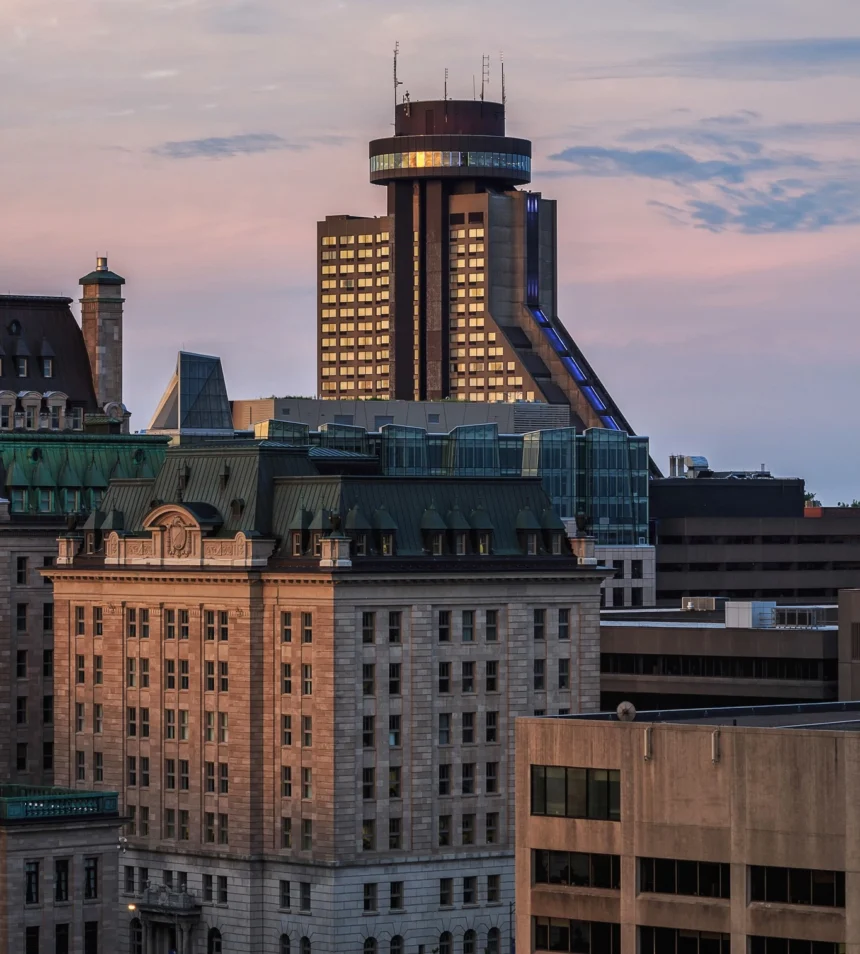
The walled Old Town in Québec City is smaller than most first-time visitors expect. Bounded by the fortifications, the Old City measures roughly 1.4 kilometres east to west and 1.1 kilometres north to south. Walking from the Porte Saint-Jean on the west to Terrasse Dufferin on the east takes approximately 12 minutes at a relaxed pace. From the Place d’Armes to the Cathédrale Notre-Dame-de-Québec is a two-minute walk. From the Château Frontenac to the Musée de la Civilisation in the Lower Town is 8 to 12 minutes via the Escalier Casse-Cou.
Seasonal character
Beyond the walled city, distances are longer but still walkable. From the Porte Saint-Jean to the Plains of Abraham is 15 minutes through the Parliament Hill grounds and along the Grande Allée. From the Château Frontenac to the Musée national des beaux-arts du Québec at the western edge of the Plains is roughly 30 to 35 minutes, mostly downhill on the way out and a steady climb on the return. From the Hôtel de Ville to the Marché du Vieux-Port at the foot of Côte de la Montagne is 10 minutes including the descent.
Saint-Roch, the lower-town neighbourhood west of the Old Port, is closer than the topography suggests. From the Old City via the Côte d’Abraham staircase, Rue Saint-Joseph in central Saint-Roch is a 12 to 15 minute walk down (and a more demanding 20-minute climb back). The funicular at the Maison Louis-Jolliet drops you in the Petit-Champlain quartier in 90 seconds and saves the 75-step descent and ascent of the Escalier Casse-Cou for those who prefer the easier option.
Sillery and Sainte-Foy, the western residential and university districts, are too far for casual walking from the Old City. From the Château Frontenac to Université Laval is roughly 6 kilometres and a one-hour walk along the Grande Allée corridor. The same trip on RTC bus 800 takes 18 to 22 minutes. From the Old City to the Place Sainte-Foy shopping centre is 70 minutes on foot or 25 minutes by bus. Most visitors who want to spend time in Sainte-Foy take a bus or rideshare in at least one direction.
For first-time visitors
Limoilou and the eastern Lairet neighbourhood are surprisingly close. From the Marché du Vieux-Port across the Saint-Charles river to the Église Saint-Charles-de-Limoilou is a 20-minute walk through the Parc Cartier-Brébeuf. The Domaine Maizerets and the Bassin Louise are pleasant 25 to 30 minute walks from the Old Port. The 3e Avenue commercial strip in central Limoilou, with its concentration of cafés and microbreweries, is a 30-minute walk from the Château Frontenac and a logical detour for anyone with a half-day to spend off the standard tourist circuit.
Hills are the variable that throws off straight-line distance estimates. The grade between the Lower Town and the Upper Town is approximately 60 metres, climbed in less than 200 metres horizontal. The Côte de la Montagne, the most direct vehicle road, is steep enough to be one-way downhill only. The Escalier Casse-Cou is faster than most stair-averse visitors expect (roughly 90 seconds up or down) but punishing in summer humidity and treacherous in winter ice.
Hours and reservations
Surface conditions matter year-round in Québec City and shape the choice of footwear more than the weather forecast itself. Old Town sidewalks are typically in good repair but uneven by Canadian suburban standards, with frequent slate and granite paving that can be slick in rain or after a freezing drizzle. Winter brings 10 to 30 centimetres of ploughed snow on most sidewalks within hours of a storm, but the ice underneath can persist for weeks during freeze-thaw cycling. Microspikes or sturdy winter boots make the difference between effortless walking and visible caution between December and March.
For trip planning, the Google Maps walking estimates for Québec City are generally accurate within 10 percent for adult visitors at moderate fitness, with one consistent exception: the algorithm underestimates climbs in the Old Town, particularly the Côte d’Abraham and the Côte de la Pente Douce between Saint-Roch and the Plains. Add 5 minutes to any uphill estimate that crosses one of those grades.