



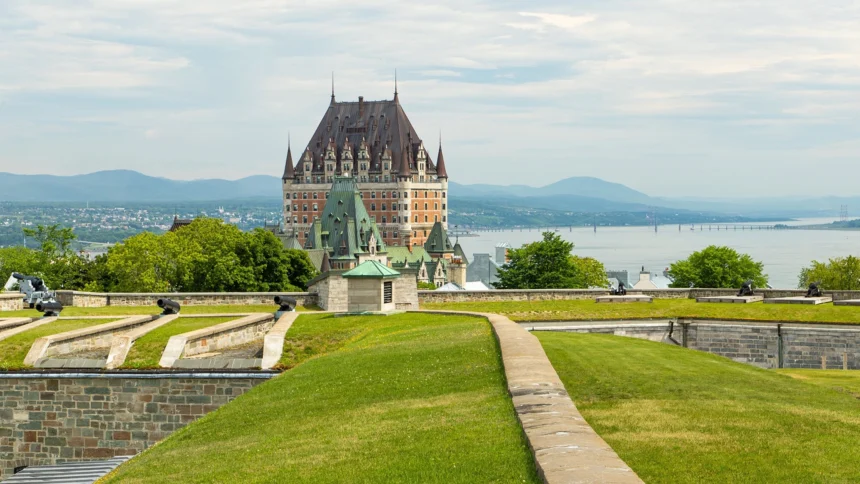
Old Québec isn’t just a neighbourhood within Québec City. It’s the entire reason the city exists as a tourist destination. Designated a UNESCO World Heritage Site in 1985, the walled historic core is the only remaining fortified city north of Mexico, the founding site of French Canada, and one of the most intact pre-industrial urban environments in North America.
It’s also surprisingly easy to misunderstand as a visitor. The Old City is compact — about 1.3 square kilometres — but densely layered with history, divided into distinct zones with different characters, and far richer than the standard tourist circuit reveals.
Here’s the complete neighbourhood guide.
The Basic Layout
Old Québec is divided into two main sections separated dramatically by a 53-metre cliff:
Haute-Ville (Upper Town)
The historic centre sits on Cap Diamant — the promontory dominating the St. Lawrence River. This is where the walls, the Château Frontenac, the Citadelle, the Parliament, and the major religious institutions are located. Administrative, religious, and political functions of New France concentrated here. The streets are narrow, the buildings stone, and the elevation creates genuinely spectacular views.
Basse-Ville (Lower Town)
Below the cliff, at river level, is the commercial and working-class section. Place Royale, Petit-Champlain, the Old Port, and the historical commercial district. This is where Samuel de Champlain established his first habitation in 1608 and where most of the actual economy of New France happened — docks, warehouses, artisans, taverns.
The Connection
Upper and Lower Town connect via:
- The Funicular — a short diagonal lift ($5 each way)
- Breakneck Stairs (Escalier Casse-Cou) — a steep wooden staircase
- Côte de la Montagne — a curving road manageable on foot
- Several smaller stairs and paths scattered through the cliff face
The Sub-Districts of Upper Town
The Château Frontenac and Dufferin Terrace Area
The absolute centre of the tourist Old City. The Château dominates; Dufferin Terrace stretches east from it along the cliff top. Place d’Armes (the open square in front of the Château) is the most photographed spot in the city.
What to do here: Visit the Château lobby (free), walk the terrace, climb to Promenade des Gouverneurs (the elevated walkway connecting to the Citadelle).
The Religious District
North of the Château: the Basilique-Cathédrale Notre-Dame-de-Québec, the Séminaire de Québec, the Ursulines Convent, and the Monastère des Augustines. This is the religious and educational heart of New France.
What to do here: Tour the Cathedral, visit the Séminaire’s museum (Musée de l’Amérique Francophone), explore the Ursulines complex.
Rue Saint-Louis / Rue Saint-Jean Corridor
The two main east-west streets through the Upper Town, connecting the interior of the Old City to the western gates. Rue Saint-Louis is more historic and quieter; Rue Saint-Jean is busier with shops and restaurants.
What to do here: Walk the length of both streets, stop at historic buildings, eat at the established restaurants, exit the walls through Porte Saint-Louis or Porte Saint-Jean.
The Fortifications and the Citadelle Area
The southern and western edges — the stone walls, the Citadelle itself, Parc de l’Esplanade, and the open ground leading to the Plains of Abraham.
What to do here: Walk the ramparts (free), tour the Citadelle (paid), visit the Parliament Building area just outside the walls.
The Sub-Districts of Lower Town
Petit-Champlain
The pedestrian cobblestone street at the base of the cliff — the most photographed residential street in Canada. Shops, restaurants, artisan workshops.
What to do here: Walk the full length, browse shops, eat at one of the good restaurants.
Place Royale and the Surrounding Streets
Just west of Petit-Champlain: the founding square with Notre-Dame-des-Victoires church (1687), surrounded by restored 17th- and 18th-century buildings.
What to do here: Visit the church, walk the square, continue to the surrounding historic streets, visit the Musée de la Civilisation two blocks away.
The Old Port
The waterfront area with the Port of Québec, the Marché du Vieux-Port (farmers market), the Naval Museum, and views out over the river.
What to do here: Browse the market, walk the waterfront, take a ferry to Lévis for views back toward the Old City.
The Commercial Strip Along Rue Saint-Paul
A quieter Lower Town street with antique shops, galleries, and cafés. Less tourist-dense than Petit-Champlain.
The Best Walking Circuit
A complete Old Québec walk (4-5 hours, covering both Upper and Lower Town):
- Start: Place d’Armes in front of the Château Frontenac
- Visit: Château interior (lobby and public spaces)
- Walk: Dufferin Terrace east to the Citadelle area
- Climb: Promenade des Gouverneurs to the Plains of Abraham
- Return: Along the walls to the Porte Saint-Louis
- Walk: Rue Saint-Louis back toward the Château
- Visit: Basilique-Cathédrale Notre-Dame-de-Québec
- Descend: Funicular to Lower Town
- Walk: Petit-Champlain, visit the Fresque des Québécois
- Visit: Place Royale and Notre-Dame-des-Victoires
- End: Musée de la Civilisation or the Old Port
Where to Eat Strategically
Breakfast: Paillard (Rue Saint-Jean) or Le Petit Coin Latin.
Lunch: Varies by where you are. Le Cochon Dingue has multiple Old City locations; Le Lapin Sauté is good in Petit-Champlain.
Dinner: Aux Anciens Canadiens (traditional), Chez Boulay (contemporary), Le Saint-Amour (fine dining).
Coffee breaks: Café Smith (Upper Town), Brûlerie Saint-Roch branches (Lower Town).
When to Visit Old Québec
Best overall season: Late September to mid-October (autumn colours, mild weather, thinning crowds).
Best for atmosphere: December for Christmas decoration, February for winter with Carnival.
Best for photography: Winter after fresh snowfall or autumn at peak foliage.
Most crowded: July (Festival d’été) and August.
Quietest: March-April and November.
The Specific Experiences Worth Building Around
If you want a specific focus for your Old Québec visit:
- Architectural/heritage focus: Fortifications walk + religious district + historic buildings tour
- Food focus: Dinner at top restaurant + Marché du Vieux-Port + coffee culture
- History focus: Musée de la Civilisation + Plains of Abraham Museum + Citadelle
- Photography focus: Dawn walks + classic viewpoints + seasonal variations
- Family focus: Funicular + Petit-Champlain + toboggan slide (winter) + Aquarium (day trip)
Practical Tips
Parking: Difficult and expensive in the Old City. Use the Dalhousie, Place D’Youville, or port parking structures.
Access: Most of the Old City is walkable but involves cobblestones, stairs, and significant elevation changes. The funicular helps with the Upper-Lower Town gap.
Timing: Mornings (before 10 AM) and late afternoons (after 4 PM) are the quietest times in summer.
Safety: Old Québec is extraordinarily safe. Standard urban awareness is sufficient.
Cash: Most places accept cards. Some small artisan shops have minimums.
What Old Québec Isn’t
Some honest expectations management:
- It’s not unchanged from 1700. Much of what you see is restored or reconstructed, though very carefully.
- It’s not a living neighbourhood the way some European old cities are. Most residents moved out during the 20th century; the economy is now primarily tourism.
- It’s not huge. You can walk the perimeter in 90 minutes. Planning multi-day visits requires repeated returns to the same areas.
- It’s not the only part of Québec City worth seeing. Saint-Roch, Wendake, Île d’Orléans, and other areas each offer distinct experiences.
FAQ
How many days should I spend in Old Québec specifically?
Minimum 1 full day; 2-3 days allow deeper exploration including museums and less-famous sites.
Can I do Old Québec and Montmorency Falls in the same day?
Yes, as a full day. Falls in the morning, Old Québec in the afternoon and evening.
Is Old Québec worth it in bad weather?
Yes. Rainy and snowy days can be atmospheric, and the indoor options (museums, cafés, restaurants) are substantial.
Are there areas of Old Québec I should avoid?
No. Entire area is safe and accessible to visitors.
How does it compare to European walled cities?
More intact than most European equivalents, smaller than some, with distinctly North American architectural elements mixed with the French colonial heritage.
Final Word
Old Québec rewards the visitor who takes it seriously. Skimming it in a few hours gives you the postcards but not the depth. Committing two or three days, walking repeatedly, visiting the less-obvious sites, eating at the good restaurants, pausing in the small corners most visitors miss — this is when the Old City stops being a checklist item and starts being one of those places you remember for the rest of your life.
Using the walled city
- Where to stay inside the walls, and when to stay outside them instead.
- The essential walking route for a first visit.
- Eating inside the walls — the honest version.
- Quartier Petit-Champlain and which street to walk.
- Terrasse Dufferin and Place Royale.






