Three days in Québec City, done right, is one day inside the walls, one day outside them, and one day leaving the city by ferry or car. Most first-time visitors reverse that ratio and spend everything they have on the Old City, which is the easy mistake and the reason they come home with a reel of cobblestone photographs and no sense of the place. This itinerary runs harder on day two and day three. It is not exhaustive. It is opinionated.
Day one: Upper Town, Lower Town, and one neighbourhood the guidebooks skip
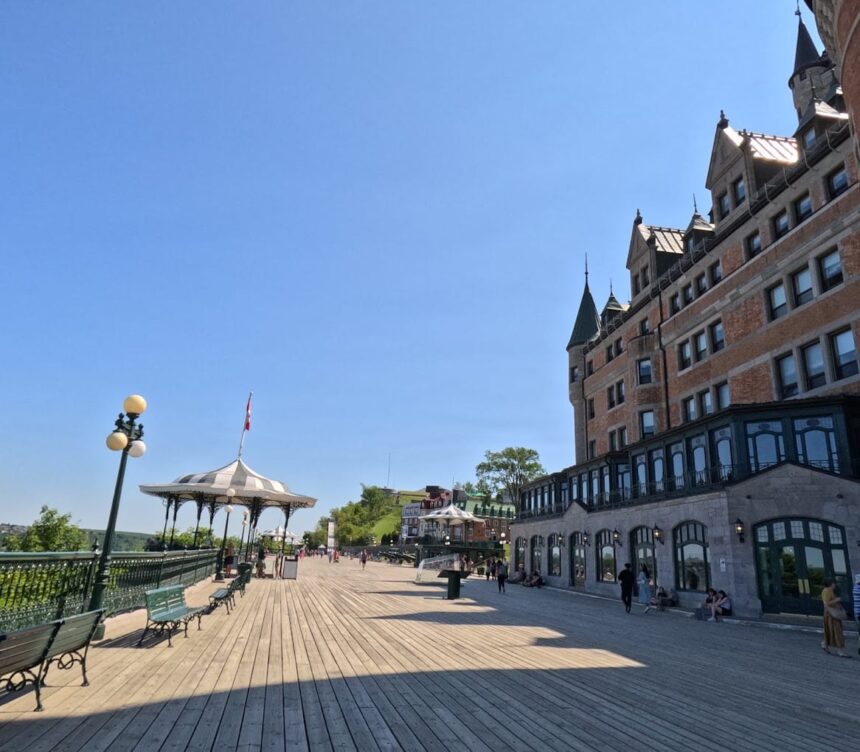
Start at Place d’Armes in Upper Town at nine. Coffee at Café Saint-Henri on Côte de la Fabrique before the lines start. Walk the Dufferin Terrace behind the Château Frontenac. Take the Funiculaire down to Lower Town (it is a sixty-second utility lift, not an attraction; treat it accordingly). Wander Rue du Petit-Champlain early, while the shops are opening and the tour buses have not yet disgorged.
Morning at the Musée de la civilisation. Lunch at Le Cochon Dingue on Rue du Cul-de-Sac or, if the weather cooperates, a Japadog at the counter on Rue du Petit-Champlain.
Afternoon, the decision the guidebooks never tell you to make: walk out of the walls via Porte Saint-Jean and into Saint-Roch. Rue Saint-Joseph Est is the independent-retail spine of Québec City. Bookstores, small galleries, the Espace Jules-Verdière, neighbourhood cafés. This is where locals spend their Saturdays, and the two hours you spend here change your read of the whole city.
Dinner back in the walls, or kept in Saint-Roch. Both work. If it is your first night, book the walls: a window table at L’Affaire est Ketchup or at Légende is the best way to end a long walking day.
Day two: Limoilou in the morning, the Plains in the afternoon, a neighbourhood dinner
Breakfast at Café La Maison Smith on 3e Avenue in Limoilou, across the Saint-Charles river. This is the district most visitors never visit. It was working-class for a century and is now in the middle of a slow gentrification; the 3e Avenue strip is the reason to go. Bookstores, a Sunday market at the Jardin Jean-Paul-L’Allier, the row of brasseries on 8e Avenue.
Mid-morning, walk back across the Lebourgneuf or take the 800 express bus back into the Old City. Spend an hour at the Morrin Centre if you haven’t. Lunch on Grande Allée.
Afternoon on the Plains of Abraham. This is not a park in the usual sense; it is the site of the 1759 battle that ended New France, and the Musée des Plaines runs a small but useful interpretation centre. In summer, the Plains are a vast public lawn with joggers and picnics; in winter, it is a skating, skiing, and sliding park. Either way, two or three hours walking the perimeter and reading the markers.
End the afternoon at the MNBAQ on the western edge of the Plains. One hour in the Pavillon Pierre Lassonde for the contemporary Québécois collection.
Dinner in Saint-Jean-Baptiste. The block of Rue Saint-Jean just outside the walls, between Côte d’Abraham and Rue de la Chevrotière, has the city’s highest density of good neighbourhood restaurants. Chez Boulay Bistro Boréal, La Bûche, or an inexpensive Vietnamese counter. Pick one and finish your night on a terrasse if the weather allows.
Day three: out of the city
Three valid choices. Pick one.
Île d’Orléans. Rent a car or book a driver, take the bridge to the island, and follow the Chemin Royal around the perimeter. The eastern half is cider, maple, and strawberry country; the western half is bed-and-breakfasts and heritage houses. A full day, two meals, back to the city for a late dinner.
Côte-de-Beaupré. Drive east along the north shore from the Pont de l’Île, stopping at the Chute-Montmorency (a waterfall taller than Niagara, without the crowds), the village of Château-Richer, the sanctuary at Sainte-Anne-de-Beaupré, and finishing at Mont-Sainte-Anne or the Cap-Tourmente wildlife reserve depending on season. Again, a full day.
The Québec-Lévis ferry. This is the low-ambition, high-satisfaction option. Walk to the ferry dock in Lower Town, cross the Saint Lawrence to Lévis, and the view of Québec City from the water is worth the twelve minutes and change each way. The south-shore promenade in Lévis has one serious bistro (La Tanière³ Chez Boulay in its Lévis incarnation rotates; check what is current) and several decent options. Back on the Québec side by mid-afternoon.
What to skip
The fake medieval dinners advertised on tour boards. The horse-drawn calèche rides on rainy October afternoons. The ghost tours unless you have children under twelve. The eleven-dollar maple lollipops from the tourist shop on Rue du Trésor.
What to leave loose
One evening with nothing planned. Québec City is a walking city and an ordinary-evening city. Book two dinners, not three. Find a bar. Sit at the counter at Noctem Artisans Brasseurs or at L’Oncle Antoine in Lower Town and talk to whoever is next to you. That is the evening you will remember.